Introduction
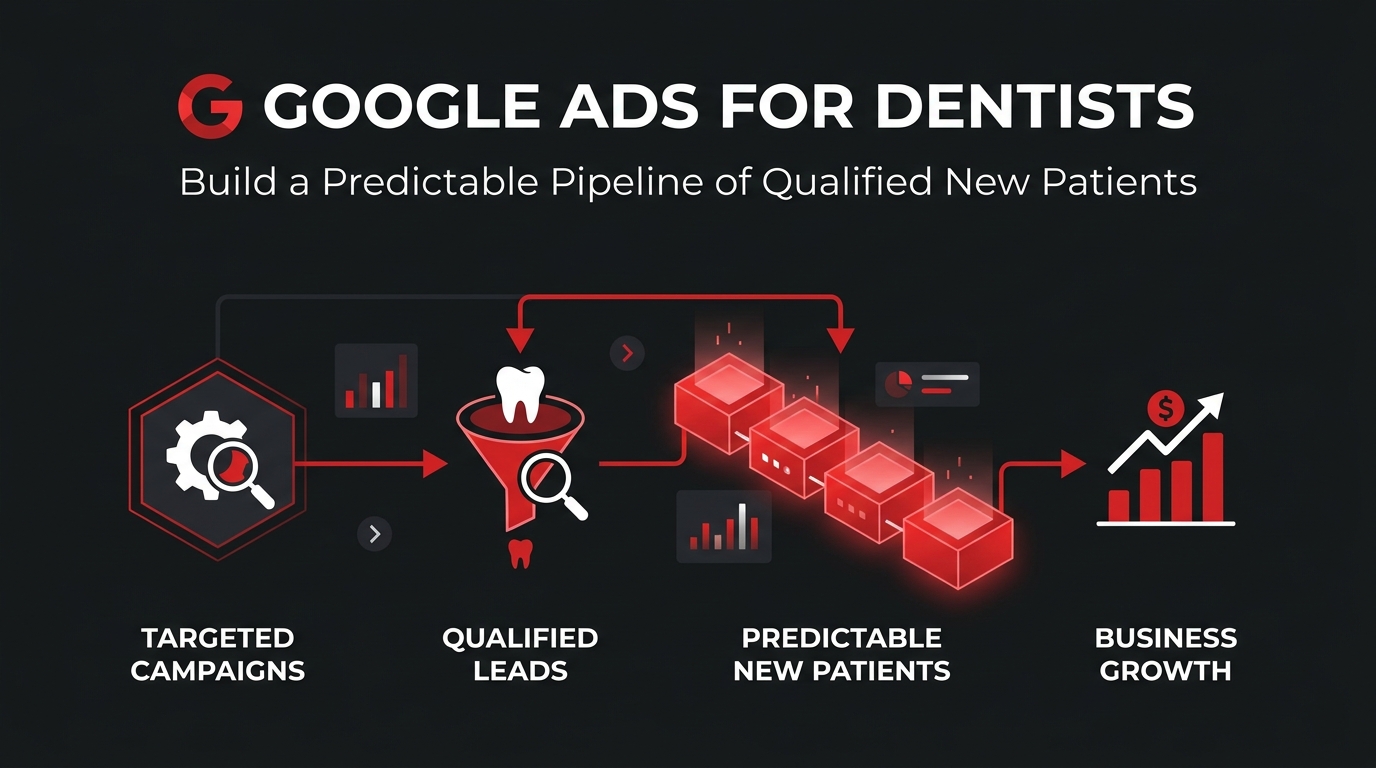
Google Ads is the fastest way to put your practice in front of patients who are actively searching for a dentist right now. But most dental practices run campaigns that hemorrhage budget — broad-match keywords, slow landing pages, and zero conversion tracking. The result is a $3,000/month ad bill with a handful of new-patient calls to show for it.
The practices that win with Google Ads aren't spending more. They're spending smarter. They understand that a patient searching "dental implants cost Charlotte NC" is worth 10x a patient searching "dentist near me," and their campaigns are built accordingly.
This guide covers exactly how to structure Google Ads campaigns for a dental practice — from keyword strategy and match types to bid strategies, landing page requirements, and the conversion tracking setup that makes optimization possible.
Whether you're running your first campaign or auditing an underperforming account, this is the dental PPC playbook built for 2026.
Campaign Structure That Converts High-Value Patients
Why campaign structure is where most dental PPC fails
Generic dental Google Ads accounts look like this: one campaign, one ad group, 40 broad-match keywords, and a landing page that links to the homepage. The Google algorithm does its best, but without clear signal from your structure, it burns budget on low-intent searches while your target patients never see the ad.
High-performing dental accounts separate intent tiers into distinct campaigns:
- Implant campaigns — single-tooth, full-arch, All-on-4, implant cost, implant consultation
- Cosmetic campaigns — veneers, teeth whitening, smile makeover, cosmetic dentist
- Emergency/General campaigns — emergency dentist, broken tooth, dentist accepting new patients
- Competitor campaigns (optional) — targeting patients searching specific competing practices
Each campaign gets its own budget, its own bid strategy, and its own landing page. This isn't optional — it's how you control spend and read performance data accurately.
Ad group structure within campaigns
Within each campaign, break ad groups by subtopic. An implant campaign might have:
- Ad Group: All-on-4 — keywords like "all on 4 implants [city]," "full arch dental implants cost"
- Ad Group: Single Tooth Implant — "tooth implant cost," "dental implant [city]," "replace missing tooth"
- Ad Group: Implant Consultation — "dental implant consultation," "free implant consult [city]"
Each ad group should have 3 responsive search ads (RSAs) with copy matched tightly to the keyword theme. Google's algorithm tests headline and description combinations — give it quality inputs and it will find the winners.
**** See how we structure dental marketing campaigns for Southeast practices Marketing Agency](https://closingmorecases.com/dental-marketing-agency)
External reference: Google Ads best practices for healthcare — Google Help Center
Keyword Strategy — Targeting Patients Who Are Ready to Book
BOFU keywords are where dental PPC money is made
Not all dental keywords are equal. The hierarchy, from lowest to highest value:
- Awareness: "do dental implants hurt" — informational, high volume, low conversion
- Consideration: "dental implant process" — researching options, moderate intent
- Decision: "dental implants cost [city]" — ready to compare, high intent
- Transactional: "dental implant consultation [city]," "best implant dentist near me" — ready to book, maximum intent
For Google Ads, prioritize decision and transactional keywords. You're paying for every click — make sure those clicks come from patients who are ready to act.
Match type strategy in 2026
Google has consolidated match types significantly. The current playbook:
- Exact match for your highest-value, highest-converting keywords. Gives you the most control.
- Phrase match to capture variations of your core keywords while maintaining intent signal.
- Broad match only with Smart Bidding (Target CPA or Target ROAS) and only after you have 30+ conversions/month for the algorithm to learn from.
Start with exact and phrase match. Add broad only once you have enough conversion data to keep Google's algorithm honest.
Negative keywords: the most underused optimization in dental PPC
Negative keywords prevent your ads from showing for irrelevant searches. Every dental account should have negatives for:
- "free" — patients seeking free dental care aren't your implant market
- "dentures" — unless you offer implant-supported dentures specifically
- "dental school" — price-sensitive searchers unlikely to book high-value treatment
- Competitor names (unless running conquest campaigns intentionally)
- DIY and informational terms: "how to," "do it yourself," "at home"
Review your search terms report weekly for the first 60 days and add negatives aggressively. This alone can cut wasted spend by 20–35%.
**** Learn how dental SEO and PPC work together SEO Services](https://closingmorecases.com/dental-seo-services)
External reference: Google Ads keyword match types explained — Search Engine Land
Landing Pages and Conversion Rate Optimization
Your landing page is where PPC wins or dies
A well-structured Google Ads campaign sending traffic to a bad landing page is a very expensive mistake. Dental PPC landing pages need to do one thing: convert intent into a booked appointment or a phone call.
High-converting dental landing pages share these elements:
Above the fold:
- Clear headline that matches the keyword intent ("Dental Implants in [City] — Book Your Consultation")
- Subheadline addressing the patient's primary concern (cost, pain, timeline)
- Phone number in large, clickable format
- Single CTA button — "Book Your Free Consultation" or "Call Now"
- Trust signals: years of experience, # of implants placed, patient reviews
Body content:
- Answers to the top 3 patient objections (cost, pain, candidacy)
- Social proof: video testimonials or 5-star review quotes with names and photos
- Provider credentials and before/after photo gallery
- Clear process overview: "Here's what happens when you call us"
Page performance:
- Load time under 2 seconds on mobile (use Google PageSpeed Insights to audit)
- Mobile-first design — 70%+ of dental PPC clicks happen on mobile
- HTTPS — Google's ad policies require secure pages
One page per campaign, not one page for everything
The biggest structural mistake in dental PPC: sending all traffic to the homepage. Your implant campaign needs an implant-specific landing page. Your cosmetic campaign needs a cosmetic-specific page. Match the message to the search intent.
This is called "message match" — when a patient clicks an ad about All-on-4 implants and lands on a page that leads with All-on-4, conversion rates jump 30–60% versus sending that traffic to a generic services page.
**** See how our website audits identify conversion gaps Website Audit](https://www.closingmorecases.com/contact-us)
External reference: Unbounce landing page optimization guide
Tracking, Bidding, and Ongoing Optimization
You cannot optimize what you cannot measure
Google Ads campaigns without proper conversion tracking are flying blind. Before spending a dollar, set up:
- Call tracking — Google's call extensions track calls from ads directly. For calls from the landing page, use a call tracking number (CallRail or CallTrackingMetrics) so you can attribute phone calls to specific keywords.
- Form submissions — Install Google Ads conversion tags on your thank-you page or use Google Tag Manager to fire a conversion event on form submit.
- Google Analytics 4 integration — Link GA4 to your Google Ads account so you can see full session data alongside ad performance.
With proper tracking in place, you'll know exactly which keywords, ads, and landing pages are generating consults — and which ones are burning budget.
Bid strategy: where to start, when to scale
For new dental accounts (under 30 conversions/month):
- Start with Maximize Conversions — Google's algorithm will optimize for the conversion events you've defined
- Set a target CPA only after you have data (30+ conversions) — setting it too early constrains the algorithm before it has signal
For established accounts (30+ conversions/month):
- Move to Target CPA or Target ROAS bidding
- Dental implant campaigns typically target $150–$300 cost-per-lead; full-arch campaigns can sustain higher CPLs given case value
- Review bid strategy performance monthly — the algorithm needs stable conversion data to function well
Weekly optimization checklist
- Review search terms report — add new negatives
- Check impression share — if below 60% on top keywords, increase bids or budget
- Review ad performance — pause RSAs with CTR below 3%
- Check Quality Score on core keywords — low QS raises CPCs; fix with tighter ad groups and better landing page relevance
- Monitor call recordings (if using CallRail) — identify conversion patterns and objections to feed back into ad copy
**** Ready to turn your ad spend into booked consults? a Free Strategy Call](https://www.closingmorecases.com/contact-us)
External reference: Google Smart Bidding strategies overview
How much should a dental practice spend on Google Ads?
Most practices in mid-size Southeast markets can generate meaningful implant consult volume at $2,000–$5,000/month. Full-arch and cosmetic practices in competitive markets (Atlanta, Charlotte, Tampa) typically need $5,000–$10,000+/month to achieve significant market share. Start with enough budget to generate 100–300 clicks/month on your core keywords — that's enough data to optimize.
How long does it take for dental Google Ads to work?
You should see calls and form fills within the first 2 weeks of a well-structured campaign. True optimization takes 60–90 days as the algorithm accumulates conversion data. Don't judge a campaign by week one — judge it after the first 90 days with proper tracking in place.
What's a good cost per lead for dental implant ads?
Single-tooth implant leads typically run $80–$200 CPL. Full-arch and All-on-4 leads run $200–$500 CPL — but at $25,000+ case values, a $400 CPL is exceptional ROI. Track cost per booked consult and cost per case accepted, not just cost per click.
Should I run Google Ads and SEO at the same time?
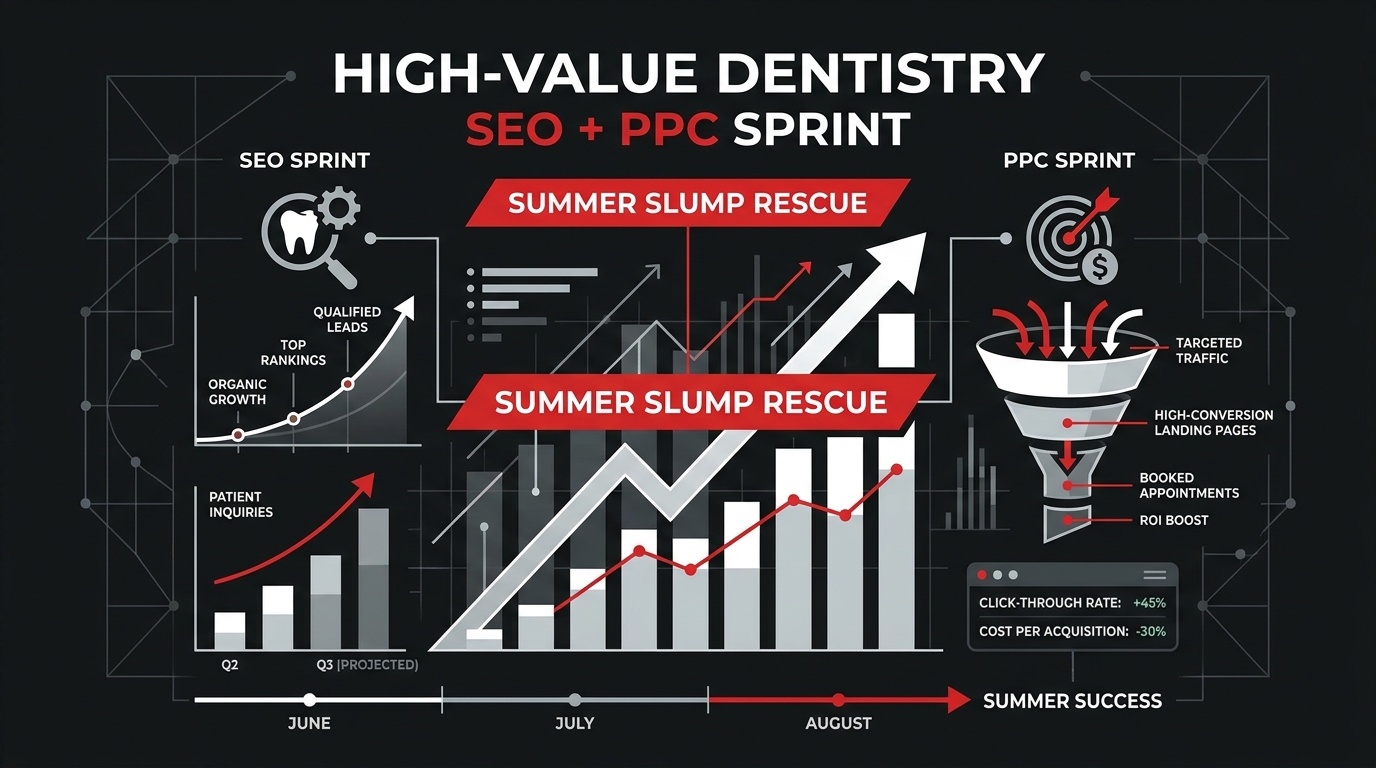
Yes — they compound. SEO builds long-term organic authority while PPC drives immediate traffic. Practices that run both see SEO data informing PPC keyword strategy (and vice versa), and they occupy more SERP real estate, driving higher total click volume.
Can I run Google Ads myself or do I need an agency?
You can set up a basic campaign yourself using Google's guided setup. But Google Ads for dentists has enough nuance — match types, negative keywords, Quality Score, conversion tracking, landing page CRO — that most practices see significantly better results with a specialist. The cost of a poorly managed campaign often exceeds the cost of expert management.
What makes dental Google Ads different from other industries?
Healthcare advertising has specific policy restrictions (no before/after in image ads, HIPAA considerations for remarketing). Dental also has unusually high case values — a single implant case justifies significant CPL. And dental purchase decisions are longer than typical e-commerce — patients research for weeks before booking. Your campaign strategy needs to account for the full patient journey.