slug: invisalign-marketing-strategy-practices-underspend
meta_description: Invisalign is a $2K–$6K case that most practices underpromote. Learn why orthodontic marketing works, budget allocation, and how to 5x your Invisalign revenue.
Invisalign Marketing Strategy: Why Practices Underspend Here
By KamGeneral1,573 words8 min read
Introduction
Here's the math that doesn't add up:
A dental implant case: $4,500–$6,000 revenue
Invisalign case: $2,500–$6,000 revenue
Yet practices spend 10x more marketing the implant than the Invisalign.
Why?
Because implant patients are rare (5–10% of population with missing teeth). They're mysterious (surgical). They feel premium.
Invisalign patients are everywhere (40% of population is interested in teeth straightening). They're simple (clear trays). They feel like a lifestyle product.
Most practices see Invisalign as "something for the teenagers" or "add-on if a patient asks." High-revenue practices see it as a dedicated profit center—a clinical and marketing asset that pays for itself 2–3x over.
This article shows you why practices leave $200K+ on the table with Invisalign, and how to capture that revenue.
The Invisalign Opportunity (Why Practices Underspend)
The Market Reality
U.S. population interested in teeth straightening: 40+ million (40% of adult population)
Of those interested:
- 5% pursue traditional braces
- 15% pursue clear aligners (Invisalign, SmileDirect, etc.)
- 80% do nothing (lack of awareness, cost concerns, or procrastination)
Translation: For every 100 patients in your practice, 30–40 are candidates for Invisalign. At $3,500 average case value, that's $105K–$140K in revenue sitting in your chair.
Most practices extract maybe 5–10 of those cases per year (5–10% of their eligible pool). Top practices extract 40–60 per year (40–60% of eligible pool).
The gap: 30–50 cases × $3,500 = $105K–$175K/year.
Why Practices Underspend on Invisalign Marketing
Reason 1: It's not "medical" enough Implant marketing feels premium because surgery is involved. Invisalign feels cosmetic/luxury. Dentists subconsciously under-invest in "luxury" services.
Reason 2: Low urgency Patients with missing teeth have urgency (can't chew). Patients with crooked teeth don't (it's cosmetic). Low urgency = lower perceived value = lower marketing investment.
Reason 3: Doctor perception: "It's easy, low margins" Some doctors see Invisalign as "simple" (just monitoring progress). Actually, Invisalign practices track remission, handle customer service, and maintain relationships for 12–24 months. Hidden labor.
Reason 4: Orthodontist turf war Many practices assume "orthodontists own teeth straightening." Wrong. 60% of Invisalign cases nationwide are done by general practitioners, not specialists.
Result: Practices leave marketing ROI on the table. Invisalign cases are easier to close (no surgery fears), require less staff coordination (no surgical scheduling), and have high patient satisfaction (visible results every 2 weeks).

The High-Revenue Invisalign Framework
Step 1: Patient Identification (Where Invisalign Patients Hide)
In hygiene chair: Look for alignment issues (crooked teeth, gaps, bite problems)
In patient consultations: Ask "Are you happy with your smile?" → 40% say no
In online reviews: Look for complaints about "crooked teeth," "gaps," "bite"
Create a simple patient classification:
- Tier 1: Obvious candidates (moderate-to-severe alignment issues)
- Tier 2: Mild candidates (minor crowding, small gaps)
- Tier 3: Interested but not obvious (mentioned in conversation)
Flag these patients in your EMR. They're your Invisalign pipeline.
Step 2: Patient Education (Shift from "Option" to "Outcome")
Current (what most practices do): Doctor: "Your teeth have some crowding. You could get Invisalign if you want, but your teeth are functional as-is. Let me know if interested."
Patient thinks: "Not urgent. I'll think about it." (Rarely does.)
Better (what high-revenue practices do): Doctor: "Sarah, your teeth have crowding that's getting worse. Here's the thing—you've got options. I can show you what your smile could look like with Invisalign. Most patients are shocked at the difference. Want to see a quick mockup?"
Patient thinks: "Wait, I could actually look different?" (Engagement increases.)
The reframe: Move from "optional cosmetic choice" to "achievable outcome with time/cost." Invisalign becomes a planned treatment, not an impulse.
Step 3: Digital Smile Design for Invisalign
This is your secret weapon.
Use software like Smile Designer or Clin-Check to show patients their "after" image. Seeing it makes it real.
Setup:
- Take one photo of patient smile (straight-on, natural smile)
- Import into Smile Designer
- Show teeth alignment options (mild straightening vs. full alignment)
- Present alongside cost ($2K, $3.5K, $5K options)
- Patient sees exact result before committing
Impact: Digital smile design increases case acceptance by 30–50% (peer-reviewed). It's that powerful.
Step 4: Invisalign Pricing Strategy
Tier 1: Mild Cases ($1,500–$2,500)
- 6–10 trays
- 3–6 months treatment
- Minor gaps or slight crowding
- Example: Single tooth spacing
Tier 2: Moderate Cases ($2,500–$4,000)
- 16–24 trays
- 6–12 months treatment
- Moderate crowding, overbite, underbite
- Example: Full-mouth mild realignment
Tier 3: Comprehensive Cases ($4,000–$6,500)
- 30+ trays
- 12–18+ months treatment
- Severe crowding, significant bite issues
- Requires refinements
- Example: Pre-implant alignment (patient needs alignment before implant)
Pricing tip: Offer all three tiers. Many patients opt for Tier 2 (moderate) because they see it as "good value compared to Tier 3." You win—higher revenue than if you only offered Tier 1.
Invisalign Marketing Channels
Channel 1: In-Office Promotion (Your Highest-ROI Channel)
Tactic 1: Before/After Invisalign Case Studies Collect 10–15 Invisalign before/afters. Display in waiting room, consultation room, and website.
Tactic 2: Patient Testimonial Videos Film 3–5 Invisalign patients explaining their experience. "Why did I do Invisalign?" "Was it worth it?" Testimonials close undecided patients at 40%+ rate.
Tactic 3: Hygiene Team Training Train hygienists to identify Invisalign candidates and hand-sell during cleanings. "Dr. mentioned you might be a candidate for Invisalign. Want to discuss?"
Hygiene hand-offs close at 60%+ (warm referral).
Tactic 4: Invisalign Consultation Appointment Create a dedicated "Invisalign consultation" appointment (separate from general consultation). Patient sees digital smile design, pricing, timeline. Higher commitment than casual "let me think about it."
Channel 2: Digital Marketing (Online Awareness)
Tactic 1: Google Ads for "Invisalign + [City]"
- Keyword: "Invisalign in [your city]"
- Budget: $500–$800/month
- Expected: 8–15 clicks/month, 2–4 consultations/month
- ROI: If one Invisalign patient per 3 clicks, cost per patient is $150–$250 (excellent)
Tactic 2: Facebook Ads Targeting Cosmetic/Lifestyle Audience
- Audience: Ages 25–50, interested in teeth whitening, cosmetic dentistry
- Ad: Before/after Invisalign result
- Budget: $300–$500/month
- Expected: 15–30 clicks/month, 3–6 consultations
- ROI: Varies by audience quality
Tactic 3: Instagram/TikTok Organic Content
- Post 1 Invisalign before/after per week
- Quick educational content: "Can I eat with Invisalign?" "How often to wear trays?"
- Builds brand around cosmetic/lifestyle positioning
Channel 3: Content + SEO
Blog topics to rank for:
- "Invisalign cost" (high buyer intent)
- "Invisalign vs braces" (comparison driving decision)
- "How long does Invisalign take" (common patient question)
- "[City] Invisalign provider" (local intent)
Writing these posts ranks in 3–6 months and generates 10–20 organic clicks/month long-term.
See Dental Marketing Budget Allocation for SEO investment guidelines.
The Invisalign Revenue Model
Revenue Projection: Current vs. Optimized
Current state (most practices):
- Invisalign cases/month: 3–5
- Average case value: $2,500
- Annual Invisalign revenue: $90K–$150K
- Marketing spend on Invisalign: <$500/month (mostly organic)
Optimized state (strategic focus):
- Invisalign cases/month: 12–18 (mostly from existing patient base)
- Average case value: $3,500 (better case selection)
- Annual Invisalign revenue: $500K–$750K
- Marketing spend on Invisalign: $1,500–$2,000/month
- Net revenue increase: $350K–$600K/year
- Marketing ROI: 15:1 to 20:1 (highest of any service)
How do you get there?
- 80% from existing patients (hygiene referrals + education)
- 20% from digital marketing (ads, organic search)
- Key: Systematic patient identification + digital smile design + pricing clarity Q: Should I offer Invisalign if I'm not Invisalign Certified? A: You can prescribe and manage Invisalign as a general dentist. Certification is optional (it's a 1-day course). Start without certification, monitor outcomes, get certified if you commit long-term.
Q: How much does it cost me to offer Invisalign? A: Affiliate fee to Invisalign (20–25% of case price) + trays/materials. Net margin is 60–70% after costs. Implant margin is 50–60%. Invisalign margins are actually better.
Q: Can I do Invisalign for severe cases? A: Mild-to-moderate cases are 80% of Invisalign candidates. Severe cases (Class III bite, high-angle cases) are better referred to orthodontist. Stay in your lane; refer the complex ones.
Q: How do I compete with SmileDirect or other direct-to-consumer aligner companies? A: You offer doctor oversight (safety), in-person fitting (comfort), faster treatment (better trays), and relationship (support). DTC can't compete on these. Market on "doctor supervised" vs. "mail-order."
Q: What's the typical Invisalign treatment completion rate? A: 70–80% of patients complete treatment. Some stop early (happy with partial results), some switch providers. Track this in your practice—high non-completion means either patient education gap or doctor oversight gap.
Q: Can I use Invisalign for prep before implants? A: Yes. Aligning teeth before implant placement improves esthetics and results. Position this as "pre-implant planning" ($3K aligner treatment + $5K implant = $8K total case). High value. Your best Invisalign patients are already sitting in your chairs.
Book a free strategy call — Let's design an Invisalign system that extracts 40–60 cases/year from your existing patient base (that's $150K–$250K/year).
Book a free website audit — See if your website is positioned to capture Invisalign searchers (most aren't).
Frequently Asked Questions
Ready to Close More Cases?
Book a free strategy call and see how we help dental practices add 40+ new patients in 90 days.
Book Your Free Strategy CallRelated Articles
General6 min read
Asheville Dental Marketing Agency Playbook for High-Value Case Growth
Asheville Dental Marketing Agency Playbook for High-Value Case Growth
General7 min read
Atlanta Dental Marketing Agency Pricing: What It Takes to Buy Consistent Implant Cases
Atlanta Dental Marketing Agency Pricing: What It Takes to Buy Consistent Implant Cases
General6 min read
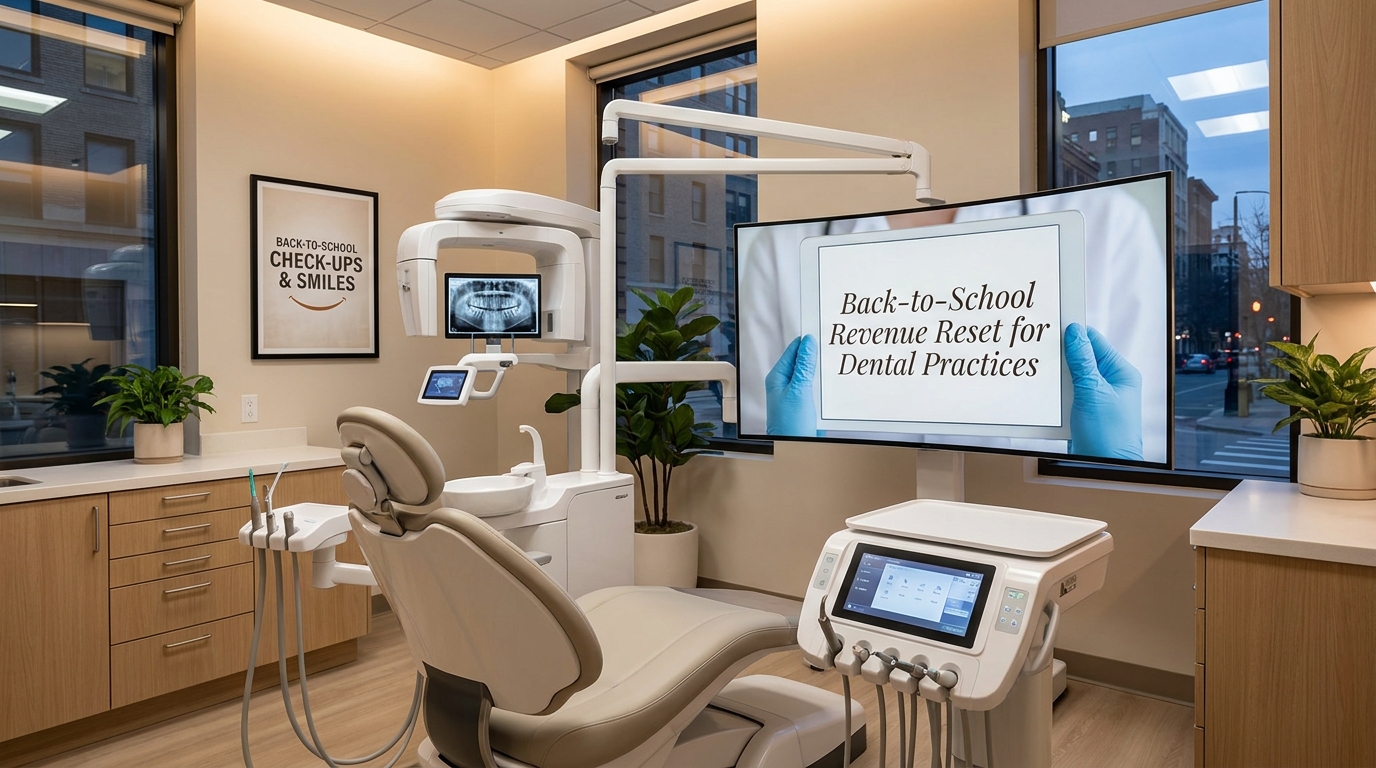
Back-to-School Revenue Reset for Dental Practices
Reset your practice for the back-to-school rush with scheduling, messaging, and financing systems that turn seasonal slumps into predictable consults.