slug: digital-marketing-budget-allocation-dental
meta_description: How to allocate your dental marketing budget across PPC, SEO, social, and content. Template + ROI benchmarks to maximize patient acquisition.

Digital Marketing Budget Allocation for Dental Practices
By KamGeneral1,656 words8 min read
Introduction
You have a $5,000/month marketing budget.
You're split: $1,500 Google Ads, $1,000 Facebook Ads, $1,500 website "updates," $1,000 miscellaneous (business cards, someone's SEO service).
Results? 15–20 new patients/month. You do the math: $250–$333 per new patient acquired.
Your friend's practice does $4,000/month marketing. They get 25–30 new patients.
Same budget, 50% more patients.
The difference? Budget allocation strategy.
Most practices spread money evenly across channels. High-performing practices concentrate budget on high-ROI channels, test rigorously, and reallocate based on data.
This article shows you the allocation framework top practices use to get 3–5x ROI from their marketing spend.

The Rule of 3s—Your Budget Allocation Framework
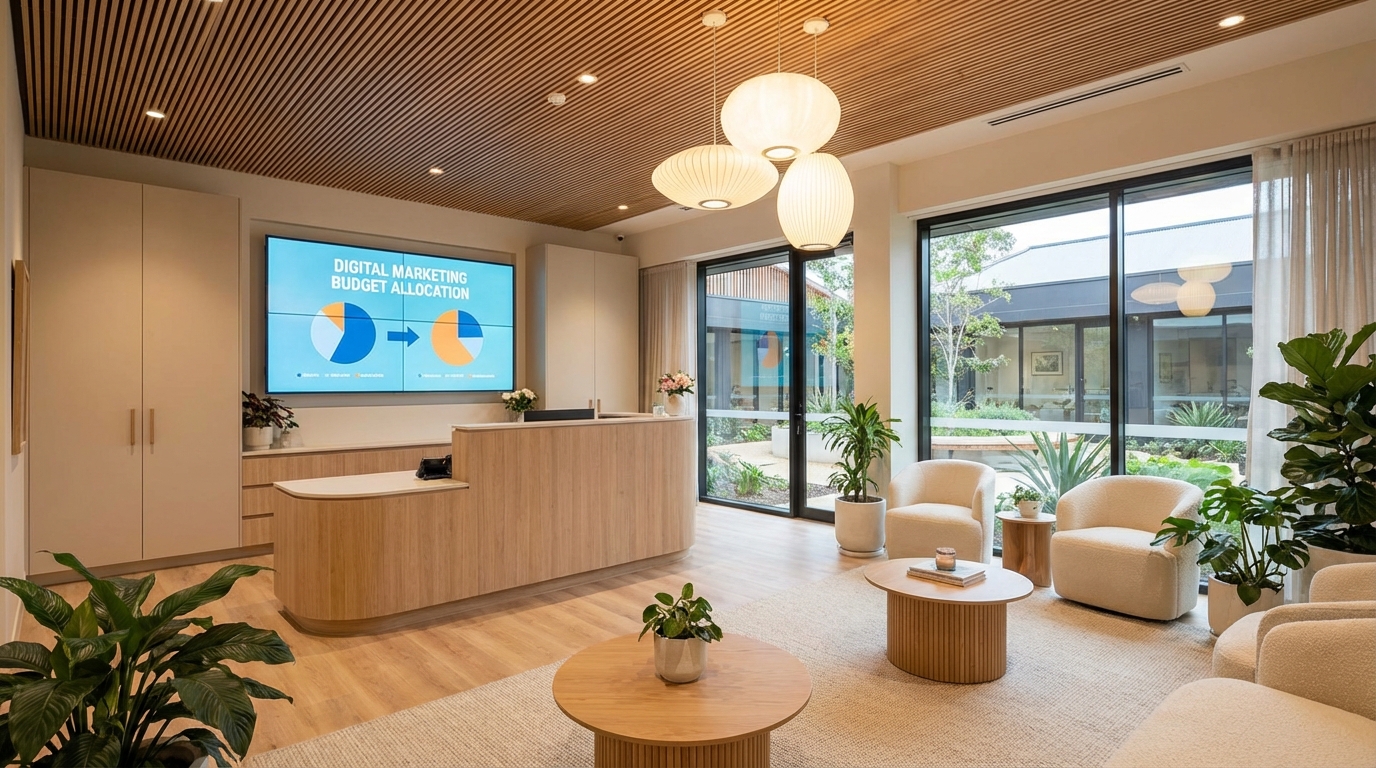
Dental practices should use the Rule of 3s: Allocate your marketing budget into three tiers based on ROI certainty.
Tier 1: High-ROI, Proven Channels (40–50% of budget)
These channels have predictable, measurable ROI. Invest heavily here.
Channel: Google Local Services Ads (GLSA)
- ROI: 5:1 to 8:1 (average)
- Cost per patient: $100–$200
- Best for: General dentistry, emergency patients, high-intent keywords
- Allocation: 25–30% of budget ($1,250–$1,500/month on $5K budget)
Channel: Google Search Ads (Local Intent)
- ROI: 3:1 to 5:1
- Cost per patient: $150–$300
- Best for: Specific procedures (implants, cosmetics), new patient high-value
- Allocation: 10–15% of budget ($500–$750/month)
Channel: Facebook Ads (Warm Audience)
- ROI: 2:1 to 4:1 (if retargeting)
- Cost per patient: $200–$500 (lead cost; varies by close rate)
- Best for: Brand awareness, nurturing warm leads, cosmetic cases
- Allocation: 5–10% of budget ($250–$500/month)
Subtotal Tier 1: 40–50% of budget ($2,000–$2,500)
Tier 2: Mid-ROI, Strategic Growth (25–35% of budget)
These channels take longer to generate ROI, but compound significantly. Invest steadily to build momentum.
Channel: Organic SEO (Content + Technical)
- ROI: 8:1 to 15:1 (after 6–12 months)
- Cost per patient: $0 (post-investment; organic traffic is "free")
- Best for: Long-tail keywords, trust-building, brand authority
- Allocation: 15–20% of budget ($750–$1,000/month)
Channel: Google Business Profile Optimization + Reviews
- ROI: 4:1 to 6:1
- Cost per patient: $50–$150
- Best for: Local search visibility, review generation, GMB management
- Allocation: 5–10% of budget ($250–$500/month)
Subtotal Tier 2: 25–35% of budget ($1,250–$1,750)
Tier 3: Foundational, Defensive Spend (15–20% of budget)
These aren't direct patient acquisition channels, but they support Tiers 1 and 2. They're non-negotiable.
Channel: Website Maintenance + Conversion Optimization
- ROI: Indirect (improves Tier 1 + 2 conversion rates)
- Impact: 10–20% improvement in PPC/organic conversion
- Allocation: 8–12% of budget ($400–$600/month)
Channel: Reputation Management (Yelp, Google, Healthgrades)
- ROI: Indirect (improves click-through rate, trust signals)
- Impact: Increases PPC quality score, organic CTR
- Allocation: 4–8% of budget ($200–$400/month)
Subtotal Tier 3: 15–20% of budget ($750–$1,000)
The Allocation Template (By Practice Size)
Solo/2-Doctor Practice ($3,000–$5,000/month budget)
| Channel | $ | % |
|---|---|---|
| Google Local Services Ads | $1,250 | 28% |
| Google Search Ads | $600 | 13% |
| Facebook Ads (retargeting) | $300 | 7% |
| Tier 1 Total | $2,150 | 48% |
| Organic SEO | $900 | 20% |
| Google Business Profile | $300 | 7% |
| Tier 2 Total | $1,200 | 27% |
| Website maintenance | $450 | 10% |
| Review management | $200 | 5% |
| Tier 3 Total | $650 | 15% |
| TOTAL | $4,000 | 100% |
3–5 Doctor Group ($7,000–$12,000/month budget)
| Channel | $ | % |
|---|---|---|
| Google Local Services Ads | $3,000 | 30% |
| Google Search Ads (multiple campaigns) | $1,200 | 12% |
| Facebook Ads + Instagram | $800 | 8% |
| Tier 1 Total | $5,000 | 50% |
| Organic SEO (multiple specialists) | $1,500 | 15% |
| Google Business Profile + Multi-location | $600 | 6% |
| YouTube/Video content | $400 | 4% |
| Tier 2 Total | $2,500 | 25% |
| Website + CRO | $800 | 8% |
| Reputation management | $500 | 5% |
| Analytics/tracking setup | $200 | 2% |
| Tier 3 Total | $1,500 | 15% |
| TOTAL | $9,000 | 100% |
How to Optimize Within Allocation
Channel 1: Maximize Google Local Services Ads (40–50% of your budget should be here)
Setup:
- Verify Google Business Profile (100% requirement)
- Enroll in Local Services Ads
- Set budget at 40–50% of total marketing spend
Optimization (Monthly):
- Track cost per click, conversion rate by keyword
- Pause keywords with CAC >$300
- Increase bid on keywords with CAC <$150
- A/B test ad copy (include "New patient special" or "Same-day emergency")
- Review customer reviews (Local Services shows stars prominently)
Expected result: 5:1 to 8:1 ROI. One of your most profitable channels.
Channel 2: Layer Google Search Ads for High-Value Procedures (10–15%)
Setup:
- Create separate campaigns for implants, cosmetics, emergency
- High-value keywords: "dental implants," "teeth whitening," "cosmetic dentist"
- Local geo-targeting
Optimization (Monthly):
- Track form submissions + phone calls separately
- Calculate ROI by service type
- Increase budget on high-ROI services (usually implants, cosmetics)
- Test different landing pages (general dentistry landing vs. cosmetic-specific)
Expected result: 3:1 to 5:1 ROI. Slightly lower than Local Services, but captures specific procedure-driven intent.
Channel 3: Build Organic SEO Steadily (15–20%)
Setup:
- Hire SEO agency or freelancer ($1,000–$1,500/month)
- Focus on local service pages + blog content
- Target informational keywords (what patients are searching for)
Optimization (Quarterly):
- Monthly keyword rankings report
- Content performance audit (which pages drive most traffic?)
- Backlink building
- Internal linking improvements
Expected result: 6 months to see real volume. 8:1 to 15:1 ROI long-term. Your lowest CAC channel (once established).
See Dental Practice Growth Benchmarks for competitive SEO strategies.
Channel 4: Use Facebook for Retention + Warm Leads (5–10%)
Setup:
- Retargeting pixel on website
- Create custom audiences (past patients, email list)
- Run softer offers (content, tips, brand awareness)
Optimization (Monthly):
- Track click-through rate and conversion rate
- A/B test audiences (age, interests, behaviors)
- Retarget people who visited implant pages or cosmetic pages
- Use engagement ads first (lower cost), then conversion ads
Expected result: 2:1 to 4:1 ROI (depends heavily on audience quality). Best for repeat patients, second opinions.
The Budget Reallocation Process
Every quarter, review your channel performance and reallocate accordingly.
Quarterly Reallocation Framework
Step 1: Calculate actual ROI by channel
| Channel | Spend | New Patients | Revenue per Patient | Total Revenue | ROI |
|---|---|---|---|---|---|
| GLSA | $3,750 | 25 | $1,200 | $30,000 | 8:1 |
| Google Search | $2,250 | 9 | $2,000 | $18,000 | 8:1 |
| $1,500 | 4 | $1,000 | $4,000 | 2.6:1 | |
| SEO | $3,000 | 3 | $2,500 | $7,500 | 2.5:1 |
| Website/Reviews | $2,500 | — | — | $5,000 (indirect) | 2:1 |
Step 2: Identify underperformers
Facebook at 2.6:1 and SEO at 2.5:1 are underperforming. Time to diagnose:
- Facebook: Are you targeting right audience? Is creative stale? Try new ad creative or audience segment.
- SEO: Is it 6+ months in? Give it more time. Is it <6 months? Expected performance.
Step 3: Reallocate from underperforming to over-performing
If GLSA and Google Search are at 8:1, consider increasing their allocation.
Old budget:
- GLSA: $3,750 → $4,250 (+$500)
- Google Search: $2,250 → $2,750 (+$500)
- Facebook: $1,500 → $1,000 (-$500)
- (everything else stays same)
Result: You've shifted $1,000 from the lowest-ROI channel to the highest-ROI channels. Over a year, that's $12,000 in additional revenue with the same budget. Q: What's the minimum monthly marketing budget for a dental practice? A: $2,000/month (minimal presence), $3,000–$5,000 (solid baseline), $8,000+ (aggressive growth). Below $2K, you're likely underfunding and getting poor results.
Q: Should I spend more on new patient acquisition or retention? A: New patient acquisition first (build base), then shift to retention. Retention is 5–10x cheaper to execute, but you need patients to retain. Ratio: 70% acquisition, 30% retention in year 1. Then 50/50 in year 2+.
Q: Is Google Local Services Ads worth it for a small practice? A: Yes, absolutely. GLSA has one of the highest ROI metrics for dental. Even if you're not big, you should dedicate 25–30% of budget here.
Q: Can I do all my marketing in-house? A: PPC and content, maybe. SEO and reputation management are better outsourced. A bad SEO strategy can hurt your rankings for years. Not worth the risk.
Q: How often should I revisit my budget allocation? A: Quarterly (every 3 months) for big adjustments. Monthly for optimization within each channel. If a channel is losing money, pause it and test something else.
Q: What if I only have $1,000/month to spend? A: Spend $500 on Google Local Services Ads (highest ROI). $300 on Google Business Profile/reviews. $200 on basic website maintenance. Grow before diversifying. Your marketing budget isn't fixed—it's an investment that needs strategy.
Book a free strategy call — Let's audit your current spending and reallocate for maximum ROI (usually 3–5x improvement).
Book a free website audit — We'll see where your marketing is leaking and tighten conversion rates on the traffic you're already paying for.
Frequently Asked Questions
Ready to Close More Cases?
Book a free strategy call and see how we help dental practices add 40+ new patients in 90 days.
Book Your Free Strategy CallRelated Articles
General6 min read
Asheville Dental Marketing Agency Playbook for High-Value Case Growth
Asheville Dental Marketing Agency Playbook for High-Value Case Growth
General7 min read
Atlanta Dental Marketing Agency Pricing: What It Takes to Buy Consistent Implant Cases
Atlanta Dental Marketing Agency Pricing: What It Takes to Buy Consistent Implant Cases
General6 min read
Back-to-School Revenue Reset for Dental Practices
Reset your practice for the back-to-school rush with scheduling, messaging, and financing systems that turn seasonal slumps into predictable consults.