slug: how-dental-practices-use-patient-testimonials-implants
meta_description: Turn dental implant patients into your marketing team. Testimonial strategy, collection process, and proven templates that increase case acceptance by 25–40%.
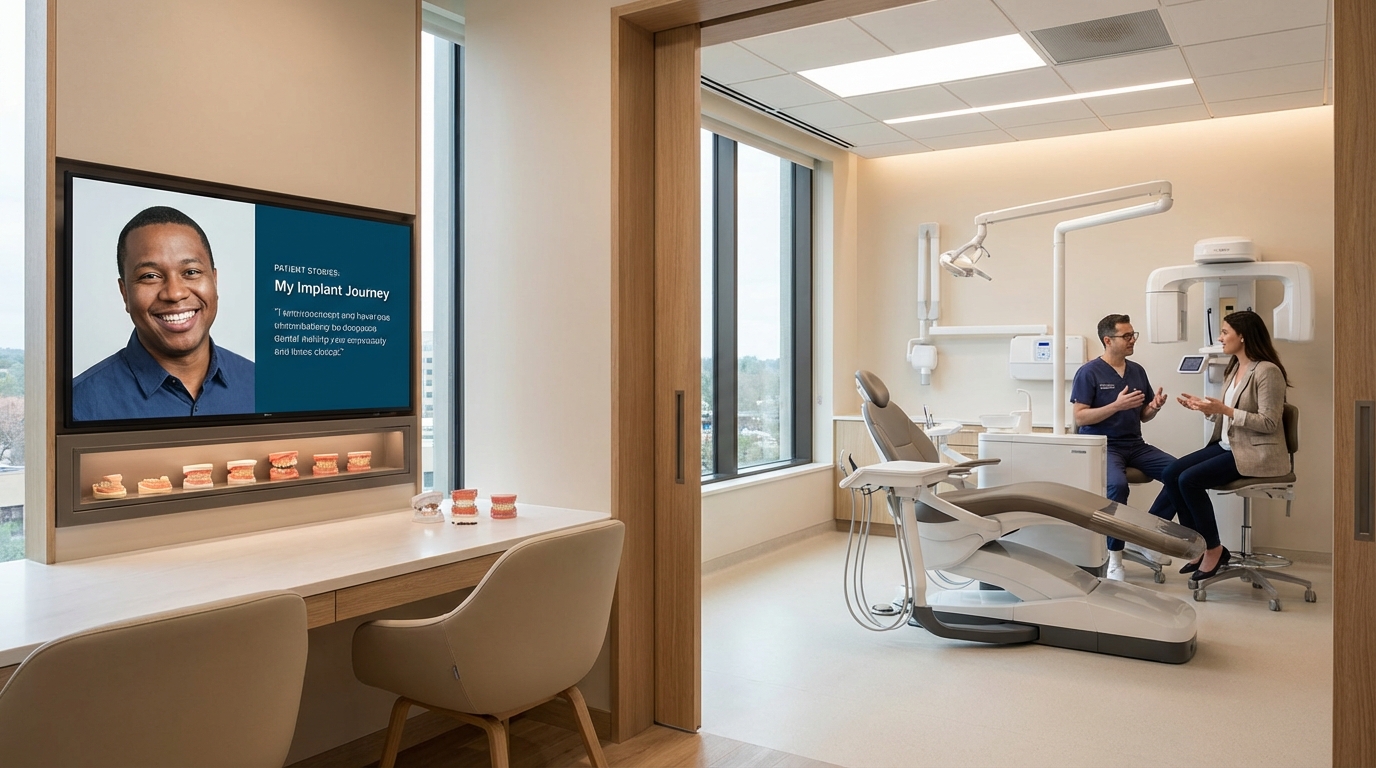
How Top Dental Practices Use Patient Testimonials for Implants
By KamImplants1,678 words8 min read
Introduction
A 58-year-old woman sits across from you, considering a dental implant. Cost is $4,500. Risk is real (surgery, recovery, replacement concerns).
You show her case studies and credentials.
Then you show her a video: A woman her age, one month post-op, saying, "Best decision I made. I can eat and smile again. Worth every penny."
Boom. She signs.
That's the power of peer proof.
Your credentials matter. Your case studies matter. But a real patient—someone who looks like her, faced her fears, and came out the other side happy—that's what closes implant cases.
The practices dominating implant revenue have one thing in common: they systematically collect and deploy patient testimonials. Not as an afterthought. As their primary sales tool.
This article breaks down how to build a testimonial engine that converts 25–40% more implant cases.
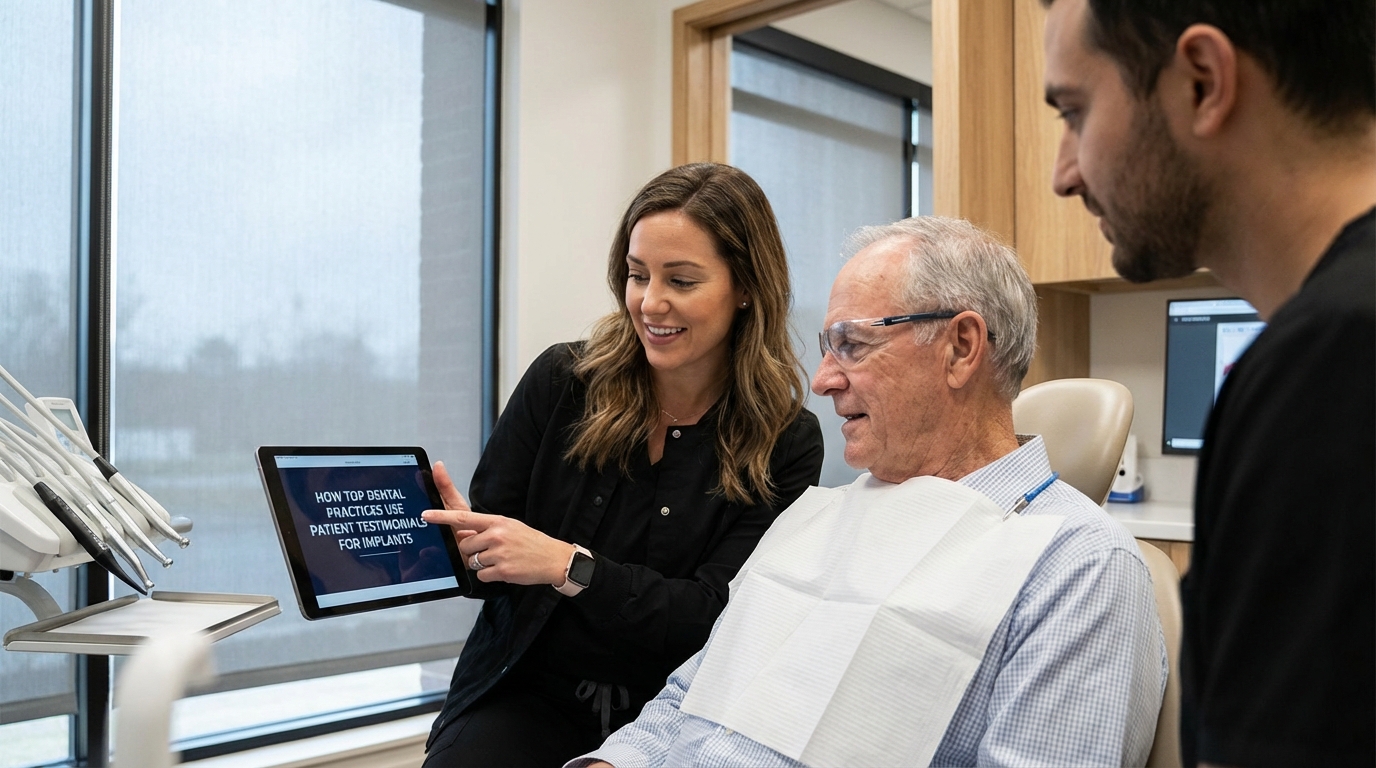
Why Testimonials Work Better Than Case Studies Alone
The Credibility Gap
A before/after photo from your website: Could be anyone. Could be photoshopped. Patient mind: "Maybe it doesn't look like that in real life."
A video testimonial from a patient: Real person. Real voice. Real emotion. Patient mind: "She looks like me. She did it. I can too."
The data:
- Practices with testimonials close implant cases at 60–75%
- Practices without testimonials close at 35–45%
- Difference: 25–40% acceptance uplift = $100K–$300K/year for most practices
Why? Because peer proof defeats skepticism better than expert proof.
Testimonials Do 3 Things Case Studies Don't:
1. Humanize the surgery Case studies show results. Testimonials show experience. A patient explaining her anxiety pre-op and relief post-op is infinitely more powerful than a before/after photo.
2. Address hidden objections Patients worry about: pain, recovery time, implant failure, cost justification. A testimonial addressing these concerns (often unprompted) demolishes doubt. A case study can't.
3. Create FOMO (Fear of Missing Out) When patients see others thriving with implants, they don't want to be "the one without." This psychological trigger is invisible in case studies but obvious in testimonials.
The Testimonial Collection System
The 3-Stage Process: Timing + Ask + Format
Stage 1: Identify Candidates (During Surgery/Recovery)
Not all patients make good testimonials. Target the ones most likely to say "yes" and deliver powerful results:
- Visible transformations: Patients going from missing teeth → implant (dramatic before/after)
- Confident speakers: Patients comfortable on camera (not all are)
- Satisfied + vocal: Check post-op follow-up satisfaction. Enthusiastic patients are your targets.
- Diverse demographics: Collect testimonials from men, women, different ages, professions (credibility across segments)
The ask timeline:
- 48 hours post-op: Send thank-you email + patient satisfaction survey
- 1 week post-op: For high-satisfaction patients, send testimonial request
- 2–4 weeks post-op: Ideal window. Patient is healed enough to look normal, enthusiasm is still high Stage 2: The Ask (Email Template)
Subject: "Would You Help Other Patients?" Hi [Patient Name],
I'm thrilled with how your implant healing is progressing. From our follow-ups, I can tell you're genuinely happy with the result.
Here's why I'm reaching out: Many patients considering implants are nervous. They worry about pain, recovery, or whether it's worth the cost. But hearing directly from someone like you—someone who's been through it and thrived—changes minds.
Would you be willing to share a 2–3 minute video or written testimonial about your experience? Nothing formal. Just your honest take on:
- What you were worried about before
- What the actual experience was like
- How you feel now
Here's the deal: If you're interested, we'll handle everything. Our team can film you at your next visit (15 minutes max) or you can record on your phone at home and send it over. Your choice.
We'll also send you a $50 gift card as a thank-you, completely separate from the testimonial.
Are you in?
Best,
[Your name]
Stage 3: Format (Video > Text > Audio)
Video testimonials (ideal):
- Patient on camera, speaking naturally
- 60–120 seconds
- Natural lighting, simple background (office is fine)
- Phone camera quality is acceptable; professional is better
- Authenticity > production value
Written testimonials (acceptable fallback):
- 3–5 paragraphs
- Answer the 3 questions (concerns before, experience during, satisfaction after)
- Include full name and age (credibility)
- Quote them on your website and emails
Audio testimonials (if patient refuses video):
- 2–3 minute phone call or recording
- Transcribe + add to website/marketing
Incentive: Offer a $50–$100 gift card or discount on future services. Do NOT tie it to positive review. The incentive is for time, not opinion.
The Collection Process (Step-by-Step)
Month 1: Identify & Ask
- Track 20 implant patients post-op
- Identify 8–10 high-satisfaction, diverse candidates
- Send testimonial request at 2-week post-op mark
Month 2: Collect & Produce
- Schedule filming/recording sessions
- Collect 5–7 testimonials (expect ~60% accept rate)
- Have basic editing done (overlay title, patient name/age)
Month 3: Deploy
- Upload to website testimonials page
- Create email sequence featuring testimonials
- Post on social media (1 testimonial per week)
Ongoing: Collect 3–5 new testimonials per month. Over 12 months, you'll have 36–60 videos representing diverse case types and outcomes.
Where to Deploy Testimonials for Maximum Impact
Deployment Site 1: Implant Consultation Room (Physical)
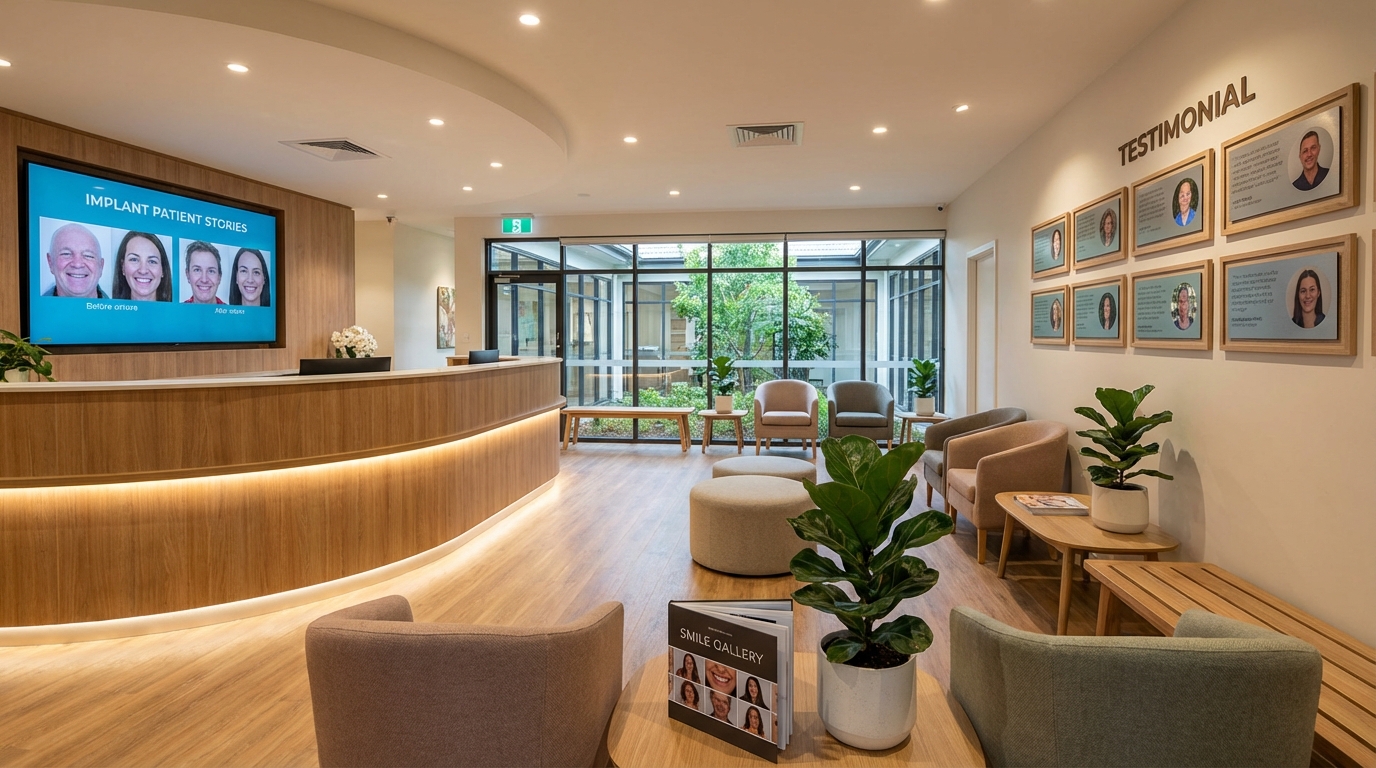
Print 5–7 of your best testimonials as simple posters or laminated cards. Place them in the consultation room where waiting patients see them.
Example layout:
- Large monitor running testimonial videos on loop
- Or printed testimonials with QR code linking to videos
Result: Patients literally see peer proof while waiting for their consultation. Anxiety drops before they even talk to the doctor.
Deployment Site 2: Your Website (Homepage + Implant Service Page)
Homepage section: "See what our patients say" with 3 rotating testimonial videos
Implant service page: Full testimonial section with 5–10 videos organized by:
- Patient concern (fear of pain, cost, recovery)
- Patient type (busy professional, retiree, etc.)
- Case type (single implant, multiple, All-on-4)
Pro tip: Link testimonial videos to related blog content. A patient watching an implant recovery testimonial should see a link to "What to Expect After Implant Surgery."
Deployment Site 3: Email Sequences
New lead nurture sequence:
- Email 1: Introduction + education content
- Email 2: Feature patient testimonial #1 (addresses initial objection)
- Email 3: Feature patient testimonial #2 (addresses different objection)
- Email 4: Case study + results
- Email 5: CTA (consultation booking)
Pre-consultation reminder email: "Before your consultation, I want you to hear from patients who've done exactly what you're considering:" [embed testimonial video]
Post-consultation follow-up: "Still thinking about your implant? Here's what one of our other patients said about the same procedure:" [targeted testimonial]
Deployment Site 4: Social Media
Post 1 testimonial per week on Instagram/Facebook:
- Video testimonial (30–60 seconds)
- Caption: Patient name, age, what they loved
- CTA: "Ready to transform your smile too? Book a free consultation."
Bonus: Testimonials drive 30–50% higher engagement than regular posts. Social algorithms favor them.
Deployment Site 5: Google/Yelp Reviews (Leverage Existing)
For written testimonials, ask patient to post on Google, Yelp, or Healthgrades. This serves dual purpose:
- Builds review score (SEO benefit)
- Creates social proof visible to future patients searching you online
The Testimonial Strategy Checklist
Collection:
- Identified 20 high-satisfaction post-op patients (this month)
- Sent testimonial requests to 8–10 candidates
- Secured incentive budget ($50–$100/testimonial)
- Scheduled filming/recording sessions
Production:
- Collected 5+ testimonials (video, written, or audio)
- Had basic editing done (name/age overlay)
- Transcribed or summarized content
Deployment:
- Website testimonials page created/updated
- Physical consultation room setup (posters or videos)
- Email sequences updated with testimonials
- Social media posting calendar created (1/week)
- Google/Yelp requests sent
Sustainability:
- Monthly collection goal: 3–5 new testimonials
- Quarterly review: Which testimonials convert best?
- Diversity goal: Represent ages, genders, case types Q: How many testimonials do I need before it "works"? A: 5–7 to see impact. 15–20 to have enough variety for different patient segments. 50+ to have a mature system with testimonials for every objection.
Q: Should I pay patients for testimonials? A: Yes, but carefully. Offer $50–$100 as a thank-you gift, not payment for positive review. Frame it as "compensation for your time," not "incentive for good review." Legal requirement in some states.
Q: Can I use testimonials from other practices/doctors? A: Ethically, no. Use only patients who were treated by you. Borrowed credibility doesn't transfer and can backfire if discovered.
Q: What if a patient refuses to be filmed? A: Ask for written testimonial instead. Not ideal, but still powerful. Written testimonials close 10–15% of undecided cases.
Q: How do I handle negative feedback or patient concerns in testimonials? A: Some testimonials will mention pain or recovery challenges. These are more credible because they're honest. A patient saying "It hurt more than expected, but worth it" is more believable than "Perfect, no pain." Use honest feedback—it actually increases conversion.
Q: Should I disclose that patients received compensation? A: Yes, if legally required in your state. Simple disclosure: "Compensated for time/interview." Transparency increases trust, not decreases it. Your patients are your best salespeople.
Book a free strategy call — Let's design a testimonial collection + deployment system that increases your implant case acceptance by 25–40%.
Book a free website audit — We'll review your current testimonial strategy and show you opportunities to convert undecided patients into surgical cases.
Frequently Asked Questions
Ready to Close More Cases?
Book a free strategy call and see how we help dental practices add 40+ new patients in 90 days.
Book Your Free Strategy CallRelated Articles
Implants4 min read
Atlanta Dental Implant Cost vs. Value Breakdown
Atlanta Dental Implant Cost vs. Value Breakdown
Implants9 min read
Augusta, GA Dental Implant Consult Nurture Sequence: Turn Leads Into Booked Patients
Augusta, GA Dental Implant Consult Nurture Sequence: Turn Leads Into Booked Patients
Implants6 min read
Austin Dental Implant Marketing Agency Playbook: Fill 60 Surgical Seats in 90 Days
Austin Dental Implant Marketing Agency Playbook: Fill 60 Surgical Seats in 90 Days