Introduction
Most dental practices look identical. Same colors, same taglines, same patient journey. That's why you're not attracting premium cases.
Branding isn't logo design—it's how you're perceived. When a patient thinks of your practice, do they see a commodity dentist or a trusted specialist? Does your brand command premium positioning or compete on price?
In this guide, we'll build a dental practice brand that:
- Attracts ideal patients (high-value, case-accepting)
- Justifies premium pricing (implants, cosmetics, ortho)
- Builds authority in your market (thought leadership, reputation)
- Creates patient loyalty (lifetime value, referrals)
1. Positioning: Own Your Market Niche
Find Your Competitive Advantage
Don't try to be "the dentist for everyone." That's bankruptcy strategy.
Instead, own one niche:
- Implant specialist (vs. general dentistry)
- Cosmetic dentistry for professionals (vs. price-conscious patients)
- Pediatric + family practice (vs. kids + adults equally)
- Orthodontics + TMJ (vs. braces alone)
- Oral surgery + complex cases (vs. routine extraction)
Why this matters:
- Patients trust specialists more (and accept higher fees)
- Your marketing budget targets one ideal patient
- Your team develops genuine expertise
- You're memorable (not forgotten in a sea of generalists)
Example positioning statement:
"We're Atlanta's implant-first practice. We help patients with missing teeth understand all their options—and we're transparent about cost and outcomes."
Action: Write your positioning in one sentence. Not "we serve families and professionals and do general dentistry." Real positioning has edges.
2. Visual Identity: Design for Trust & Premium Perception
Colors, Fonts, and Visual Systems
Your website, business cards, office signage, and ads all need visual consistency. This consistency builds trust and premium perception.
Color psychology for dental practices:
- Blue/teal = trust, calm, professional (most common—differentiate elsewhere)
- Green = health, growth, natural (cosmetic/holistic positioning)
- Gold/navy = premium, luxury, established (command higher prices)
- Warm gray + accent = modern, approachable, clean (cosmetic + family)
Avoid:
- Neon colors (looks unprofessional)
- Too many colors (creates visual chaos)
- Clipart (screams "cheap website template")
- Stock photos with fake smiles (patients see through it)
Real examples of strong dental branding:
- Aspen Dental (corporate blue + clean typography)
- Local high-end practices (custom logos, professional photography, consistent visual language)
Action: Audit your current visual identity. If it looks like a generic template, invest in custom branding (designer: $3K–$8K for logo + brand guidelines). This pays back in patient perception.
3. Core Messaging: Tell Your Story
Three Core Messages
Your patients need to understand:
- What you do (what services, who you serve)
- Why you're different (positioning edge)
- Why they should trust you (credentials, proof, philosophy)
Example messaging framework:
| Message | Example |
|---|
| What | We specialize in dental implants and complex restorations. |
| Why Different | We prioritize patient outcomes over rapid case completion. Our average implant success rate is 98.7% (industry: 95–97%). |
| Why Trust | Dr. Smith completed 200+ implant cases. Board-certified periodontist. Published research on implant longevity. |
Action: Write three core messages for your practice. Use these in your website copy, social media bios, and patient conversations.
4. Patient Experience Design: Brand Every Touchpoint
The Patient Journey (Brand Perspective)
Branding isn't just external—it's the entire experience:
-
First impression (before appointment): Website, Google reviews, ads
- Does your site look professional? Can patients book online?
- Are reviews visible and authentic?
- Is your ad copy clear about what you offer?
-
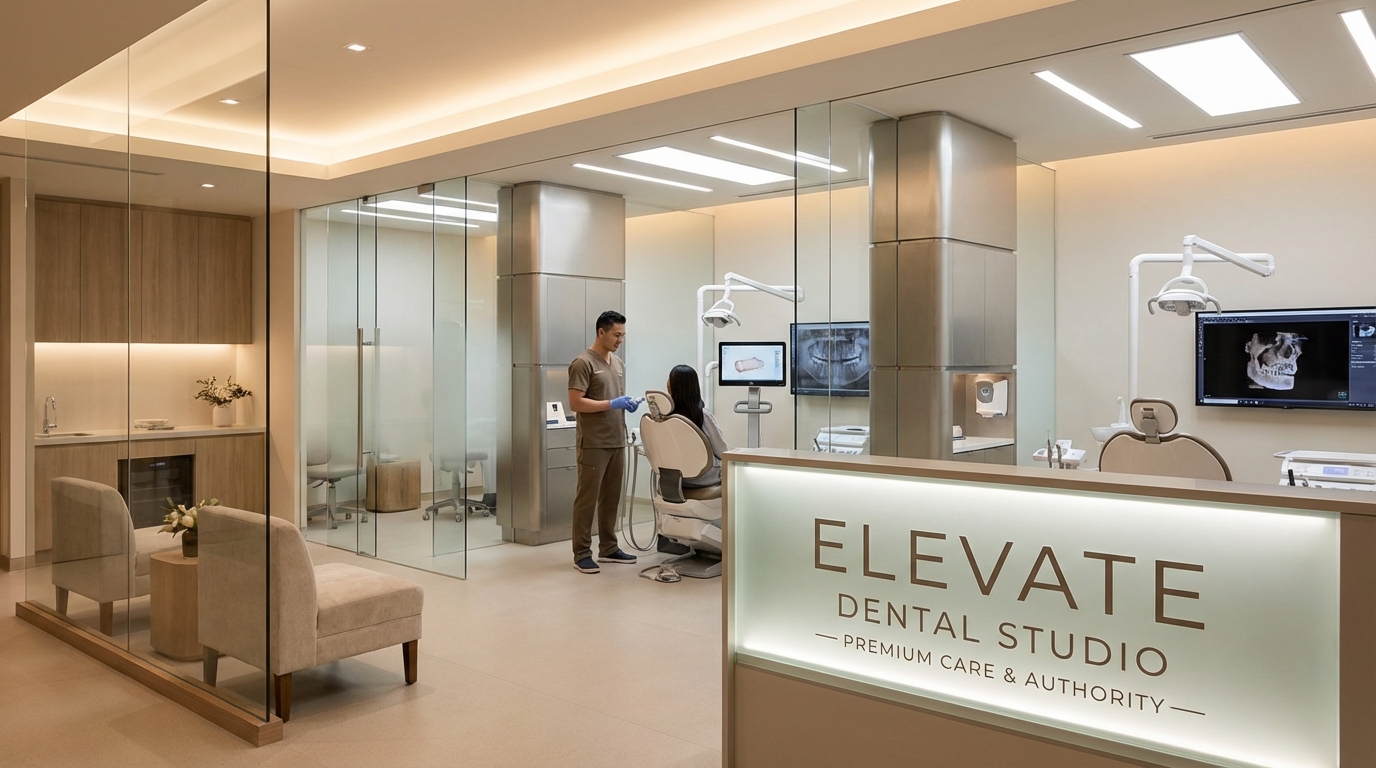
Arrival (office experience): Signage, waiting room, check-in
- Consistent branding visible everywhere?
- Waiting room reflects your positioning (luxury: leather chairs; family: welcoming toys)?
- Staff demeanor matches your brand promise?
-
Treatment delivery (clinical): Exam room setup, doctor communication, procedure transparency
- Doctor explains diagnosis/options clearly (not rushing)?
- You show before/afters from similar cases?
- Treatment plans emphasize outcomes, not just cost?
-
Follow-up (post-care): Email, SMS, phone, reviews
- Prompt follow-up showing you care?
- Did you ask for review/referral?
- Do you maintain patient relationships over time?
High-end brand example:
A luxury dental practice texting week-of-treatment confirmations, calling 48h post-op to check in, and sending personalized thank-yous. That's branding.
Action: Map your patient journey. Rate each touchpoint (1–5). Where are the gaps? Fix the 2–3 lowest-scoring touchpoints first.
5. Authority & Thought Leadership: Become the Expert
Build Credibility Through Content
Patients choose specialists. Position yourself as an expert:
- Educational content: Blog posts on implants, cosmetics, financing (like this one)
- Case studies: Before/afters with patient stories (with consent)
- Speaking engagements: Local chambers, dental associations, media appearances
- Published research: Even small case reports build credibility
- Professional certifications: Visible credentials (board-certified, fellowship trained)
Real example:
Dr. who publishes quarterly case studies on implant outcomes attracts more surgical cases than Dr. who never creates content. Both are equally skilled—but one is visible as an expert.
Action: Commit to one authority-building activity per month:
- Write one detailed blog post (you, or hire a writer)
- Film one short case study video
- Appear on one local podcast/chamber panel
- Add one new credential/certification
6. Reputation Management: Reviews & Patient Advocacy
Build Social Proof
High-value patients research before choosing a dentist. Your online reputation matters.
Where they look:
- Google Reviews (highest trust)
- Healthgrades, Zocdoc, RealSelf (specialty reviews)
- Facebook (local recommendations)
- Your website testimonials
How to get reviews:
- Ask after positive experiences (high case acceptance, successful implant)
- Make review process easy (link in email, SMS, in-office tablet)
- Respond to all reviews (professionally, gratefully, address concerns)
- Respond faster to negative reviews (shows you care about patient experience)
Standard: Aim for 4.7+ average rating with 50+ reviews. This removes objection for new patients.
Action: Audit your current reviews. Rate count and quality. If under 30 reviews or below 4.5 stars, implement review-asking system this month.
Q: How much should we invest in branding?
A: $3K–$10K for initial branding (logo, guidelines, website refresh). Then ongoing: content, reputation management, visual updates.
Q: Won't premium positioning scare away patients?
A: Yes—low-value patients. That's the goal. You want patients who accept treatment, not shop around.
Q: How long until branding pays back?
A: 6–12 months for noticeable shift in patient quality. 18+ months for full authority positioning.
Q: Can we rebrand if we've been generic for years?
A: Yes. Start with positioning, then visual refresh, then messaging rollout over 2–3 months.
Q: What if we're just a small, one-doctor practice?
A: Even more important to own a niche. Solo practices win by specialization (implants, cosmetics, ortho) not generalization.
CTA: Ready to position your practice as a premium specialist? Book a free strategy call and we'll audit your current positioning, identify your market niche, and build a 90-day branding roadmap.