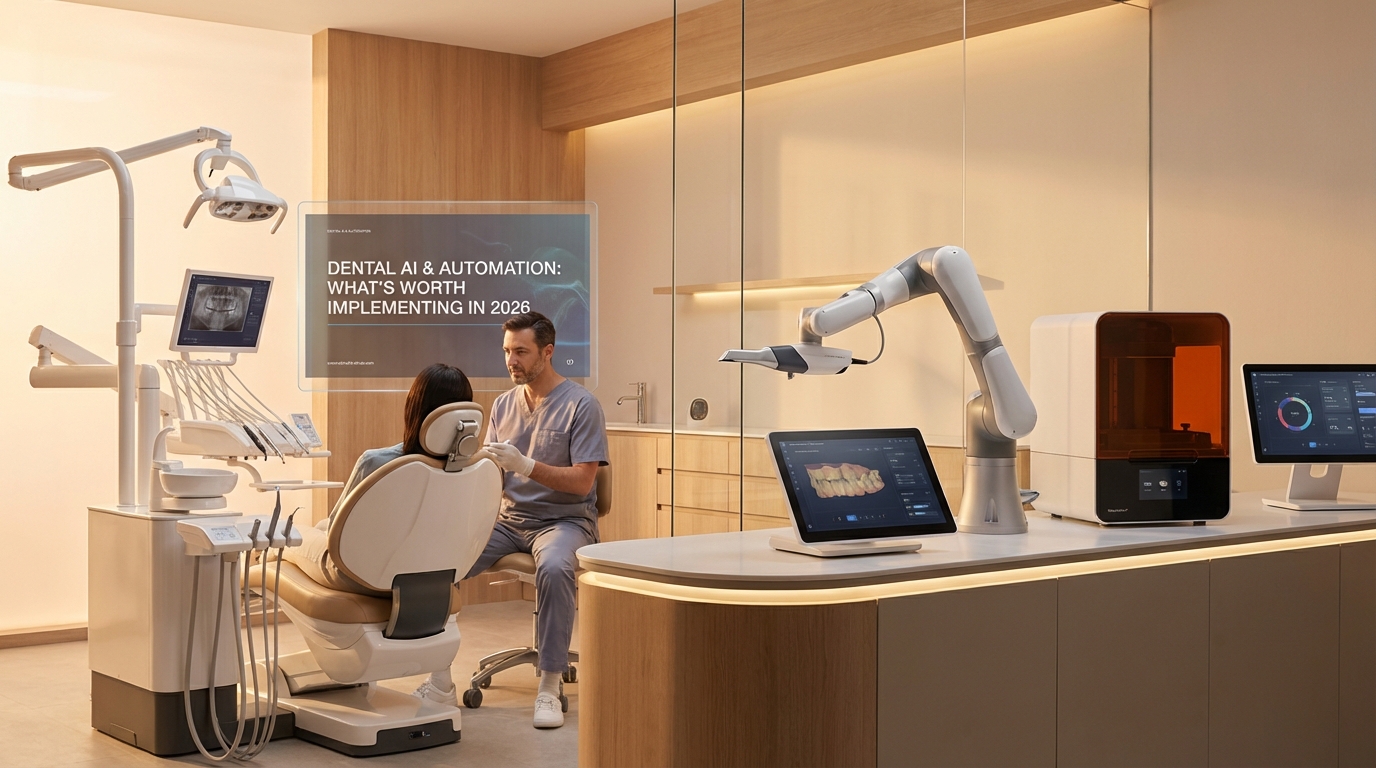
AI is not a buzzword anymore—it is a lever that sits between your ad spend and booked treatment planning. The practices that dominate implants, All-on-4, and cosmetic dentistry in 2026 have already started treating AI + automation as a partner, not an experiment. That means putting the right models on page to triage leads, pairing automation with human judgment, and failing fast until the stack feeds trained setters, coordinators, and doctors the signals they need.
This guide breaks that stack into four revenue-focused moves. You will see how AI pulls cold leads into consult-ready status, how automation keeps the CRM honest after the first hello, how data-driven follow-up closes more presentations, and why governance + playbooks matter if you want to move from pilots to predictable six-figure months. Each section includes internal links to the services that support the work, external citations so you can send them across approvals, and a CTA that points to our strategy call or website audit so the momentum doesn't stall.
Where AI actually moves the needle for high-value dental cases
Speed, clarity, and human-in-the-loop decisions
AI is powerful when it solves the two hardest problems in dental marketing: too many leads and zero context. Most clinics still treat incoming inquiries like an email inbox. AI, when tuned for your high-value offerings (implants, sedation, cosmetic), becomes a rapid triage desk. Start with a smart intake form/grid that captures treatment intent, urgency, insurance status, and financing comfort. Pair that intake with an AI scoring model trained on your historical consults, so every new lead arrives with a likelihood-to-close index rather than a blank slate.
The difference shows up in response time. Automotive and insurance companies already benchmark 90-second replies because McKinsey reports that conversion chances drop more than 50% after the first minute. Apply that benchmark to your implant funnel and you see why non-linear AI triage matters: the bot can confirm interest, surface financing intent, and route the lead to a human setter before any competitor gets the text. Link this to your Dental Marketing Agency pillar page or to our implant marketing playbook so you can trace the impact from AI intake to your broader strategy.
See how our Dental Marketing Agency pillar ties together AI triage, financing, and patient journeys at /dental-marketing-agency-pillar-page.
McKinsey’s analytics team shows speed-to-lead is the single biggest predictor of deal velocity in professional services
Automating consult qualification and CRM handoffs without sounding robotic
Scripted triage + automation that respects the patient experience
Once AI flags a lead as consult-ready, automation takes over the choreography. The moment a lead scores above a threshold, your workflow should text a warm acknowledgement, update the CRM, and place a consult hold on the calendar. This is not a dry automation—it includes the human script that still feels personal (“Thanks, Dr. Patel’s team already pulled your X-rays. We’ll text you two time slots with financing on a quick call.”). Tools like Zapier, Make, or HubSpot workflows can handle the data flow, but the script should live in your Dental CRM follow-up guide so setters know what to say and what to log.
Combine automation with visual dashboards. Use conditional logic to highlight when a lead spends more than three hours in the “Awaiting Setter” stage, or when financing answers have not been captured yet. Automated nudges should remind the setter to confirm dental insurance, financing partner, and preferred doctor before the consult. The result: fewer drop-offs, higher confidence for the coordinator, and a CRM filled with structured, searchable signals rather than free-form notes.
Anchor these workflows to the Dental CRM follow-up guide
HubSpot’s lead-response study says a 5x better response time lifts conversion odds 40–50%
AI-powered follow-up for treatment acceptance and financing conversations
Keep the emotional momentum until they say yes
High-ticket dentistry is emotional. AI helps here by keeping the story fresh between consult and treatment acceptance. Use automation to deploy contextual content—case studies, financing calculators, before/after galleries—triggered by the consultation stage, not just by time. When a patient says they need more time, flag the coordinator to send a short video walkthrough of the treatment timeline. AI-driven personalization ensures the message references the exact procedure (All-on-4 vs. cosmetic bonding) so it feels bespoke.
Follow-up automation should also be tied to financing conversations. When your patient indicates they want a financing option, automatically share your curated financing presentation plus a scheduling link for a financing expert. This keeps the patient in the funnel instead of ghosting you after the consult. The Dental Implant Consultation Conversion Rate guide shows how these touches raise acceptance from 32% to 48% when combined with structured automation and financing nudges.
See conversion math + scripts in the Dental Implant Consultation Conversion Rate guide
Forrester’s CX research highlights that contextual follow-up increases trust and lifts conversion by 18%
Governance, measurements, and scaling pilots into reliable revenue
Walk before you run with guardrails and ROI dashboards
AI and automation are only as good as the governance around them. Set measurable goals for each pilot: average response time, automation-triggered bookings, CRM data completeness, and treatment-value lift. Tie those metrics to weekly standups so leadership can approve incremental budgets knowing exactly how much time the new stack shaves from setters and what lift that gives to pipeline value.
Create a guardrail checklist before deploying new automations. Document the data sources, the person responsible for oversight, when to roll back, and how patients can opt out. This ties directly into our Dental Marketing Agency pillar outline, where the operational blueprint includes automation governance layers. Once pilots hit your target metrics, scale by cloning the stack into another service line (sleep apnea, cosmetic dentistry) rather than starting from scratch.
Map these guardrails back to the Dental Marketing Agency pillar outline
Gartner’s AI governance framework explains how to balance risk and experimentation
CTA: Book a free strategy call (https://www.closingmorecases.com/contact-us) or Book a free website audit (https://www.closingmorecases.com/contact-us) so we can map AI + automation into your revenue playbook this quarter.
Frequently Asked Questions
What is the first AI automation dental practices should deploy?
Start with a speed-to-lead layer that scores intent and immediately routes high-value leads to a human setter. That unlocks the data you need to build better automation later without overwhelming your team.
How do we keep AI from feeling pushy to patients?
Script every automation with empathy, reference the exact treatment, and always offer a “talk to a human” CTA. Use your CRM to store every response so future touches feel informed, not robotic.
Can automation replace front desk coordinators?
No. Automation should augment coordinators by handling data transfer, reminders, and simple scheduling. Humans still close the consult, answer insurance questions, and guide financing conversations.
What metrics prove AI + automation are worth the investment?
Track response time, automation-led bookings, treatment acceptance rate after automation, and revenue per automation cohort. Compare those metrics to historical baselines before the stack went live.
Do we need a dedicated AI specialist on staff?
Not initially. Start with a marketing or ops lead who understands your funnels, then expand to a dedicated automation architect once volume demands it. You can also partner with an agency to run the experiments.
Book a free strategy call and see how we help dental practices add 40+ new patients in 90 days.
Book Your Free Strategy Call