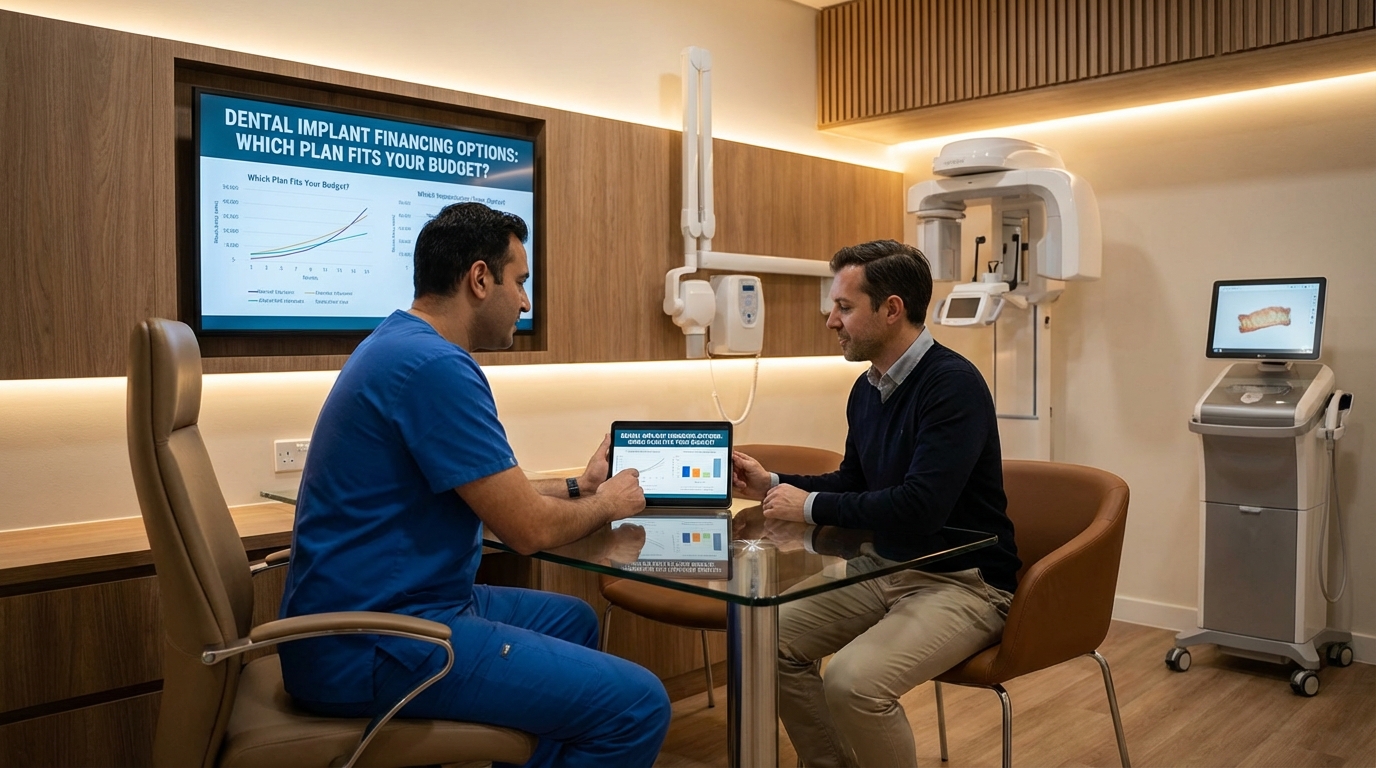
Patients arrive ready for transformation but leave with a question mark when financing is a surprise or treated like a checkbox. When your team presents a price and says “we offer financing,” you hand the objection back to the patient and back to a committee of family members with doubts.
The smartest high-value practices treat financing like a conversion engine, not a compliance form. That means: architecting the right options, matching each plan to a patient profile, scripting every handoff, and marketing financing so leads arrive pre-sold.
This article gives you a repeatable system for every implant consult. You will know which plan to offer first, how to train scheduling + coordination + surgeon teams, how to keep data on adoption, and where to drive demand externally so financing becomes revenue, not risk.
Build a financing architecture before you quote price
Use data to design the plans that keep implant consults moving
High-performing implant practices start with the numbers: case volume, average ticket, approval cadence, and which plans already look like winners. If you do not know whether the majority of your consults close with a lender versus an in-house split-payment, you are guessing each time you walk into the treatment room. Work from your Dental Implant Financing Playbook and align the architecture to actual revenue, not aspirational marketing copy.
Document three core plans that cover every urgency and comfort level—something like a 0% interest 12-month lender option for people who can qualify, a flexible in-house plan for moderate-credit candidates, and a shorter-term split payment for fast timelines. This framework keeps consults consistent, allows the team to speak in minutes and dollars, and protects the consult from drifting into a pricing debate.
Dental Implant Financing Playbook
ADA patient financing resource
Match plans to patient profiles, not just sticker shock
Segment by urgency, credit comfort, and decision timeline
Patients are not homogenous; they have distinct business cases for saying yes. Create three profiles—The Planner (motivated, methodical, wants flexibility), The Nervous Newcomer (credit shy, needs human reassurance), and The Time-Compressed Candidate (needs surgery fast, wants clarity). For each profile, match a plan type, payment script, and a reassuring proof point so your coordinator can deliver confidence instead of speculation.
Pair those profiles with lender partners that simplify the workflow. A partner like CareCredit’s dental program or PatientFi can approve in minutes and replace paperwork chaos with concierge service. Train coordinators to explain, “We have a dedicated financing concierge who submits the paperwork for you so we can lock your surgery date today,” and store those scripts in your Dental Implant Consultation Conversion Rate tracker as part of your playbook.
Dental Implant Consultation Conversion Rate
CareCredit dental program
Train every role so financing feels effortless
Script the handoffs and reward adoption metrics
Financing conversations begin at scheduling. Without a script, your front desk either avoids the topic or drops it into a 15-minute monologue. Give schedulers a tight, 60-second script that gathers income range, introduces plan tiers, and positions financing as a bridge to the transformation they already want. The implant coordinator should have a deeper script that ties financing to treatment outcomes, while surgeons need a single closing sentence like “We’ll cover financing before we leave the room so you can focus on the plan.”
Measure adoption with incentives, not fear. Track consults that covered financing, average approval time, and financed-case revenue on a weekly scoreboard. When adoption hits a milestone—say, 40% more financed cases—celebrate with a brief team huddle or lunch. External research, like the HBR guide on micro-story training for sellers, reminds us stories plus scripts fuel recall. Pair that with your Dental Implant Financing Close More Cases ritual so the team knows the process, the numbers, and the reward.
Dental Implant Financing Close More Cases
HBR story training for sellers
Market financing to bring qualified leads to the funnel
Turn your messaging into measurable demand
Treat financing like its own service page. Refresh your website and Google Business profile with clarity around “implant financing near me” and “dental implant payment plans.” Embed structured FAQs, highlight the monthly payment range, and link to your Dental Marketing Agency pillar page so searchers see the commitment to high-value cases before they ever call. Run paid copy that says “Financing approved in 15 minutes” and pair it with a financing-specific CTA that drives consultations.
Track every marketing call or form mentioning financing, tag it in your CRM, and review the conversion path weekly. If a plan underperforms, survey your coordinators: what objection kept them from offering it? Update your scripts, content, and SEO to reflect real conversations instead of ideal scenarios. When you tie financing marketing to consult revenue, you stop “hope-based” marketing and instead invest in a measurable pipeline engine.
FAQ
- How do we choose between lender options and an in-house plan? Compare approval speed, monthly payment, and your control over the terms. Use a lender like CareCredit when the patient needs a fast yes and you want an external party to handle underwriting; use in-house plans when you need custom payment windows or want to keep the margin within the practice.
- Should we mention financing before the treatment plan? Yes. Mention it during scheduling so patients arrive expecting options rather than asking for them mid-consult. That removes sticker shock and keeps the consult focused on outcomes.
- What data should we collect before the consult to match a plan? Capture income range, preferred payment method, urgency, and credit comfort. That gives your coordinator the context to offer the right plan within the first 90 seconds of the consult.
- How many financing options should we present? Stick to three clear paths—something like a premium lender option, a flexible in-house option, and a hybrid split payment. Too many choices overwhelm, so keep presentation consistent and repeatable.
- Do we need a dedicated financing coordinator? Not necessarily, but somebody must own the metric. Whether it’s the implant coordinator or front desk leader, assign ownership of financing adoption, reporting, and objections so it does not fall to “ whoever has time.”
- How do we keep marketing and consult messaging aligned? Use shared scripts, shared content briefs, and weekly huddles to review objections. When marketing promises “easy financing,” your team must be able to deliver it inside the practice.
Book a free strategy call and see how we help dental practices add 40+ new patients in 90 days.
Book Your Free Strategy Call