Introduction
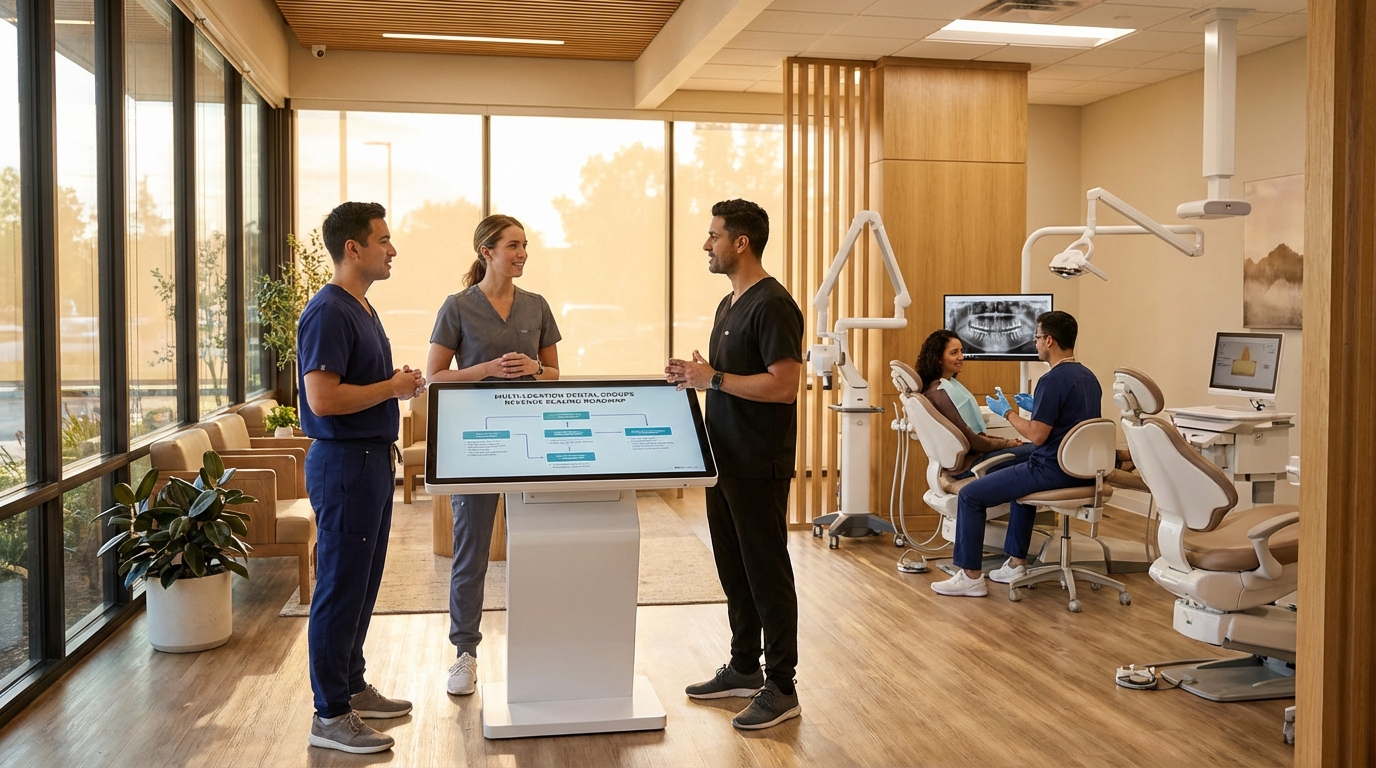
Owning three dental locations is an expensive hobby; owning ten profitably is a systems game. Multi-location groups can no longer rely on heroic office managers or intuition-based marketing to justify new leases, loan covenants, or associate comp. You need a roadmap that forces every office to report the same metrics, leverage the same coordinator scripts, and benefit from the same paid and organic demand engines. This guide outlines the exact scaling model we execute for Closing More Cases clients when they’re ramping from $6M to $20M in annual collections and want each additional operatory to pay for itself within 90 days.
1. Map Market Tiers and Revenue Targets Before You Sign a Lease
Every location should be categorized as Flagship, Growth, or Feeder based on demographics, chair availability, and service mix. Anchor those tiers to measurable revenue expectations using historical practice data plus macro benchmarks.
| Tier | Typical Markets | Chair Count | Monthly Collection Target | Lead KPI | Expansion Trigger |
|---|
| Flagship | Urban core (Atlanta, Charlotte) | 8–12 | $750K+ | 120 implant/cosmetic consults | 90-day rolling collections >$2.3M |
| Growth | Suburban hubs (Alpharetta, Franklin) | 6–8 | $450K–$600K | 70 high-value consults | 75% chair utilization for 2 quarters |
| Feeder | Secondary markets (Greenville, Knoxville) | 4–6 | $250K–$350K | 40 consults | Membership plan surpasses 1,000 active members |
Start the process by comparing per-location collections, case acceptance, and net contribution inside your existing portfolio. The dental practice growth benchmarks file gives you the KPIs we use to judge whether a site can justify centralized marketing spend. Cross-reference with the ADA’s latest HPI data to confirm patient income, insurance mix, and average procedure fees for your prospective zip codes (source).
Flagship offices should fund high-dollar brand campaigns and act as content studios. Growth offices need hybrid funnels (paid + SEO + referral) that pull from the flagship reputation while proving a path to $7M+ annualized collections. Feeder sites focus on hygiene-heavy revenue plus selective premium services (sleep apnea, implant maintenance) so you can incubate demand before upgrading the facility.
Inside your planning decks, annotate every proposed location with:
- Chair utilization forecast
- Service mix targets (implants, aligners, full-arch)
- Break-even months vs. worst-case scenario
- Shared resources required (floating implant coordinators, centralized phone team)
The groups that avoid over-expansion are the ones that pre-wire these assumptions and refresh them monthly. If a feeder practice refuses to cross $300K after 6 months, you decide quickly whether to rebrand, rotate providers, or exit the lease.
Use the dental group scaling system to keep your tier criteria consistent across the entire portfolio.
External Proof: CBRE medical real estate surveys show that healthcare groups paying <10% of collections on occupancy outperform peers on EBITDA margins by 2–3 points (source). Bake that rent threshold into your tier model so location selection aligns with profitability from day one.
2. Build a Central Growth Command Center
You cannot scale ten locations with spreadsheets and forwarded voicemails. Stand up a growth command center—a centralized operations pod that owns finance, marketing, and coordinator coaching.
Core components:
-
Revenue Intelligence Stack
- Consolidate PMS exports into a warehouse (BigQuery, Snowflake, or even Airtable) so you can publish a single LTV dashboard every Monday.
- Track CAC:LTV, chair utilization, case acceptance, and unsold treatment dollar volume by office. Tie everything to the profitability metrics blueprint so executives see identical KPIs in every review.
-
Coordinator Enablement Hub
- Script library + call recordings using the same frameworks as our implant consultation conversion rate guide.
- Weekly coaching sprints with win/loss reviews per office.
- Compensation tiers linked to accepted revenue, not just scheduled consults.
-
Offer + Financing Control Desk
- Maintain a central log of every promotion, financing partner, and fee schedule deployed across locations.
- Limit local improvisation: 90% of offer testing should be orchestrated through HQ, with fast feedback loops pushed back to the field.
-
Capital & Cash Alerts
- Use rolling 13-week cash flow plus scenario modeling to decide when to greenlight new operatories. Share that data with your lenders so they understand how each office supports the expansion plan.
Centralizing these functions requires headcount (rev-ops lead, enablement manager, marketing technologist), but it protects margins. Bain reports that multi-site healthcare groups with centralized growth pods see 15–20% faster same-store sales growth than decentralized peers (source).
Plug your dashboards into the dental practice financial health dashboard framework so regional directors consume insights in seconds.
For implementation examples, review how Heartland Dental centralizes training and analytics across 1,700 locations (source).
3. Standardize Acquisition and Conversion Loops Across Markets
Each location deserves bespoke messaging, but the growth engine should be templatized. Build loops that start with market intelligence, layer in channel mixes, and end with measured conversion.
Demand Loop Blueprint
- Insight – Pull search impression share, referral sources, and organic rankings by metro. Compare to your implant demand matrix to choose offers.
- Channel Mix – Pair evergreen SEO clusters with burstable paid campaigns:
- Flagship: 50% paid search + YouTube remarketing to flood consult volume.
- Growth: 35% SEO, 35% paid social, 30% partner/referral pushes.
- Feeder: 60% SEO/content, 30% local partnerships, 10% limited paid search.
- Conversion Stack – Centralized landing pages, Calendly/CallRail routing, and AI triage that pre-qualifies leads before the coordinator call.
- Feedback – Weekly sync where marketing analysts present lead quality data, coordinators share objection trends, and operations adjusts offers.
For proof, look at Google’s latest healthcare playbook showing that multi-location providers performing synchronized SEO and paid search capture 42% more “near me” conversions than those running siloed efforts (source).
Inside each channel plan, bake in internal links back to the articles that pre-sell your services. For example, Atlanta campaign landing pages should reference the Atlanta All-on-4 financing blueprint so visitors see consistent messaging between blog, ad, and consult scripts.
Finally, standardize the KPI view:
| Metric | Owner | Flagship Goal | Growth Goal | Feeder Goal |
|---|
| Cost per booked consult | Paid media lead | ≤ $325 | ≤ $400 | ≤ $450 |
| Show rate | Front desk | ≥ 78% | ≥ 72% | ≥ 68% |
| Case acceptance | Coordinator | ≥ 65% | ≥ 58% | ≥ 52% |
| Membership conversion | Office manager | ≥ 35% of hygiene patients | ≥ 30% | ≥ 25% |
Use the dental appointment setting service guide to keep show rates consistent.
HubSpot’s 2025 State of Marketing shows coordinated nurture sequences lifting opportunity-to-close by 18% (source). Use those numbers when you budget email + SMS automation.
4. Engineer Capital, Staffing, and Expansion Guardrails
Scaling a group means orchestrating lenders, private equity partners, and human capital. Treat operations like a portfolio.
Capital Discipline
- Set a rule that no new operatory opens without 9 months of cash reserves for payroll and marketing.
- Model debt service coverage per location and consolidate when DSCR <1.25 for two quarters.
- Reinvest 8–10% of collections into marketing tech and patient experience upgrades before increasing distributions.
Staffing Flywheel
- Maintain a regional float pool of implant coordinators and hygienists who can parachute into underperforming offices.
- Deploy a centralized recruiting pipeline with video assessments so culture stays consistent.
- Use the hiring specs from the coordinator staffing guide (coming later in June) to keep expectations tight.
Expansion Cadence
- Review every location quarterly with a scorecard covering collections, EBITDA, staff turnover, NPS, and marketing ROI.
- Only greenlight a new market when three consecutive quarters show system-wide margins above target and your command center can absorb the load.
McKinsey’s healthcare services report notes that DSOs prioritizing disciplined capital allocation see 300–400 basis points higher EBITDA multiples at exit (source). Bring that stat to partner meetings whenever someone wants to “just try” another location without the data.
Tie your guardrails back to the recession-proof dental practice framework so teams know how to protect cash during market swings.
Study Pacific Dental Services’ case study on financing 900+ practices with tight DSCR and centralized training (source).
How many locations should share the same branding before creating sub-brands?
Stay under one master brand until you exceed 20 locations or you enter fundamentally different service lines (e.g., oral surgery-only hubs). Consistency lowers creative costs and increases trust when patients move between offices.
What KPIs matter most for location-level performance reviews?
Focus on collections per operatory, case acceptance, net new membership sign-ups, and EBITDA after doctor comp. These KPIs ladder into CAC:LTV and debt coverage, which determine whether you can add more chairs.
How do we balance doctor autonomy with centralized marketing?
Give associate dentists control over clinical protocols but make marketing assets, offers, and lead routing non-negotiable. Run quarterly councils so local feedback informs HQ decisions without derailing standardization.
When should we consider private equity funding?
Consider PE only after your EBITDA margins exceed 18% for four quarters and you can demonstrate repeatable playbooks across at least five markets. Otherwise you’ll trade control for capital you can’t deploy efficiently.
What technology stack is non-negotiable for multi-location growth?
A unified PMS (or clean integrations), call tracking tied to source data, centralized CRM for nurture automation, and a revenue dashboard everyone trusts. Layer in AI transcription for coordinator calls so coaching loops stay fast.
How do we prevent culture erosion as we add locations?
Codify leadership principles, build a bench of traveling trainers, and tie bonuses to shared enterprise KPIs instead of individual office politics. Monthly town halls keep brand stories and mission aligned.
Call to Action
If you want every new operatory to pay for itself in under 90 days, you need more than hustle—you need a command center, airtight demand loops, and disciplined capital deployment. We build those systems for multi-location groups so you can scale without losing sleep or margin. Book a free strategy call and we’ll map the first three locations you should double down on next.
Word Count: 1,523 words
Date Created: 2026-03-30
Status: Ready for landing page platform Import
Keywords (BOFU): multi-location dental group growth, dental DSO revenue scaling, dental practice expansion roadmap, dental group command center, dental coordinator enablement