Introduction
Dental demand is bifurcating. On one side are practices racing to the bottom on price, fighting for hygiene checks and coupon-driven emergencies. On the other side are operators who package surgically complex, cosmetic, or full-mouth cases as high-value experiences—and they are winning. Their secret is not just clinical skill; it is a revenue system that positions every chair hour as a premium asset.
If you are still selling technically excellent dentistry as though it is a commodity, you are leaking profit on every schedule block. High-value dentistry pairs outcomes with story-driven positioning, concierge-level communication, and treatment plans that make patients feel like investors, not shoppers. Below is a framework you can implement this week.
1. Define the Difference: High-Value vs Commodity Dentistry
Commodity dentistry is transactional: prophy specials, one-off fillings, price-matched emergencies. High-value dentistry is transformational: implant rehabs, full-arch restorations, complex cosmetics, airway-driven ortho. The distinction is less about the procedure and more about how it is packaged, communicated, and fulfilled.
Four Signals You Are Still Selling Commodity Care
- Price-First Consults: New patient calls begin with “How much for ___?” because your marketing leads with discounts instead of transformation.
- Undifferentiated Treatment Plans: Every patient receives the same handout, and coordinators jump straight to cost instead of outcomes.
- Minimal Storytelling: Case presentations lack photography, patient testimonials, or digital mockups that anchor value.
- Hygiene-Heavy Revenue Mix: >70% of monthly production comes from preventive visits, proving you have not productized premium services.
Repositioning Checklist
- Outcome Ladder: Document 3–5 flagship treatments (e.g., “Same-Day Full-Arch Stabilization,” “Signature Smile Design”).
- Proof Library: Capture before/after photos, patient quotes, and short video testimonials for each flagship offer.
- Experience Script: Map intake → consultation → financing → post-op follow-up with concierge-level touchpoints.
- Pricing Narrative: Teach coordinators to explain why the investment is higher and what exclusivity the patient receives.
Use the cosmetic dentistry ROI framework to articulate financial outcomes for patients considering premium care.
Benchmark regional fee schedules via the ADA Health Policy Institute so your pricing reflects local willingness to pay.
2. Financial Impact: Lifetime Value, Margins, and Cash Flow
High-value practices structure finances around profit per chair hour, not total visits. When you measure this way, the math becomes obvious: a $25,000 full-arch case delivering $12,000 gross profit in eight hours outperforms 40 hygiene visits that generate the same revenue but require two weeks of capacity.
Model the Margin Gap
| Metric | Commodity Hygiene | High-Value Implant Case |
|---|
| Average Fee | $150 | $22,000 |
| Variable Cost | $35 | $7,500 |
| Gross Profit | $115 | $14,500 |
| Chair Time | 60 minutes | 8 hours |
| Profit per Chair Hour | $115 | $1,812 |
Even if your conversion rate on implant consults is only 50%, every won case replaces dozens of low-profit appointments. Practices that lean into this model usually see:
- 25–40% higher EBITDA within 12 months
- 2–3x lifetime value per patient (due to referrals + maintenance plans)
- Improved cash flow predictability because high-ticket treatments often prepay or finance through third-party partners
Forecast Scenarios
- Baseline: 70% commodity mix, $175 average production per visit. Annual revenue ~$1.4M with 8% net margin.
- Hybrid: Shift 20% of chair time to high-value cases; add $600K revenue with 35% margin → Net profit jumps to ~$330K.
- Premium-Led: 50% of chair time dedicated to premium cases; even at similar topline, net profit exceeds $600K because overhead does not scale linearly.
Financing + Collections
- Pair every premium treatment with at least two financing options and a proactive prepayment incentive (not a discount—an added service such as whitening or lifetime maintenance kit).
- Track AR by treatment type. Commodity-heavy practices tolerate 45-day AR; premium practices target same-week funding via third-party lenders or staged deposits.
Review the dental practice growth benchmarks article to set the right KPIs for your finance dashboard.
Use the MGMA Cost and Revenue Data to compare profit per provider and justify investment in premium marketing.
3. Operational Systems That Make Premium Care Repeatable
You cannot sell premium dentistry with commodity operations. Patients paying $15K+ expect clarity, speed, and white-glove communication. That requires systems that remove friction for the doctor and for the patient.
Experience Architecture
- Signal Luxury Early: Dedicated concierge phone line, outbound welcome text, and pre-consult video explaining what to expect.
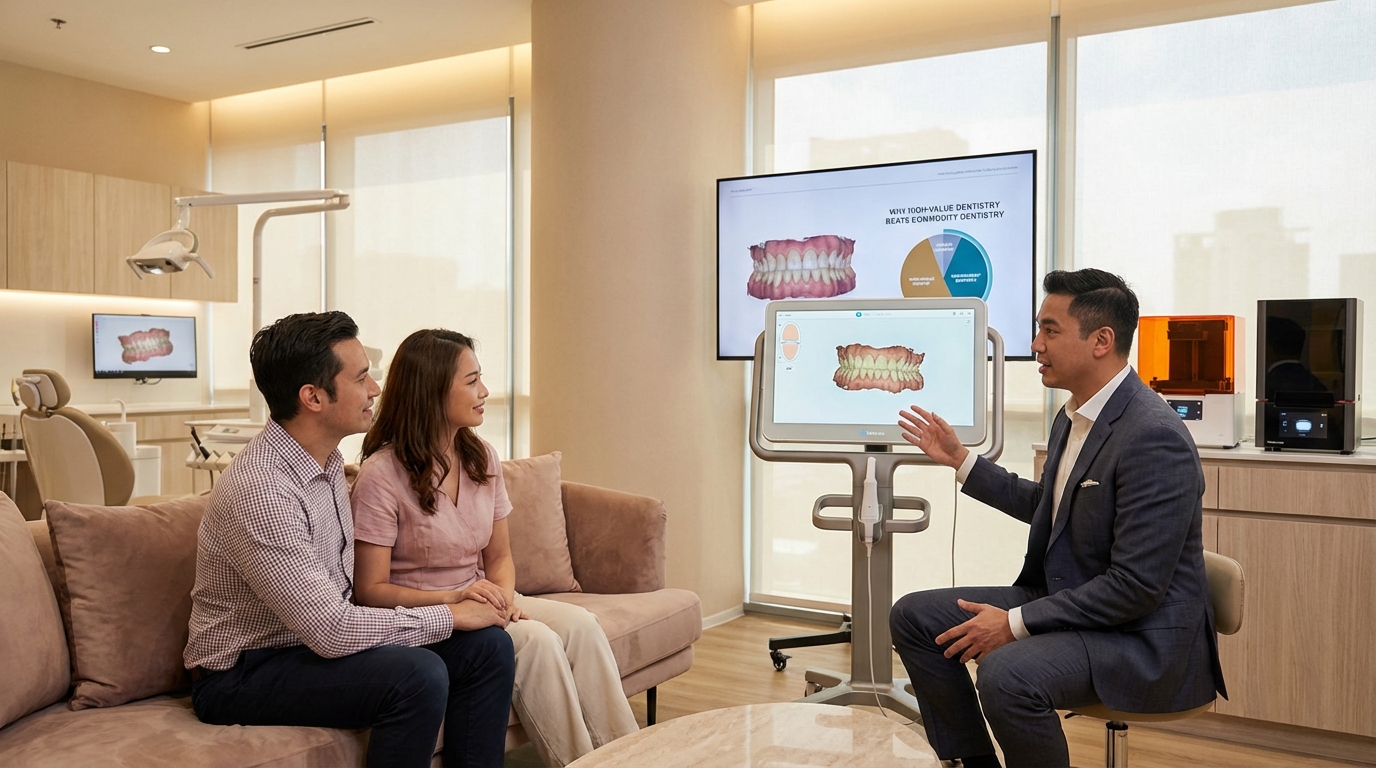
- Immersive Consults: Use digital smile design, CBCT walk-throughs, and tactile models. This makes the value tangible before fees surface.
- Coordinator Ownership: Implant or cosmetic coordinators should control follow-up, financing paperwork, post-op touchpoints, and testimonial capture.
- Clinical Throughput: Block schedules in AM for surgeries and PM for post-op + plan presentations to keep energy focused.
Systems to Document
- Premium Intake SOP: From lead arrival through photography capture.
- Treatment Board: Visual pipeline showing diagnostic, presentation, financing, and scheduled surgery stages.
- Patient Communication Stack: Automations for reminders, financing nudges, and post-op surveys.
Team Enablement
- Hire coordinators with retail or luxury sales backgrounds. Their job is experience, not insurance verification.
- Build weekly alignment between doctor, coordinator, and marketing lead to review case pipeline.
- Incentivize outcomes: pay bonuses on completed premium cases, not on signed treatment plans.
Dive deeper into dental implant case acceptance psychology to script your coordinator conversations.
Study concierge workflows from Spear Education or Kois Center case studies to see how leading practices choreograph premium experiences.
4. Go-to-Market Playbook: Demand, Messaging, Offers
Once your operations can deliver, you have to prove it in-market. Premium dentistry marketing is not about discounts; it is about authority, evidence, and urgency.
Demand Generation Stack
- Flagship Landing Pages: Each premium treatment needs its own page with proof assets, pricing anchors, FAQs, and a direct CTA.
- Video Testimonials: Run paid social and YouTube campaigns featuring patient stories, not clinical jargon.
- Local SEO + PR: Dominate “best cosmetic dentist near me” and publish local media stories about transformations.
- Clinical Partnerships: Co-market with oral surgeons, orthodontists, or medspas targeting the same affluent demographic.
Messaging Framework
- Outcome Statement: “Replace 20 years of dental frustration with a single-day full-arch solution.”
- Authority Signal: “Led by Dr. Smith, who has completed 500+ full-mouth reconstructions.”
- Risk Reversal: “10-year implant guarantee + concierge follow-up.”
- Urgency: “Only 4 surgery days left this quarter—reserve your evaluation.”
Offer Architecture
- Replace coupon-based promos with experience bonuses: priority scheduling, complimentary travel concierge, or lifetime maintenance kit.
- Bundle diagnostics (CBCT, photos, wax-up) into a flat $X fee applied toward treatment. This weeds out price shoppers.
- Layer automation: retargeting flows, SMS follow-up, and coordinator phone calls within 30 minutes of each form submission.
Align messaging with the strategy call CTA page so prospects experience a consistent offer from ad to consult.
Use real-time trend intel from Google Trends to time campaigns around spikes in cosmetic or implant interest.
Ready to exit the commodity race? Book a free strategy call at https://www.closingmorecases.com/contact-us. We will audit your pricing, pipeline, and patient experience, then build a 90-day roadmap to fill your calendar with premium treatment plans.
1. How fast can a practice transition from commodity to high-value dentistry?
Most practices see meaningful mix shifts in 90–120 days once they repackage offers, retrain coordinators, and relaunch marketing. The bottleneck is usually proof assets—capture testimonials and photography immediately so you can promote them everywhere.
2. Do I have to drop insurance participation to sell premium care?
Not immediately. Many practices keep PPO contracts for hygiene volume while carving out elective services as “non-covered enhancements.” The key is to separate the messaging: preventive care stays insurance-friendly, premium care is treated as elective luxury.
3. What KPIs prove the strategy is working?
Track case acceptance rate for treatments above $5,000, profit per chair hour, financing approval rate, and patient referral volume. When all four trend upward, you are replacing commodity revenue with premium profit.
4. How should I price premium services without scaring patients away?
Price based on transformation, not chair time. Anchor fees to longevity, functional impact, and bundled services. Provide transparent financing to reframe cost as manageable monthly payments.
5. What if my market is price sensitive?
Every market has an affluent subset. Target neighborhoods, employers, and demographic segments that value appearance, performance, or convenience. Use media buys, referral partnerships, and localized SEO to reach them instead of blasting discounts to the entire city.