Introduction
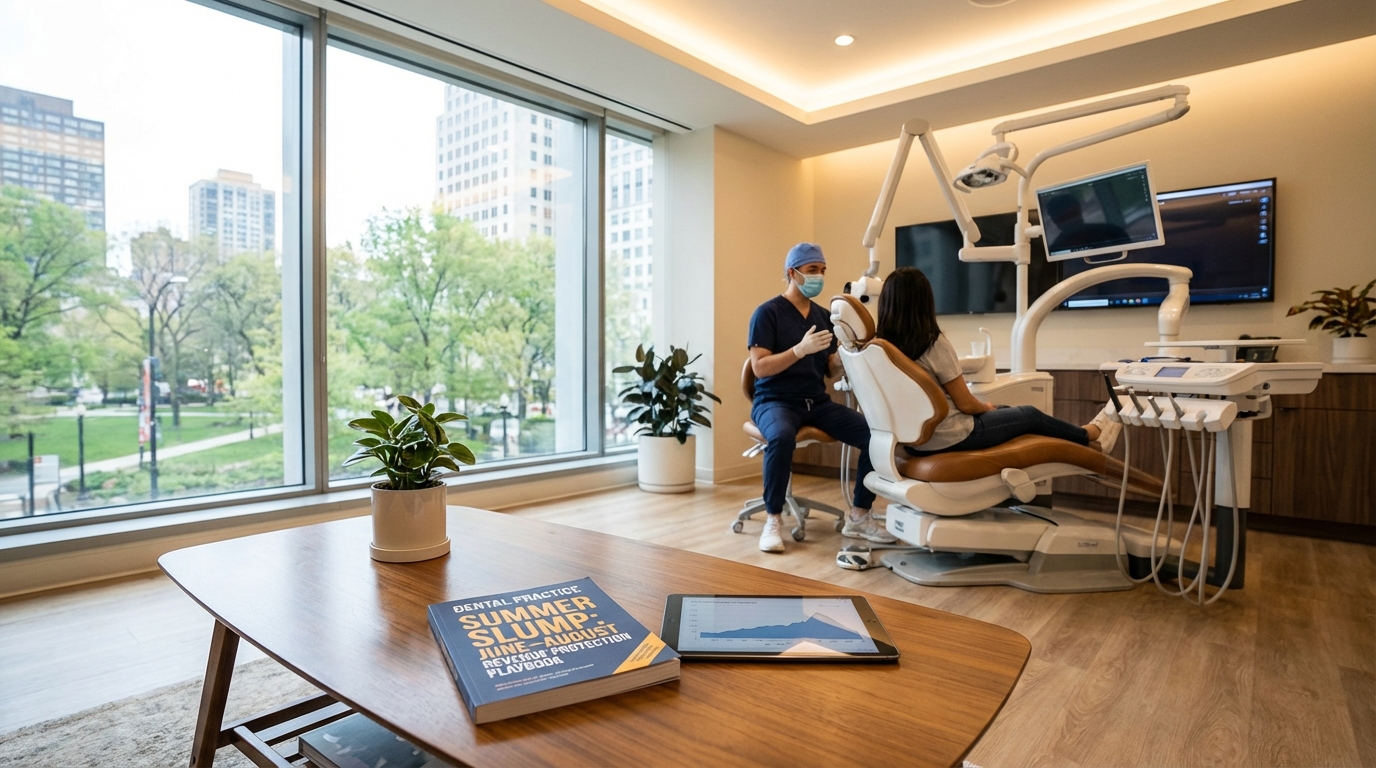
Every June, coordination teams see calendars fill with blocked days, team vacations, and patients who want treatments after school starts again. Left unchecked, that pause turns into a three-month hole in implant production, cosmetic cases, and membership revenue. The secret to beating the summer slump is treating it like a revenue event window—not a gap.
This playbook covers the four levers you can pull today: diagnosing the seasonal dip, locking in staffing and scheduling, re-arming marketing with tight offers, and protecting revenue with financing and retention. The work you do now makes July and August your quietest cash-generating months instead of a lull.
1. Know the Summer Slump Signal Before It Spreads
Your revenue curve is predictable when you track the right inputs.
The average Southeastern practice loses 18–24% of monthly production from June to August because hygiene capacity is overloaded or teams triage cancellations instead of filling them. That� signal shows up as empty Monday afternoons and a spike in "call me back in the fall" notes. If you watch volume across the rolling 90-day window, you'll see it before the CFO notices. Use tools like your dental practice growth benchmarks report to compare summer drop-offs to other offices in your market.
Reinforce this section with the benchmark playbook so department leads can see the same weekly data.
Google Trends data for "dental implant specials" and "cosmetic dentistry near me" consistently shows search interest rising through May and peaking in late June, then tapering in August (https://trends.google.com/trends/explore?q=dental%20implant%20specials). Use that trend line to start campaigns early, before the competitors take their own vacations.
Action steps:
- Build a June–July dashboard with production, case acceptance, and cancellation rate per location.
- Highlight the weeks where cancellations exceed 8%—those are your "alert weeks" for ramping outreach.
- If your practice management system can run at-a-glance, drop a "vacation alert" tag on the calendar for all providers so marketing teams know when to overbook recall communications.
The goal is to make the slump visible, measurable, and shiftable before it becomes an excuse.
2. Lock Down Operations: Bracket Scheduling + Appointment Recovery
Summer scheduling is a sprint, not a trickle.
You can't expect high-value treatments to survive on a floating schedule. That� why top practices bracket their calendars: reserve two-hour blocks each week for implant consults, use the first two days after July 4th to run hygiene recall sprints, and staff a dedicated team that handles cancelations and rebooks within 24 hours.
Pair this section with the dental appointment setting service guide so front-desk teams have scripts and data-backed follow-up windows.
The ADA� market research library shows that practices with formalized recall teams keep 37% more patients during seasonal declines (https://www.ada.org/resources/research/market-research). Lean on those benchmarks to justify staffing the recovery line.
Operational tactics:
- Vacation + capacity map: Every provider submits evening/day-off requests by May 15 so you can plan two weeks of coverage. Reserve "overflow" chairs in July for emergency implant consults and implant conversions.
- Cancelation rapid-response: Set a 24-hour rule: if a high-value patient cancels, the coordinator calls within 20 minutes and offers a same-week appointment + limited-time bonus (e.g., complimentary CBCT). Fill that spot before your lean days arrive.
- Team huddles: Run a Monday morning briefing that includes the "slump radar" (locations, days, providers, targeted offers). Share the benchmark data so ops and marketing align on what success looks like.
Treat this block as guaranteed revenue insurance. When the calendar fills, the marketing and finance teams only need to keep the demand steady.
3. Re-Arm Marketing for Summer-Level Demand
Craft campaigns that reinforce urgency while the market still searches.
Summer is not the time to slow down marketing—it� when your paid and organic channels should scream "limited seats". Deploy three synchronized campaigns: (1) recall acceleration (hygiene + diagnostics), (2) high-value implant/cosmetic demand, and (3) reactivation for patients who asked to defer. Each campaign must have a clear CTA, proof of capacity ("Four spots left for July"), and a conversion path tied to your high-value service pages.
Use the dental marketing agency playbook as your backbone for channel mix, media buying, and internal linking from blog content to service pages.
SmallBizTrends highlights that seasonal campaigns that align creativity, timing, and scarcity convert 3x better than generic evergreen ads (https://www.smallbiztrends.com/2018/05/seasonal-marketing.html). Copy that structure for your June–August messaging without diluting on price.
Campaign checklist:
- Recall acceleration (May 28–June 15): Text + email sequences that push patients to reconfirm appointments posted on your recall calendar. Add social content with behind-the-scenes footages (team prepping for summer) to reduce phone volume.
- High-ticket demand (June 1–July 3): Launch a PPC blitz aimed at implant, cosmetic, and restorative keywords with landing pages optimized for conversions (tight copy, CTA, financing options). Link to published articles (like this one) to increase dwell time and internal link equity.
- Reactivation push (July 5–August 1): Call or text anyone who said "summer" in the consult and offer a "summer-ready" slot. Use Instagram Stories + LinkedIn POV posts referencing "we kept 4 implant chairs open for second-half revenue" to keep your pipeline credible.
Measure results each week—touch not just inquiries but booked consults (your conversion focus). If one channel underperforms, reroute budget to the next best performer (usually Gmail + call center). Summer marketing is a revenue lever, not a branding exercise.
4. Protect Every Dollar with Pricing, Financing, and Retention
The summer slump is a revenue gap only if you treat treatments as one-off transactions.
Instead, protect revenue by pairing every consult with a financing option, a membership program, or a premium follow-up plan. Patients who plan for summer vacations still have budgets—they just need clarity on payment + appreciation for your consult team guiding them. Use the dental practice patient lifetime value calculator (or your internal version) to show how a $4,500 implant case generates $24K of lifetime value, justifying a slightly longer consult or a higher upfront deposit.
Point to the implant financing page (https://closingmorecases.com/dental-implant-financing-options) so coordinators can pull financing scenarios during the consult and show them with a whiteboard demo.
Dental Economics explains how lifetime value calculations help you reinvest marketing dollars and protect margin (https://www.dentaleconomics.com/practice/article/14173455/how-to-calculate-patient-lifetime-value). Use those insights to keep leadership comfortable with the summer spend.
Protection tactics:
- Price guardrails: Offer premium packages only during summer ("Summer Advantage Implant Plan") to cover labs, sedation, and financing. Highlight the ROI (LTV) so patients see the value instead of the price.
- Financing stack: Promote in-house or third-party plans with a limited-time rate or an automatic $250 lab credit when they apply before Aug 1. This gives urgency and ensures consult pipeline converts.
- Retention fallback: Build a "Summer Serve" retention plan that includes short-term aftercare (virtual check-ins, VIP membership). Once patients see the value post-treatment, you have the referrals that patch the next seasonal gap.
If you turn summer slumps into financing-boosted conversions and retention programs, you don't just survive—you compound the Q4 pipeline.
Summer is the easiest time to sell fear and excuses—don�t let it be. One conversation, two clear offers, and a ready calendar can turn June–August into your best revenue quarter yet. If you want help building the exact campaigns, pricing bundles, and leadership briefings that protect every chair, let�s plan it together.
Book a free strategy call to map the next 60 days, or book a free website audit if you need the landing pages that convert during the slump.
Q: How far in advance should we start planning for the summer slump?
A: Start the strategic planning in late April (6–8 weeks before June) so you can align marketing, operations, and finance. That gives you time to set the recall campaigns, lock in staffing coverage, and edit high-ticket promos before prospects start researching summer treatments.
Q: Do we really need to block marketing budget during what feels like a slow season?
A: Yes. The slump only looks slow because you�re reacting to cancellations. Instead, treat June–July as a peak opportunity window and invest in the exact two campaigns laid out above. Practices that stopped marketing in June lost 20% of implant consult volume by August; the ones that kept ads running filled their pipelines for Q3.
Q: What if our team is already stretched with vacations?
A: That� why you build the vacation + capacity map. Use a "summer support" roster with float coordinators and a dedicated cancelation hotline. You can also cross-train a marketing team member to own rapid response calls. The goal is not to work more—it� to systematize the summer workflow.
Q: How can we show patients that summer is still a good time for expensive treatments?
A: Lead with value. Use the lifetime value story (implant patients bring $24K of revenue) and a financing plan that spreads the cost. Also, highlight the benefit of starting treatment now: board holiday bookings, align sedation schedules, and lock the lab timeline. Pair that with a short-term bonus (whitening, premium follow-ups) to make the timing feel strategic.
Q: Should we switch up our internal KPIs for June–August?
A: Yes. Add two seasonal KPIs: (1) percent of canceled high-value consults recovered within 24 hours, (2) dollars booked in the "Summer Advantage" bucket. When the team sees these tracked weekly, they prioritize recovery over reactive chaos.
Q: What� the best way to keep referrals flowing during a slow season?
A: Push referral partners (orthodontists, oral surgeons, specialists) an automated "summer reminder" with a case highlight and a limited referral bonus. Combine that with a patient education campaign (ebook + video) so the warm leads keep coming even if the direct Google clicks dip.