The practices that win six-figure implant months in the Southeast treat treatment plan presentations like revenue ops, not show-and-tell. Every data point, visual, and script is choreographed so the patient understands exactly what happens if they wait and exactly how to pay when they act now.
Our Charlotte full-arch client had a 38% acceptance rate before we rebuilt their presentation. Ninety days later, the same team was closing 64% of $18K+ plans because the conversation followed a repeatable five-step sequence.
If you want the same lift, start with better prep, force a binary decision, and make the follow-up impossible to ignore. Here's the exact playbook.
Start the Treatment Plan Presentation Before the Patient Sits Down
Pre-wire the stakes, economics, and visuals
Most teams scramble to print X-rays after the consult. High-performing offices arrive with a one-page summary: diagnosis, cost of doing nothing, production target, and patient priorities pulled from intake. That prep comes from listening to recorded intake calls, scoring leads, and flagging insurance status so the handoff isn't blind.
The outcome: when the patient sits, you can open with, “Here's what waiting costs,” not “Here's what we found.” Our Tampa implant studio client built a 4-field pre-brief (chief complaint, urgency, household budget, desired outcome). That alone jumped show-up-to-yes conversion by 9 points in three weeks.
Dental marketing agency revenue blueprint
ADA Health Policy Institute: patients delay care due to cost
Walk Through the 5-Step Closing Formula
Scripts for each move
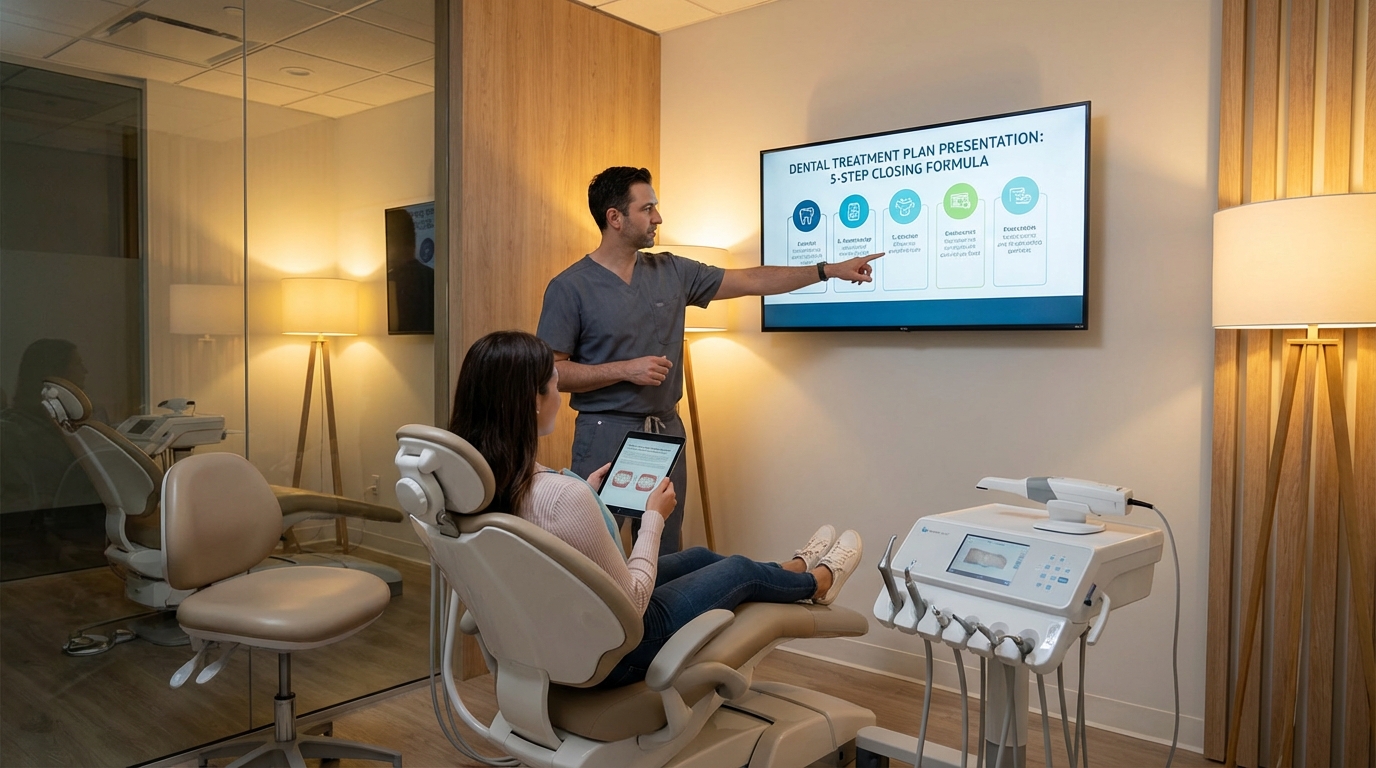
Blake's 5-step treatment plan presentation keeps the patient engaged and eliminates “I'll think about it”:
- Frame the stakes. Open with their words: “You told us chewing on the left side is impossible. Here's the scan proving why that matters.”
- Quantify production + timeline. Show total fee, phases, and chair time. We anchor treatment to life events (“We can have this done before your daughter's August wedding”).
- Social proof. Drop a comparable before/after and a one-sentence testimonial with production numbers (“[Midtown Dental, Atlanta] produced $112K last month using this system”).
- Financing menu. Offer three payment paths with monthly equivalents. Keep it simple: Pay-in-full, extended financing, hybrid.
- Binary close. “We can reserve your seat for June 18th or June 25th. Which works?”
Pair this flow with visuals—tablet slides, intraoral photos, same-day SmileFy mockups. The intake team supports it by confirming budget guardrails before the patient ever stands up; your dental appointment setting playbook should collect that data.
Dental appointment setting system
Search Engine Journal on guided conversion flows
Remove Risk With Financing, Visual Proof, and Social Math
Make premium care feel predictable
Patients don't reject treatment—they reject vague payment paths. Bring a laminated financing sheet, highlight monthly equivalents at $10K, $18K, and $30K ticket sizes, and tie each to outcomes (“$327/month gets you back to steak dinners without pain”). In Atlanta, we use Ally + Sunbit plus an in-house 12-month option capped at 20% AR exposure. That mix secured 71% financing adoption for one Midtown doctor.
Stack proof: live calculator, before/after book, QR code to video testimonials, plus a quick ROI story (“This is how [Buckhead Smile Studio] picked up $34K in reactivated treatment last quarter.”). When marketing aligns with operations, your dental SEO services page, blog, and automation all promise the same experience the coordinator delivers.
External validation matters. Think with Google reports that nearly half of healthcare consumers spend two or more weeks researching financing before they call. Cite that, then show patients you already did the math.
Dental SEO services alignment
Think with Google healthcare financing research
Operationalize Follow-Up So the Yes Sticks
Scoreboards, CRM, and 90-second callbacks
A tight presentation fails if follow-up is chaotic. After the binary close question, document the patient's answer in your CRM, trigger automated reminders, and assign a same-day check-in if they need to loop in a spouse. We build a “48-hour conversion lane”: text, email, and coordinator call within 90 minutes, then daily touches for two days. That's how a Jacksonville full-arch center added $78K in booked production last month alone.
Track three metrics weekly: show-up rate, consult-to-yes rate, and financed vs. cash split. When the numbers lag, listen to call recordings, role-play, and tighten your offer stack. Our dental CRM & follow-up automation program bakes these checkpoints into every workflow, so nothing depends on tribal knowledge.
External benchmarks keep the team honest. HubSpot's sales speed-to-lead data shows contact rates nosedive after five minutes, so train your coordinator to call before the patient even reaches the parking lot.
Dental CRM & follow-up automation
HubSpot speed-to-lead data
Book a free strategy call
Frequently Asked Questions
How long should a dental treatment plan presentation take?
Keep it under 12 minutes. The coordinator walks through the five steps in 8–10 minutes, then hands back to the doctor for clinical confirmation. Anything longer dilutes urgency and hurts the binary close.
What should I include in a high-ticket treatment plan packet?
Bundle the diagnosis summary, phased timeline, fee schedule with monthly equivalents, financing consent, and at least one patient story with production numbers. Add QR codes to video testimonials so the patient can revisit proof at home.
How do I talk about financing without sounding pushy?
Lead with the outcome (“This gets you chewing steak again”) and present the financing options as enablers, not discounts. Explain each option in plain language, then ask, “Which path makes the most sense for you?”
What metrics prove our new presentation is working?
Track show-up rate, consult-to-yes rate, average production per case, and the percentage of plans leaving with a scheduled start date. When those numbers climb week over week, your presentation is landing.
Should the dentist or treatment coordinator present the plan?
Have the dentist deliver the clinical stakes, then hand off to the coordinator to cover investment, financing, and scheduling. Patients trust the doctor for diagnosis but need a trained closer to handle the money conversation.