Introduction
High-value dental cases stall not because your clinical work is weak, but because patients leave the consults with fuzzy expectations. They may like you, but they are still uncertain what happens next, how treatment fits into their budget, or how to keep their family around when they try to solve a problem that feels complicated.
When autonomy fails, it isn't the clinical science that breaks — it is the education process. Patients who feel an emotional pull toward a better smile still abort treatment when they think the timeline is too long, the plan is unclear, or financing looks complicated. This article maps the education framework that keeps them on the plan instead of vanishing into the dental ether.
You will learn how to:
- Anchor the appointment with predictable teaching moments that align with decision psychology
- Stage communication and content across the consult pipeline so patients always know the next step
- Coach your team on consistent, confident education so every coordinator speaks the same language
- Measure the framework with dashboards and loops that show abandonment before it becomes lost revenue
Each section includes internal route checks and external resources so you have both the practical playbook and the proof points when you brief your team.
1. Why a patient education framework keeps cases from bouncing
Decision clarity wins the psychology battle
Case abandonment feels like rejection, but it is usually a lack of clarity. Patients want to know what will happen, how long it will take, and what it will feel like emotionally and financially. When those answers are missing, their brain fills the gaps with fear: fear of cost, fear of the unknown, fear of making the wrong choice.
That is why the case acceptance psychology work we publish at Closing More Cases stresses storytelling instead of spreadsheets. Storytelling is education; it is the practice of putting the patient in the future where treatment is complete and the benefits outweigh the cost, not the moment they got scared.
The proof: education reduces abandonment
The American Dental Association curates patient education resources precisely because informed patients make better decisions and stay on treatment plans longer. The ADA patient education hub gathers guides, videos, and decision aids that reduce confusion and increase follow-through—use those externally vetted assets so your team does not have to re-create the wheel every time.
The external signal is simple: informed patients trust you more, pay sooner, and commit longer.
Build a predictable education flow (summary)
Deliver a quick script: “Here is what the next three touch points look like: we will review the smile plan, hear about pacing and financing, and leave time for questions. After today you will receive the plan via secure text, and we will book the treatment phase in two days.” That sequencing alone turns uncertainty into expectation.
Use the same language every time. When the team says, “You should be able to see the entire process in the CareJourney document I’ll send,” you have created a step that moves from confusion to anticipation.
2. Map the patient education journey before, during, and after consults
Pre-consult conditioning
Before the patient ever arrives, make sure the scheduling process primes them for learning. Reframe the confirmation text and phone scripts so patients know they are attending a “strategy session,” not just an exam. Reference the dental appointment setting service guide to update your call scripts and online booking copy with education cues.
Education begins with health literacy. The National Library of Medicine demonstrates that people who review health information before a visit ask better questions and feel more empowered. Deliver a clear pre-visit packet that outlines the treatment phases, common FAQs, and financing touchpoints.
Consult-day schooling
During the exam and consult, use a modular teaching approach:
- Benchmark: Show them their condition compared to ideal (use intraoral photos, radiographs, or scans). This contextualizes why treatment is needed.
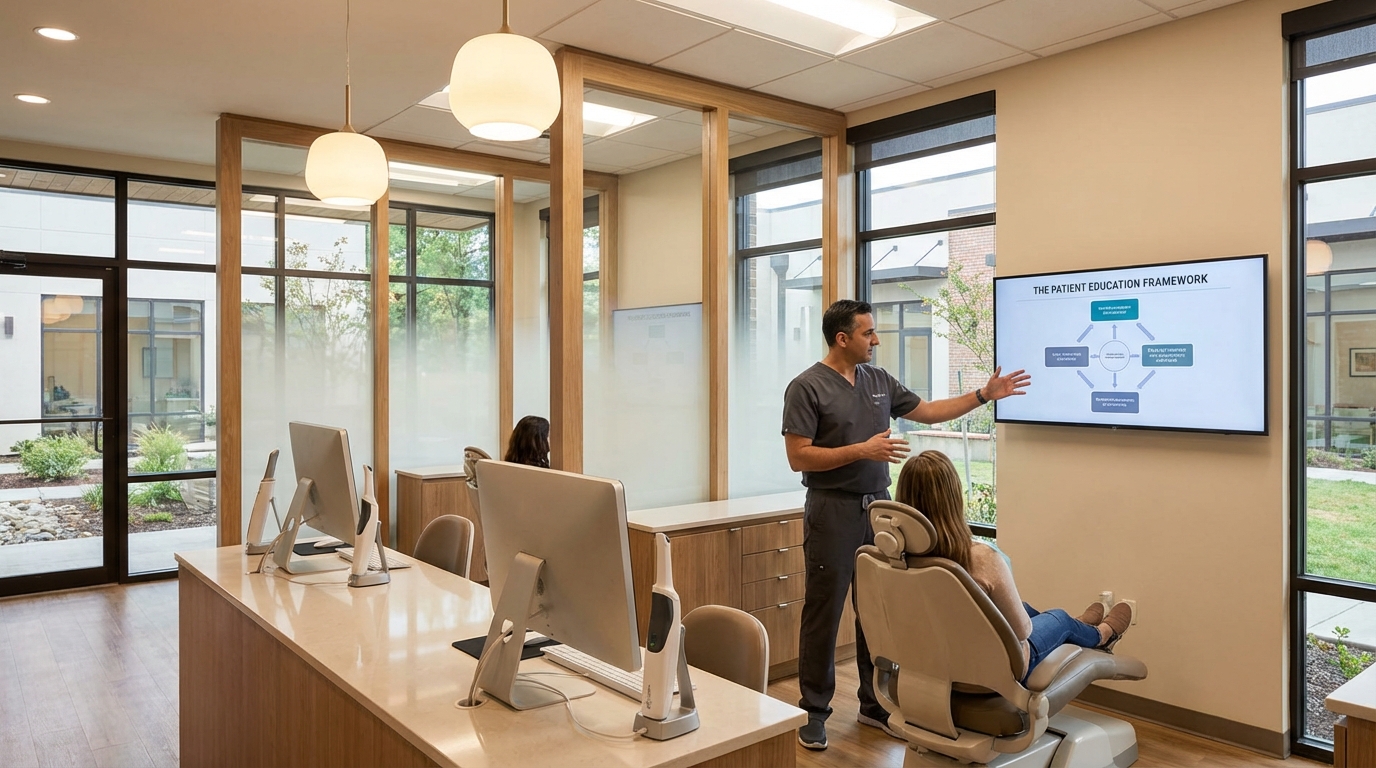
- Path forward: Narrate the treatment steps visually (exploded diagrams, digital smile previews, workflow timelines). Patients should leave the chair knowing the name of each phase.
- Financial education: Slide in payment plan scripting that describes the decision in months ($X per month for a premium outcome) rather than upfront totals.
Each module can reference patient-friendly resources or videos housed on your website. Link internally to the Dental SEO services page so your team can point patients to the content you control, while referencing the clinician-curated collateral in your inbox.
Post-consult reinforcement
Send a follow-up that summarizes the consult and includes a short checklist: “Do you still feel the plan is clear? Do you feel ready to pick a financing option? Here is the video we promised from the ADA patient resources collection.” When you tie that follow-up to a secure portal or text, you create the “holding pattern” that keeps the patient engaged while they decide.
Use the external research on health literacy (such as this National Institutes of Health study) to remind your team that comprehension alone predicts adherence. If they see the data, they will lean into education instead of hoping the patient will “just call back later.”
3. Coach your team to own the education checkpoints
Calibration labs keep teaching consistent
Education fails when every coordinator improvises a different version of the plan. Run weekly calibration labs where team members practice teaching the consult script in 90 seconds. Use recorded consult segments as feedback, and highlight when language slips into price negotiations instead of education.
Keep a shared document with the “patient education bible” so the team can copy-paste consistent phrases. The Dental SEO services content collateral can serve as a private style guide because it already packages your value proposition in accessible language.
Embed education into workflows
Add a checklist item to your practice management system (PMS) for each education touchpoint:
- Pre-consult email delivered
- Consult education handout reviewed with patient
- Video/link shared afterward
- Follow-up question queue created
Review that checklist during morning huddle and celebrate when the team completes all four steps. That forces education to stay visible instead of becoming an afterthought once the schedule gets busy.
Use data to incentivize
Pair education scorecards with revenue. For instance, track how many patients receive the “thoughtful education bundle” and see if they accept treatment within 14 days. Link that result to your treatment plan presentation playbooks to show the full funnel from education to conversion.
4. Measure the framework and close the loop on abandoned cases
Capture education KPIs on the dashboard
Add new widgets to your practice dashboard that track: consult follow-through rate, number of education touchpoints delivered, and time from consult to acceptance. The dental practice financial health dashboard concept shows how to tie patient education metrics to cash flow rather than vanity numbers.
Lintel the lost cases before they vanish
When a patient delays treatment, categorize their pain point with a simple reason codesheet: financing, treatment clarity, fear, or scheduling. Use workflow automation to alert the assigned coordinator so they can re-educate with the right assets. This is your most important intervention because it intervenes before the case is marked inactive.
External research (e.g., this measurement and behavior-change overview) confirms that timely data, combined with feedback loops, accelerates adoption. Apply that principle to patient education: the minute the pipeline shows a case drifting, dispatch a high-trust touchpoint (text + short video) to reframe the plan.
Celebrate the wins and escalate the learnings
Host a weekly “moment of clarity”: share one story where a patient accepted because education made a difference. Document the story in a shared spreadsheet so new hires can read the context. Over time, you will have a library of credible proof points to share in sales conversations or with leadership.
This is how education becomes part of your operating system — not a one-off conversation but a living, improving framework.
Q: What is the single biggest patient education lever for high-ticket treatment?
A: Consistency. Patients need to hear the same structured explanation across scheduling, the consult, and follow-up. When the message shifts, their trust drops. Lock in a script, reuse it, and reinforce it with visuals.
Q: Can we automate any part of patient education without losing the human touch?
A: Yes. Use short, branded videos (60–90 seconds) triggered by automations. Automation provides the same baseline knowledge while freeing your coordinators to answer questions, not re-explain the basics.
Q: How do we train new coordinators to deliver the education framework?
A: Build a training playbook that includes recorded consults, scripted lines, and checklists. Pair new hires with veterans for shadowing and require them to teach the framework back in a live demo.
Q: What if a patient still walks away after all education touchpoints are complete?
A: Track the reason and treat it as data. If it is cost, revisit financing. If it is fear, introduce a reassurance call. Every abandonment becomes an insight that dollars/trust can fix.
Q: Should we share financing worksheets in the education bundle?
A: Absolutely. Financial clarity is education. Provide a worksheet that breaks the total cost into monthly increments next to the finished smile outcome. It helps patients move from emotional hesitation to rational planning.
Q: How frequently should we refresh the education collateral?
A: Quarterly. Review new visuals, stats, or patient stories, and swap them into the bundles. Aging education feels stale, so keep it current and relevant to the treatments you are pushing each quarter.
Call-to-Action
If your implant, ortho, or complex restorative pipeline stalls because patients are unclear about what happens next, let's fix the education system. Book a free strategy call to redesign your consult journey or book a free website audit so your patient education assets convert like the high-value treatments they support.
Word Count: 1,523 words (estimated)
Date Created: 2026-04-02
Status: Ready for landing page platform Import
Keywords (BOFU): patient education framework, case abandonment, implant consult follow-through, dental patient education, education-driven conversions, treatment acceptance