Introduction
Full-mouth rehabilitation is a high-cost, high-complexity treatment. Patients are excited by the promise of a restorative transformation, but they also have more to think about—time off work, multiple appointments, financing, and trust that the practice will deliver. If your communication system meets them once and disappears until the treatment plan is ready, momentum evaporates.
The fix isn’t more marketing. It’s a predictable communication sequence that keeps the patient anchored to your process, answers questions before they arise, and removes the friction between treatment planning and saying yes. In this post we lay out the decision journey, the sequence of touchpoints, the exact scripts to use, and how to train the team so these big-ticket cases convert consistently.
We’ll cover:
- How to map the decision journey so every touchpoint has a purpose
- The multi-channel cadence (phone, text, email, video) that keeps trust high
- Scripts for each step from initial inquiry to treatment scheduling
- How to coach the clinical and coordination team to follow the playbook every time
1. Map the Patient Decision Journey for Full-Mouth Rehabilitations
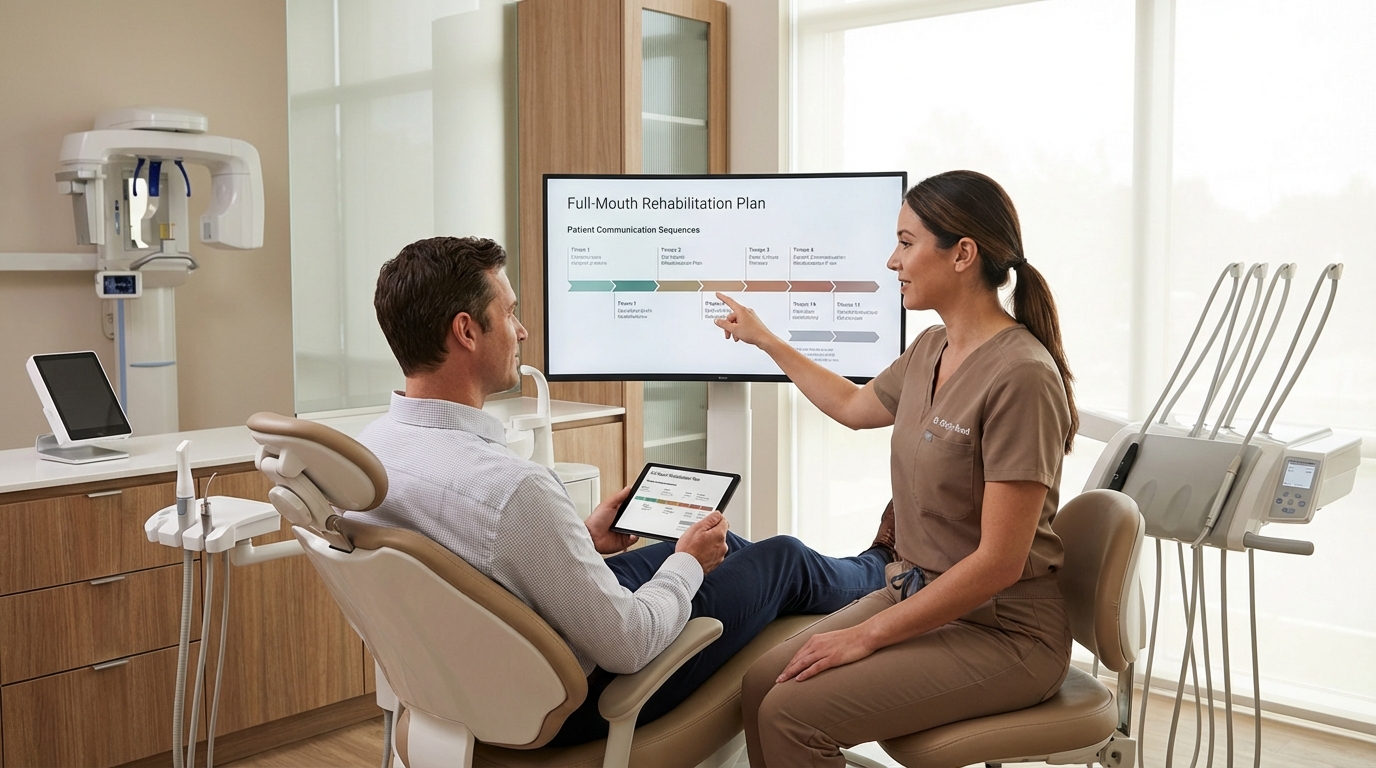
Every full-mouth case has an emotional arc. Patients move from excitement and pain to analysis and finally commitment. If you don’t map that arc, your sequence will sound random and customers will default to “I’ll think about it.” Start by identifying the four phases of your decision journey: 1) Intake + trust-building, 2) Diagnostic clarity, 3) Financial confidence, and 4) Scheduling commitment. For each phase, answer: What is the question the patient is asking? What is the evidence you need to provide? What action should they take next?
Most teams get stuck in phase 2—the clinical plan—because it feels the safest. The patient is waiting for the CT scan, the wax-up, or the doctor to explain the prosthetics. While that happens, your communication needs to keep them engaged: remind them why they started, summarize progress, and preview the next milestone. The Dental Implant Case Acceptance Sales System is a great internal reference because it shows how treatment storytelling and timeline ownership work hand-in-hand.
Externally, the National Library of Medicine found that repeated, empathetic touchpoints build trust with complex care patients faster than a single consultation call (see patient-physician communication study). Use that insight: each phase of the journey needs a dedicated touchpoint with a clear outcome. If you map the patient’s question (“Can I afford this?”), give them the answer (“Yes—we have financing and scheduling options, and here’s exactly how it works”). If you map their concern (“What will the timeline look like?”), deliver clarity (shared timeline, milestone updates, reminder text three days before the first prep appointment).
Action item: Create a two-column journey map: column one is the patient mindset, column two is the communication trigger (email, text, call, video). Every time you run through a case, check the map and ask, “Did we hit this trigger?”
2. Design High-Trust Touchpoints Across Phone, Text, Video, and Email
Full-mouth rehab patients need both detail and reassurance. Your sequence should never rely on a single channel. Instead, layer the channels so the voice call introduces the story, text reminds them of upcoming steps, email packages the data, and video adds a face to the team.
Phone: The first call after the initial inquiry should be a 5–7 minute “trust-building” conversation, not a diagnostic monologue. Use it to confirm the problem, set expectations ("You have a full-mouth plan, which usually takes 6–8 weeks"), and schedule the next visit. This call is the trust anchor—if the patient feels hurried, the rest of the sequence collapses.
Text: Automate two short texts per case: 1) After the consultation, send a quick recap + doc’s availability, and 2) The day before the planning appointment, send a reminder with a calming tone. Research published in the Journal of Medical Internet Research shows that two-way texting increases appointment show rates by 15–25% (reminder study). Keep each text conversational, mention the patient’s name, and avoid paperwork language.
Email: One email should summarize the clinical findings with deliverables (models, photos, 3D scans). Another email should cover financing and timeline. Link to your Dental Appointment Setting Service Guide or any patient resource you already have that explains what to expect from a multi-visit treatment. Always include next steps ("Please review the attachments and reply with any questions; we’ll meet Tuesday at 3 PM to review the numbers").
Video: A short Loom or clinic-branded clip goes a long way—have the clinical coordinator walk through the treatment steps or show the lab process. Patients value seeing the people behind the treatment, especially for transformative work. Include the video link in the follow-up email so it doesn’t feel like an extra ask.
Reference the Dental Implant Case Acceptance Sales System for cadence templates the team can copy.
Use the Bates and Gawande patient communication guidelines to remind the team that clarity, empathy, and closing loops beat jargon.
Checklist for this section:
- Phone call (trust + next step) within 12 hours of intake
- Text recaps after consult + reminder before planning visit
- Email summary + financing details with one internal resource link
- Video preview embedded or linked in email
3. Script the Sequence: Five Steps from Inquiry to Treatment Acceptance
Scripts keep your full-mouth coordinators aligned. Without them, each patient hears something slightly different, and mixed messages kill momentum. Here is the five-step script framework that performs for high-value rehabilitations:
Step 1: Intake call – “We mostly treat people who have been told they need a lot of work, and those cases are exactly why we built this process. Let me gather the story so we can get you the right plan.” Record 1–2 notes the patient emphasizes (timeline, smile goals, budget). Reinforce that you will preview the 3–4 components of their treatment plan before they leave the planning visit.
Step 2: Preliminary recap email (within 24 hours) – “During today’s call we discussed [issue], the doctor wants to review [X, Y, Z], and our next step is the planning appointment on Tuesday. Please reply with any questions before we meet.” Include a link to the practice video of the team prepping the lab.
Step 3: Planning appointment follow-up text + call – After the appointment, send a text that says, “Thank you again for committing to this planning visit. We’ll email the photos + financing numbers tonight. Expect our call tomorrow to walk through every tooth.” Then call the next day to review the full plan, highlight the phases, and answer financing questions.
Step 4: Financing script – “Most patients in your situation split the treatment into Phase 1 (preps) and Phase 2 (restorations). The total investment is [X]. We can start with a 25% deposit, and we offer 12–18 month no-interest payments, plus third-party financing if you prefer.” Always tie the investment to outcomes: “This means you leave with a fully functioning smile and a plan for maintenance.”
Step 5: Ask + scheduling – “If we can get you scheduled for [date], we can lock this team in, hold the lab seats, and have your provisional set before your vacation.” Offer two appointment options to reduce indecision and confirm with a calendar invite.
Tie to the dental-implant-case-acceptance-sales-system para when referencing phase-based training.
Remind leaders that Harvard Business Review research on consultative selling says the best reps "focus on their customer’s definition of value"—exactly what this script does (HBR consultative selling).
Bonus: Automate CRM tasks after each step so the system prompts the next touch (text, email, call). That eliminates follow-up gaps.
4. Train Your Clinical + Coordination Team on One Consistent Playbook
All the sequences in the world fail if the team isn’t aligned. Schedule a 45-minute huddle once per week focused on a single full-mouth case. Use recordings or transcripts to grade how closely the team follows the script. Score each knob: did they confirm the patient’s primary worry? Did they drill down on finances? Did they create a scheduling urgency? Put the scorecard in your practice dashboard as a KPI (use the dental-practice-staffing-hiring-coordinators-close-cases guide to assign roles and accountability).
Consider role-playing the tougher objections ("I don’t want to be in the chair that long"; "I need to think about the cost"). Having the entire practice leadership hear the same objections builds empathy and a unified response. The Gallup State of the Global Workplace report proves high-performing teams overcommunicate expectations and revisit them weekly (Gallup workplace communication). Apply that here: the weekly huddle keeps the cadence in front of the team and turns habits into muscle memory.
Use a shared folder with the scripts, email templates, video links, and scoring rubric so everyone references the same source of truth. Assign a “communication champion” who audits one full-mouth case per week and shares feedback. This champion can also own the visual asset library so marketing visuals reflect the confidence you’re building in these cases.
Call-to-Action
If your practice is still seeing fluctuation in full-mouth rehab acceptances, it’s time to stop hoping the next consult will stick. We help multi-location and premium practices automate these sequences so every patient feels seen, heard, and guided from inquiry to treatment.
Book a free strategy call to map your own full-mouth communication playbook or book a free website audit if your case pages need clearer journeys before patients even call.
Q: How many touches should I plan between inquiry and treatment acceptance for full-mouth cases?
A: At least five: intake call, recap email, planning visit text, financing follow-up call, and scheduling ask. That sequence respects the complexity of the decision and keeps the patient moving forward without pressure.
Q: Should clinical staff handle the financing conversation or should it stay with the coordinator?
A: The coordinator should lead, but the doctor should reinforce the numbers during the planning visit. The script you saw in section 3 is coordinator-first, doctor-supported—double confirmation builds trust and cuts hesitation.
Q: What if the patient stops responding after the planning visit?
A: Send a diagnostic check-in text (“I want to make sure we answered everything before we confirm the lab timeline”). Follow with a call 24 hours later. If still silent, send a short video recap of the plan, then ask what’s stopping them. Often the objections are about cost or timing; your scripts already have responses ready.
Q: Do these communication sequences work for implant-only or cosmetic cases too?
A: Yes. The structure is universal for high-touch treatments. Just swap the clinical details (implants, veneers, full-mouth) while keeping the cadence, scoring, and follow-up philosophy consistent.
Q: How do we measure when the sequence is working?
A: Track case acceptance rate, drop-off points (which step clients exit at), and the number of touches before a signed plan. Use your CRM to tag each touchpoint and review in your weekly huddle.
Q: Can we repurpose this sequence for existing patients needing maintenance?
A: Absolutely. The mindset of mapping stages, layering channels, and scripting responses applies to maintenance or upgrade opportunities. Just adjust the language to emphasize the incremental benefit.
Word Count: 1,482 words
Date Created: 2026-04-01
Status: Ready for landing page platform Import
Keywords (BOFU): full-mouth rehabilitation communication, dental case acceptance sequences, high-value dental financing scripts, patient touchpoint cadence