Introduction
Scaling a dental group is not the same as doubling down on one practice. You're now designing a miniature enterprise with marketing, finance, clinical, and operations teams that all have to work together. Growth that happens without this alignment produces burned-out coordinators, slipping treatment plan acceptance rates, and marketing campaigns that run into capacity walls.
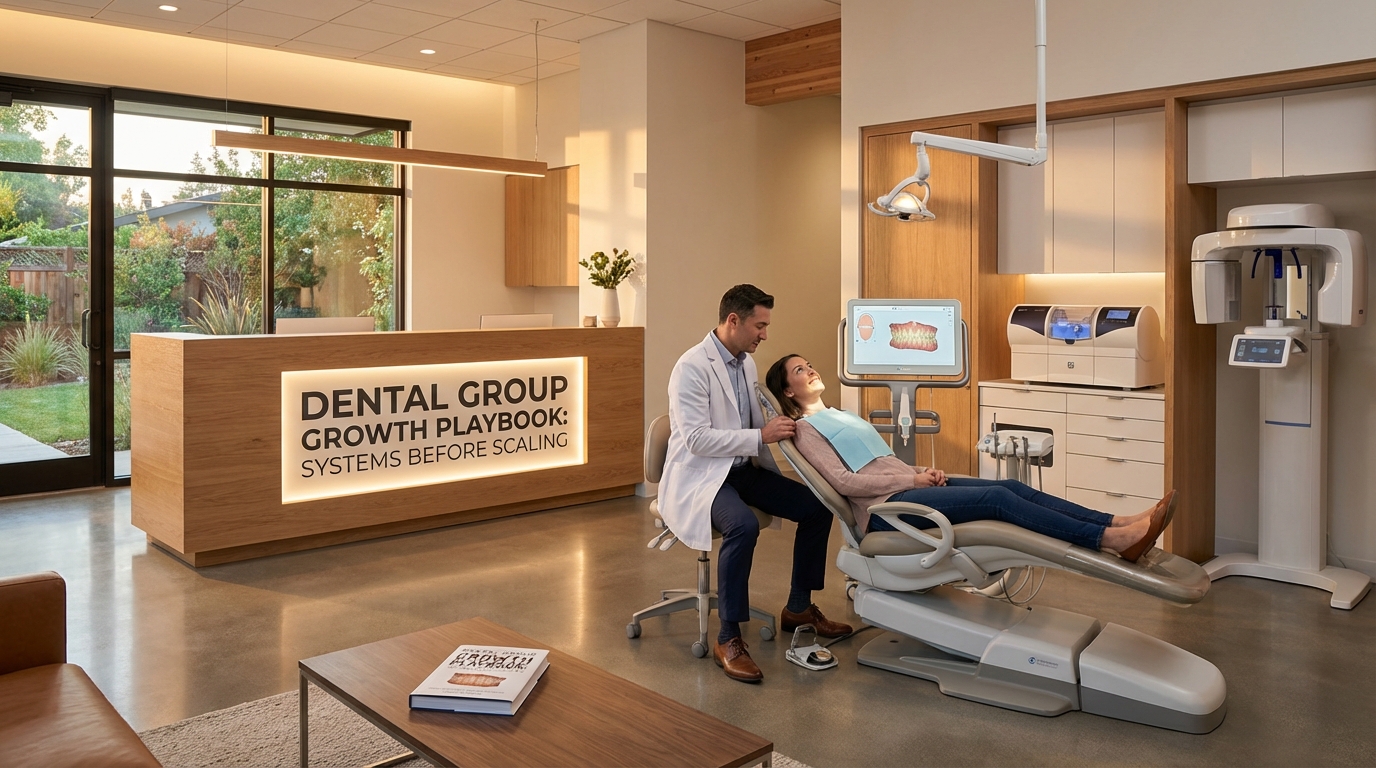
The highest-leverage moves happen before you sign another lease. Design the systems, define the KPIs, and orchestrate the leadership rhythms so each new location becomes another predictable revenue engine instead of a crisis magnet. This playbook walks through the architecture, the dashboards, the marketing-operational bridge, and the week-to-week execution rituals that keep dental groups on the path to 6-figure months.
1. Build the Systems Architecture for Dental Group Growth
Systems-first growth starts with a clear architectural blueprint: clinical operations, finance transparency, and marketing funnel hygiene all need documented workflows and playbooks. Without that blueprint, each new location invents its own rules—double-booked consults, mismatched messaging, and treatment coordinator confusion.
Clinical Operations Backbone: Create location playbooks that capture everything from consult workflows to implant case acceptance scripts. Use the dental group scaling system as your starting template: document who owns patient education, how treatment coordinators hand off cases, and what signals trigger capacity limits.
Finance & KPI Stack: Implement a central dashboard that aggregates revenue per location, treatment mix, and patient lifetime value. Link this dashboard to your patient lifetime value calculator so acquisition budgets and case acceptance goals all tie back to one number.
Marketing & Sales Processes: Funnel automation can only scale when marketing, outreach, and intake teams use the same naming conventions, follow-up cadences, and qualification criteria. Refer to the dental appointment setting service guide to standardize lead scoring and handoffs, ensuring every prospect has the same experience no matter which location they contact.
External reference: Harvard Business Review’s article on systemizing growth warns that companies that assemble growth-focused systems before demand rises reduce duplication and increase quality control (https://hbr.org/2016/01/how-to-avoid-the-scaledown-syndrome). Dental groups can borrow the same playbook: design the system, then feed it demand.
Outcome: When systems are documented, every new hire can plug in faster, every marketing campaign has a capacity guardrail, and you can prove to investors or lenders that growth won't break the group.
2. Align Revenue & Operations with Data-Backed KPIs
Systems are only as good as the data that drives them. Connect your revenue operations stack so leaders can see the same numbers without waiting for end-of-month reports.
Revenue visibility: Track revenue by treatment type (implants, restorative, hygiene, memberships) and by stage (consults booked, consult-to-treatment, treatment completion). Use dashboards that highlight patient lifetime value (link back to dental practice pricing strategy) and the profitability of each case.
Operational KPIs: Follow appointment efficiency: consult fill rates, no-show percentages, and treatment plan acceptance. These metrics tie into your clinic control points—if acceptance dips, run a root cause with treatment coordinators and marketing to see if messaging misaligned with capacity or quality conversations faltered.
Marketing KPIs: Monitor CAC per cohort and compare it against the patient lifetime value derived from your centralized calculator. Marketing can run aggressive campaigns for high-LTV segments because finance already knows how much a patient is worth. This makes it easier to advocate for premium channels (LinkedIn, specialist PPC) that bring in surgical consults.
External authority: Dental Economics’ breakdown of 5 essential practice metrics (https://www.dentaleconomics.com/business/article/16389075/the-5-metrics-every-practice-owner-should-track) reinforces the need for velocity+profit measurement—convert rate, retention, case acceptance, production, and collections. Align your dashboards to track those same metrics.
When these KPIs trend, use the dental implant consultation scripts to keep each consult aligned to your desired outcomes, ensuring coaching touches replicate across practices.
Result: Every leadership meeting becomes a fact-based decision, and you're able to detect when a location is ready for marketing fuel or needs a capacity pause instead.
3. Marketing & Growth Engines That Respect Clinical Capacity
Growth marketing often pushes demand faster than clinics can handle. The solution is marketing that is tightly coupled to capacity and treatment focus.
Treatment-focused campaigns: Build messaging that matches what each location can deliver. If a location has two implant surgeons and a strong sedation team, prioritize high-ticket implant cases and tie the campaign to patient education funnels that nurture prospects through the same journey the clinic is ready to serve.
Lead routing playbooks: Use intake coordinators to score leads (implants vs hygiene) and route them to the right location, staff, or follow-up tier. Reference the dental marketing agency pillar page for internal alignment on how we package these services, making sure all marketing collateral references the same value propositions.
Coordination with capacity: Before launching paid search or LinkedIn outreach, run a capacity check: how many high-value consults can the treatment coordinator team handle in the next 30 days? If you're already booked solid, pause the campaign or target a lower-intent segment. This avoids the reputation damage of “sold out” messages or rushed consults.
External inspiration: McKinsey’s research on demand-supply alignment (https://www.mckinsey.com/business-functions/operations/our-insights/the-power-of-supply-chain-integration) shows that companies with integrated demand/supply planning increase throughput without adding headcount—a mindset dental groups can copy by linking marketing calendars to treatment capacity charts.
Outcome: Marketing no longer spins faster than operations can keep up. Instead, campaigns are purposeful investments that feed well-documented revenue paths, reducing wasted spend and preventing patient experience breakdowns.
4. Execution Playbook & Leadership Rhythm
Systems and KPIs only win if leadership enforces a consistent rhythm.
Weekly leadership syncs: Run a Monday planning stand-up that covers demand signals, capacity, and revenue. Use a simple control panel: consults booked per location, case acceptance velocity, marketing spend vs pipeline, and bottlenecks flagged for treatment coordinators.
Pre-mortem reviews: Before opening a new location or launching a service, run a pre-mortem with the leadership team. Ask: “What could break our systems?” Capture staffing needs, IT integration (PMS, CRM), and marketing handoff points. This ritual prevents a new location from inheriting last-minute chaos.
Coaching loops: Pair each treatment coordinator with a “systems buddy” who ensures they follow the documented workflows, run the same checklists, and escalate issues before they become habits. Document all learnings in your group operations wiki (prioritize the dental implant coordinator scorecard so staffing standards stay high).
Quarterly reviews: Evaluate the system architecture quarterly with a simple rubric: Are workflows documented? Are KPIs tracking? Is marketing tied to capacity? If any area falls behind, assign a rapid-response owner to fix it before more growth is added.
External reference: Scaling Up’s Rockefeller Habits (https://scalingup.com/) remind teams that zero-defect execution relies on a consistent meeting rhythm, daily metrics, and clear accountability—systems your dental group can adopt immediately.
Result: Discipline breeds predictability. When leadership commits to this playbook, you can add locations, services, or campaigns without chaos because everyone sees the plan, data, and next actions.
Q: How many systems do we need before pursuing the next location?
A: Enough that every critical workflow—consult scheduling, case acceptance, treatment coordination, finance reporting, and marketing handoff—has a documented owner, checklist, and escalation path. If a new location takes longer than 10 minutes to understand how things work, keep refining the systems.
Q: What KPIs should our dashboard prioritize for dental group growth?
A: Focus on consult-to-treatment acceptance, patient lifetime value, capacity utilization (dental chairs booked / available time), marketing CAC per treatment type, and treatment coordinator throughput. Align those with revenue so you know when the group is ready to add more demand.
Q: How do we keep marketing aligned with clinical reality?
A: Create a marketing-capacity guardrail that ties campaign launches to treatment coordinator availability. Build a shared calendar showing seats available per week and only launch paid campaigns when there’s more than a 10% cushion above booked consults.
Q: Can we scale without standardizing treatment coordinator roles?
A: Not sustainably. Treatment coordinators are the bridge between marketing and clinical delivery. Use scorecards, onboarding templates, and role-based playbooks so every coordinator replicates the same consult experience and keeps systems healthy.
Q: How do we ensure leadership keeps the execution rhythm?
A: Assign a dedicated rhythm owner (operations lead or COO) to run the weekly stand-up, document decisions, and follow up on action items. Use the Rockefeller Habits framework: consistent meetings, daily metrics, core values, and accountability.
Q: Do we need a shared CMS for all locations to use the same content?
A: Yes. Centralize your content library so every location can access the same case studies, scripts, and patient education assets. Use a system like landing page platform CMS or Notion to store templates and update them in one place.
Call-to-Action
You can grow dental groups faster when the systems, KPIs, and marketing engine all work in harmony. If you’re ready to document the playbook, align your leadership rhythm, and book more high-value treatment plans predictably, book a free strategy call. Need help auditing the content, SEO, or UX that fuels those campaigns? Book a free website audit and we’ll map the next sprint together.