Introduction
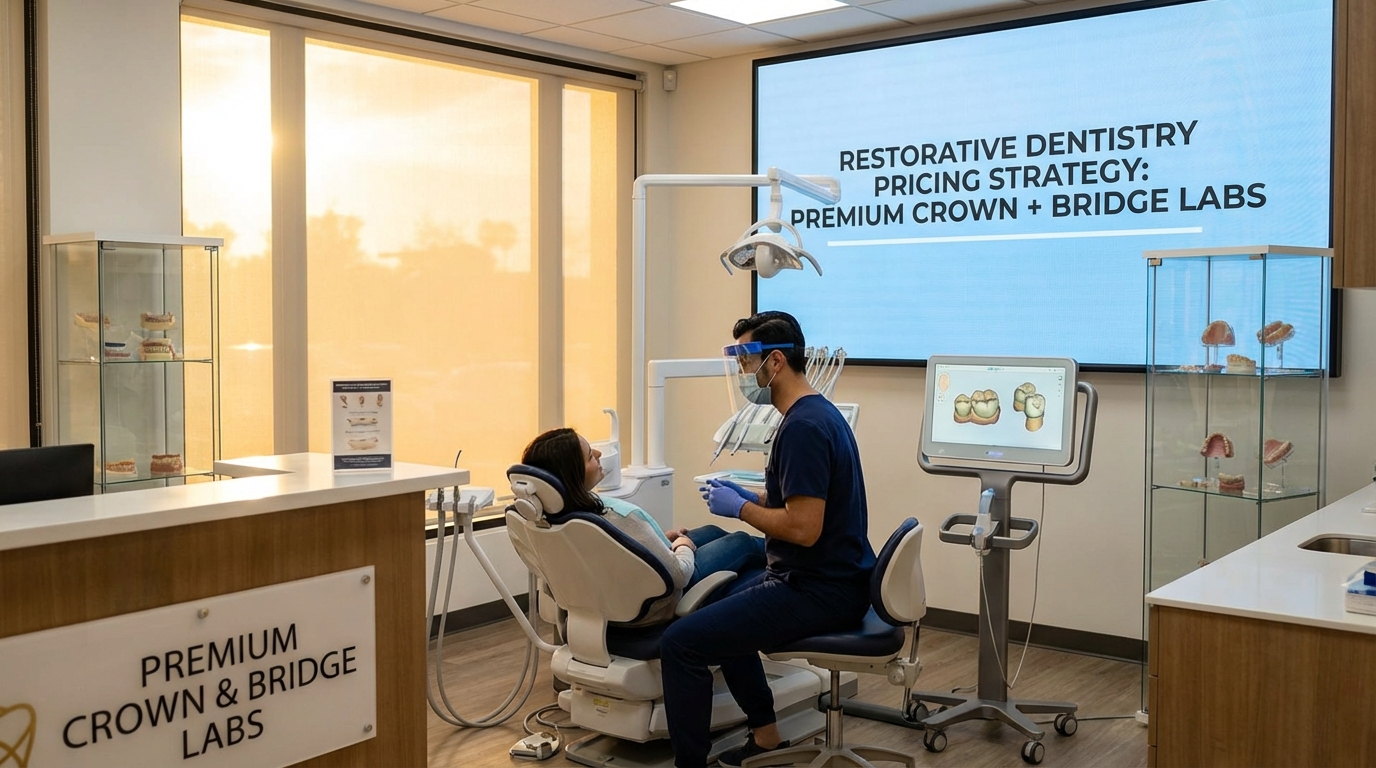
Restorative dentistry is where high-value revenue lives. When you pull a crown or bridge out of a commoditized price book and treat it like a premium service, you protect your profit margin and elevate patient expectations. The problem is that most practices still price crowns and bridges by copying competitors—throwing discounts at complex lab work or letting consult teams guess what the lab will charge.
This post lays out a pricing strategy built around premium crown and bridge labs, structured packages, and revenue operations that prove the investment. Expect internal references (like the dental-practice-pricing-strategy-money-conversation guide) and external data (ADA + Dental Economics research) showing how pricing clarity fuels profits. If you are ready to stop undercutting your lab partners and start using restorative pricing as a lever for funding implants, this is your blueprint.
1. Benchmark Premium Pricing Against Case Complexity, Lab Partner Value, and ROI
The first mistake is pricing restoratives per tooth instead of per outcome. A full-coverage zirconia crown for an aesthetic zone is not the same as a molar crown that hides in the back of the mouth. Tie your prices to the complexity of the case, the lab relationship you have, and the *revenue you unlock when the case converts.
Start with the ADA’s Business Conditions report (https://www.ada.org/resources/research/health-policy-institute/business-conditions) to identify where your market sits on average. Add internal indicators: consult-to-treatment acceptance from the dental-implant-case-acceptance-sales-system and your average case value document. Benchmark your packages against this data so you can answer, “Why is this crown 20% higher than the competitor across town?”—because you deliver premium lab control, tighter delivery windows, and better treatment coordination.
Use a tiered approach: Base, Premium, and Concierge packages. Each tier adds things the patient values (digital shade matching, sedation, custom sintered zirconia, lab callbacks) while the price increases accordingly. When you share these tiers during the consult, you show transparency and respect for patient budget. Internal highlight: tie each tier to the dental-marketing-agency-pricing framework where premium clients pay more because the agency delivers higher ROI. That mental model helps patients understand why your restorative packages have the investment they do.
Externally, Dental Economics consistently reports that premium labs reduce remakes, which equals fewer appointments and lower cost per case (https://www.dentaleconomics.com/practice/article/14180181/how-to-price-restorative-dentistry). When you factor in fewer chair hours and elevated patient satisfaction, the premium price protects rather than penalizes the patient. Document that math on your pricing page so you can refer to it during objections.
Takeaway Checklist
- Use ADA benchmarks + internal consult data to quantify value.
- Tier pricing around lab services and patient outcome value.
- Link each tier to pipeline outcomes so marketing knows which channels to invest in.
2. Build Modular Crown + Bridge Packages to Protect Your Lab Relationships
Premium labs demand volume and predictability. Your pricing strategy should reflect that by bundling crown, bridge, and implant restorative services into modular packages. If you commit to a lab’s concierge service or rush lane, negotiate cost savings and pass the value onto patients through clearly labeled waivers instead of hidden markdowns.
Create a “Restorative Experience Sheet” that outlines: the lab partner, digital workflows (scans, models), turnaround time, and finishing touches such as esthetic characterization or custom shading. This sheet becomes part of the consult, not a back-office note. When patients see the lab story, you reinforce why choosing premium is not a luxury—it’s a guarantee of reliability.
Bundle lab services with maintenance plans or upgrades. For example, offer a 3-year warranty on restorations done through the premium lab tier, included in the price. When you explain that the warranty covers revisions because the lab is on retainer, you reduce price sensitivity. Pair this with internal context from the dental-appointment-setting-service-guide to maintain appointment velocity even for more complex restorative packages.
For financing, offer 12–24 month options that span multiple tiers but keep the lab commitment part of the total package. Patients prefer predictable monthly payments rather than surprise lab invoices later. Finance the concierge tier as “the experience you deserve” while the base tier remains accessible—this flexibility lets you capture premium revenue without losing patients who still value affordability.
Externally, consult the American Association of Cosmetic Dentistry’s look at patient expectations: people are willing to pay more when they feel the treatment is curated (https://aacd.com/aacd-study-on-cosmetic-dentistry-pricing). Use that insight in your marketing language.
Modular Package Strategy
- Document lab partners and benefits for each tier.
- Offer bundled maintenance or warranty language.
- Finance the total package so lab costs never surprise the patient.
- Tie every package back to a metric (conversion rate, no-show rate, or lab remake reduction).
3. Script the Consult + Objection Responses So the Team Defends the Price with Confidence
Restorative pricing rarely collapses because of numbers—it crumbles because of uncertainty. Train your consult team to explain the premium price through scripts, not guesses. Pull inspiration from the practice owner compensation benchmark & profitability audit playbook where every money conversation is data-driven.
Script example: “Our concierge lab partner cuts turnaround time by 30% and guarantees the final shade. That investment protects your smile and our schedule. Here’s what we’ve built into this case...” Notice the focus is on protection and guarantee, not just cost. Use language like “This price reflects our team’s coordination, our lab’s commitment, and the patient’s expectation for precision.” Auditing the script into the CRM ensures consistent language.
When patients object, refer to specific ROI metrics: “Remember, this is not just a crown—it’s a 5-year partnership. Premium labs reduce remakes, which means fewer trips and less chair time. The lab is part of the cost, not an add-on.” Use internal service references like the dental-implant-consultation-conversion-rate resource to show the numbers, which makes the conversation less emotional and more rational.
During training, role-play the following objections: “Why can’t I just use the in-house lab?” “This feels expensive.” “What if my insurance doesn’t cover it?” Equip the team with data: remakes cost $500+, premium labs reduce remake risk by 40% (source: Dental Economics). Document these responses in a living script document and rehearse them weekly.
Training Agenda
- Review the pricing tiers and associated lab commitments.
- Practice the script for each objection using CRM prompts.
- Update the FAQ page (internal) with new lab talking points.
- Score each consult on whether the team highlighted the lab story, explained warranties, and recited financing options.
4. Protect Margin with Dashboards, Analytics, and Lab Scorecards
The final piece of this pricing strategy is systems. Run a monthly restorative pricing dashboard that shows: case count per tier, lab costs per case, consult-to-treatment conversion, and rework dollars. Use your dental-practice-financial-health-dashboard as the template. The dashboard becomes the guardrail that tells you when to raise prices, renegotiate lab agreements, or invest in more training.
Create a lab scorecard that tracks turnaround times, remake rates, and delivery quality. When a lab misses the promised rush window, you have the data to push for rebates or to move cases to a better partner. Conversely, when the lab exceeds expectations, highlight that in your marketing and use the data to justify future price increases.
Tie these dashboards into marketing budgeting. If the premium tier shows a 68% consult-to-treatment rate (source: internal analytics), you can confidently allocate more PPC spend toward advertising that tier. That’s how you link a premium pricing decision to marketing ROI and motivate your team to chase high-value cases.
Externally, the HBR article “How CFOs Can Drive Strategic Decision Making” (https://hbr.org/2019/10/how-cfos-can-drive-strategic-decision-making) reminds us that finance and operations must share one version of the numbers. Your restorative pricing dashboard is that version. When everyone sees the same data, your pricing conversations stay calm and strategic.
Margin-Protecting Metrics
- Price per tier vs. actual lab cost
- Conversion lift from premium tier vs. base tier
- Remake dollars saved per lab partner
- Marketing ROI tied to high-value restorative spend
Q: Should restorative pricing change after we switch labs?
A: Yes—if the lab changes the value you deliver, adjust the price. When you sign a premium lab that offers lower remakes or faster delivery, the investment pays off through fewer chair hours. Document the pricing shift in your dashboard and communicate it to patients as an enhancement (not a surcharge).
Q: How do I explain the premium price to patients using insurance?
A: Focus on the value statement: the premium lab reduces visits, protects aesthetics, and includes a warranty. Offer a financing cadence that spans the total investment so insurance covers part of the cost while the patient handles the rest over time. Always show the bundled package so the patient sees what they are receiving—not just what they are paying.
Q: Can we still offer discounts if we prioritize premium labs?
A: Discounts should be rare. Instead of reducing the price, add value (e.g., free whitening, complimentary night guard). When you discount a premium lab case, you train patients to expect lower quality. Preserve margin by packaging in services or offering financing incentives tied to the tier you actually want to sell.
Q: What if the premium tier is slowing down consults?
A: Review your analytics. If the conversion gap between base and premium is wide, audit the scripts and talk tracks. Maybe the team is pushing premium too early or not explaining the lab benefit. Use CRM prompts to remind them to speak to the warranty and lab timeline.
Q: How often should we revisit pricing tiers?
A: Quarterly. Align the review with your profitability audit so you only adjust pricing when lab costs, consult data, or insurance trends actually change. Quarterly reviews keep you responsive without causing sticker shock.
Q: Do these pricing principles apply to implant restorations?
A: Absolutely. Implant crowns and bridges already command premium dollars—your goal is to formalize that premium with packaged lab experiences, scripts, and dashboards. Implant restorative pricing should live in the same tiered structure you use for crowns and bridges.
Call-to-Action
Ready to lock in restorative pricing that funds premium labs, keeps case acceptance high, and aligns your practice with financial clarity? Book a free strategy call so we can audit your restorative pricing, scripting, and dashboards. Or book a free website audit to make sure your service pages, CTAs, and internal links match the premium experience you’re building.