Meta description: Keep implant financing approvals on autopilot so high-value dental practices close more $18K+ cases, stay compliant, and scale without adding staff. TL;DR: Top-of-funnel traffic only becomes revenue when financing moves from manual chaos to a coordinated command center. This playbook explains why delaying financing conversations kills consult momentum, how to wire automation and dashboards together, how to keep every message compliance-safe, and exactly which metrics prove the lift so you can justify the tools.
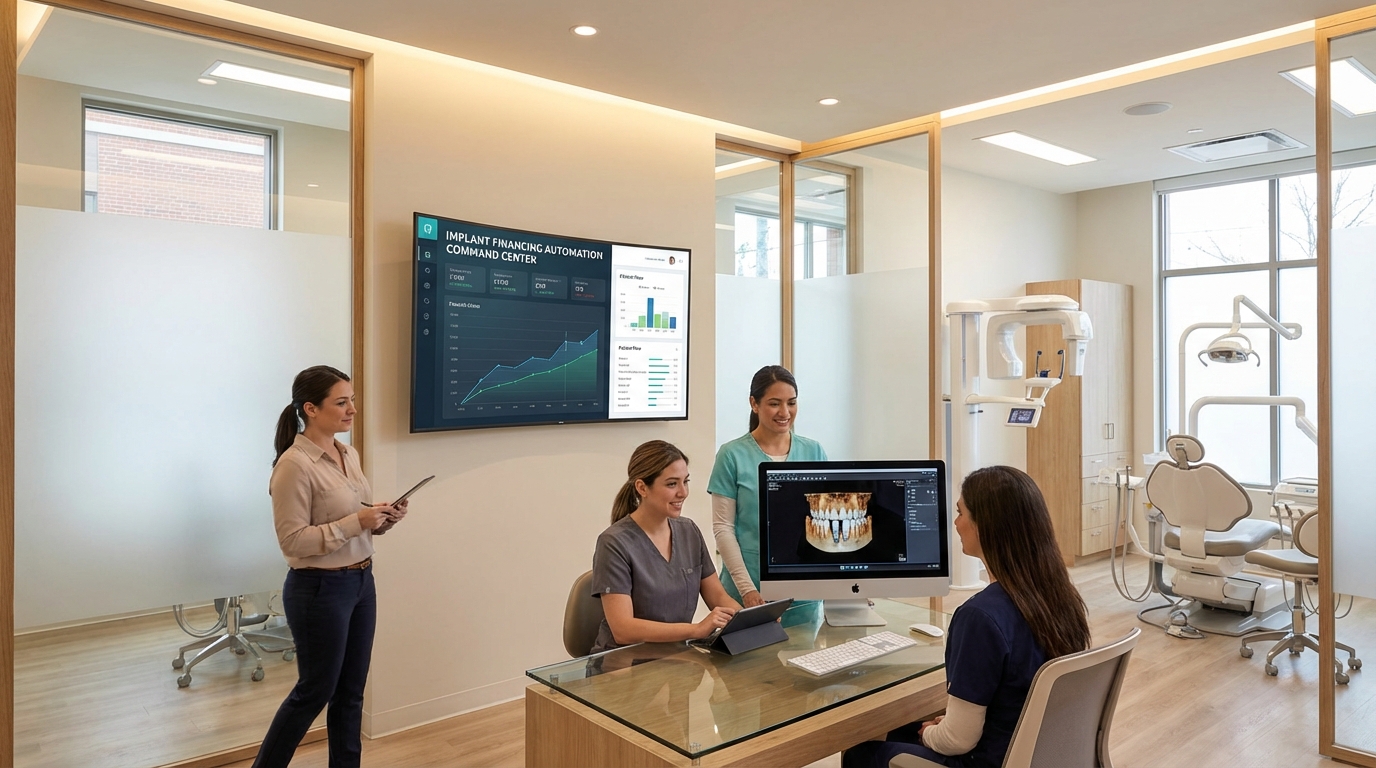
Implant Financing Automation Command Center for High-Value Dental Practices
By KamImplants1,777 words9 min read
Intro: Why financing is the choke point in every implant machine
Implant consults are one of the most expensive assets your practice buys. You spend ad dollars, SEO effort, referral energy, and team hours just to get patients into your consult chair. The mistake most practices make is assuming the cash register opens once the consult is over. In reality, consult-to-treatment flow is choked at financing. Without an automation command center that routes approvals, disclosures, and follow-up in real time, the patient hears crickets between the consult and the financing agreement, and the deal cools.
Marketing partners like the ones described on the dental SEO services page can fill the top of the funnel with high-quality leads, but that effort is wasted unless you also own the financing lane. Building a financing automation command center ensures every lead that comes from paid search, organic content, or referrals has a predictable handoff into treatment financing so monthly revenue targets are stable.

Why financing hiccups cost more than consultations
Most implant inquiries need multiple confirmations, a financing estimate, and either a soft approval or a suggestion for an alternative solution before the patient feels ready. If your front desk is still printing PDFs, sending them manually, and waiting for the patient to reply, you have a fragile process that loses patients when life gets busy. You may win the consult, but the case stalls while the patient waits for a coordinator call, a lender approval, or a second opinion from a spouse. In the meantime, your calendar fills with the next wave of leads that expect instant momentum.
High-value practices treat financing as part of the conversion funnel, not an afterthought. That means every financing asset — from pre-approvals to payment plan summaries — is automated, traced, and linked to your cases. Automation should send a personalized financing guide the second the consult is marked "qualified" in your CRM instead of waiting for a coordinator to remember. The minute your automation queue knows a lead clicked "book" on a strategy call and selected a $350/month plan, it should trigger three actions: email the offer, update the financing record, and remind the coordinator to follow up within two hours. If that reminder includes the patient’s preferred communication channel (SMS or email), the patient feels attended, and conversion probability jumps.
The command center mentality is the antidote to ad-hoc financing workflows. It brings discipline, speed, and visibility to the touchpoints that actually close consults.

Designing the command center: dashboards, triggers, and accountability
Treat your financing automation like a control room. Start by defining the stages that matter to you: Lead captured, Consult confirmed, Financing packet delivered, Pre-authorization received, and Case accepted. Each stage should have dedicated automation triggers that fire immediately and record timestamps for measurement.
For example, when a patient books a strategy call for a high-value treatment and indicates a preferred payment method, your CRM should:
- Tag the lead with "Financing Required" so your dashboard shows pipeline volume in real time.
- Auto-send a financing guide that outlines options, disclosures, and an estimated monthly payment for the investment level they indicated.
- Notify the implant coordinator with all case context, including the patient’s financing preference, estimated case value, and notes from the strategy call.
- Schedule an automated follow-up (SMS or email) that lands 24–48 hours after the consult if the financing approval isn’t logged yet.
These triggers ensure the right person acts, the right information is in the shared workspace, and the lead never falls through the cracks. Use a dashboard view that pulls from your CRM, practice management software, and financing partners so you can see how many consults are waiting on approvals, which lenders are pending, and who is owning each case. If your practice already relies on a command center for content and lead flow, this financing view integrates naturally; if not, build it alongside your revenue ops work with a team that can deliver quick wins and documentation.
Linking this command center to your strategy call process keeps everyone accountable. We walk clients through the same workflow on the strategy call high-value dental cases page, and the reason it works is because financing becomes a measurable stage on the same revenue map as marketing and consult preparation.
Compliance-safe messaging that still feels human
Financing conversations are sensitive, and automation can’t sound like a robo-pitch. You also have compliance obligations around disclosures, truth-in-lending, and FAIR lending rules. That’s why every automation sequence must be vetted by your compliance team, criminal defense, or legal counsel before it goes live, and why templates should include the exact playback of financing numbers, approval ranges, and the patient’s right to cancel.
A typical financing automation sequence includes:
- Trigger #1: Immediately after the consult is marked "financing needed," send a personalized email with a short paragraph about why your practice recommends implants, a PayPlan breakdown, and a short video explaining the financing options. Embed the ADA’s guidance for financing best practices (https://www.ada.org/resources/practice/practice-management/financing-patients) to build credibility and verify that the sequence complies with accepted language.
- Trigger #2: If no action occurs within 24 hours, the automation sends a friendly SMS that mentions the name of the financing plan and a link to upload documents (for example, proof of income or ID). Keep the tone conversational: “Hey Sarah, just checking in on your implant approval. I’m here to help with any questions.”
- Trigger #3: Once a lender pre-approval is logged, automatically email the treatment coordinator and the patient a confirmation that outlines the payment schedule and includes the same disclosures discussed during the consult. This keeps both sides aligned and preserves the audit trail.
- Trigger #4: If the patient doesn’t sign within 72 hours, a final message recaps the investment and offers to schedule a short clerical review call. Frame it as partnership, not pressure. A citation from a respected publication such as the Harvard Business Review piece on consultative conversations (https://hbr.org/2022/03/the-value-of-a-sales-conversation) reinforces that your goal is to co-create a plan rather than sell something.
Automation does not replace the human touch; it sets the guardrails so that when a coordinator or dentist calls, they already know where the patient stands. Combine the data, automation, and human follow-up so every financing conversation feels proactive, timely, and confident.
Proving ROI with metrics, dashboards, and revenue forecasts
A command center without measurable output is just noise. Feed your automation data into a dashboard that tracks these KPIs: consults waiting on financing, average time from consult to financing approval, drop-off reasons (declined, ghosted, decided on other provider), and revenue per consult after automation. These metrics make it obvious whether the command center is working and where to invest next.
Set a baseline before automation: what percentage of implant consults close with financing within seven days? After automation, compare the new rate and highlight the revenue impact with simple math. For instance, improving the conversion from 38% to 52% on $18K implants with 30 consults per month adds $85,000 in treatment revenue every 30 days.
Pair that internal proof with the performance lift that your marketing team delivers. When you can say, “Our dental SEO services drive 150 leads per quarter, and the financing command center closes 14 more consults than the old process,” you tie automation to dollars, not just efficiency. Share this in weekly revenue huddles, and keep the dashboard accessible to leadership so nobody doubts the investment.
Set a recurring review cadence to celebrate wins (for example, “financing approvals up 27% month over month”) and to identify bottlenecks (“six consults are stuck because lender X hasn’t responded”). Use those insights to refine automation sequences, add new triggers, or retrain coordinators. The command center becomes a living system that evolves with your revenue goals.
Summary & next steps
Connect financing, marketing, consults, and revenue through a dedicated automation command center. Identify the key stages that matter to your practice, build triggers that keep compliance intact, and monitor KPIs so you can prove the lift every month.
Next Step: Book a free strategy call (https://www.closingmorecases.com/contact-us) so our team can audit your current financing workflow, template the command center, and hand off the automations that keep consults moving.
CTA: Book a free strategy call (https://www.closingmorecases.com/contact-us) and we will show you how to keep financing from derailing $18K+ cases.
Q: How fast can we launch an automation command center for implant financing?
A: Most practices can launch the first wave within 7–10 business days. That timeline assumes you already have pricing, lender partners, and intake templates documented. If any of those are missing, we use the first sprint to capture them and still ship automation in 3 weeks.
Q: Do automated messages feel robotic to patients?
A: Not if you personalize them. Use merge fields for the patient’s name, financing tier, and case value, and keep the tone conversational—"We’re here to walk you through every step." Automations handle the logistics; your coordinators handle the human context.
Q: Which KPIs prove the automation is working?
A: Track consult-to-financing approval velocity, financing approval rate, and the incremental revenue generated by cases that close because automation nudged them. You can also measure time saved per coordinator to show the operational value.
Q: Can we integrate this command center with our existing CRM or practice management software?
A: Yes. Most systems like Lighthouse, Eaglesoft, Dentrix, or HubSpot expose APIs or webhook capabilities. Use automation tools like Zapier, Klaviyo, or custom webhooks to trigger sequences when a consult moves stages.
Q: What happens if a patient needs a bridge loan or private money?
A: Build conditional logic in the automation that routes those leads to a specialized financing packet. If a patient selects “bridge financing” on the intake form, the sequence should instantly send a bridge-specific guide and schedule a call with a financing specialist.
Q: What is the impact on revenue?
A: Practices that move from 35% to 55% consult-to-case acceptance with $18K implants are adding roughly $72,000 in monthly revenue per location. Even a 5% lift on that case value is enough to justify the tools and staff time.
Frequently Asked Questions
Ready to Close More Cases?
Book a free strategy call and see how we help dental practices add 40+ new patients in 90 days.
Book Your Free Strategy CallRelated Articles
Implants4 min read
Atlanta Dental Implant Cost vs. Value Breakdown
Atlanta Dental Implant Cost vs. Value Breakdown
Implants9 min read
Augusta, GA Dental Implant Consult Nurture Sequence: Turn Leads Into Booked Patients
Augusta, GA Dental Implant Consult Nurture Sequence: Turn Leads Into Booked Patients
Implants6 min read
Austin Dental Implant Marketing Agency Playbook: Fill 60 Surgical Seats in 90 Days
Austin Dental Implant Marketing Agency Playbook: Fill 60 Surgical Seats in 90 Days