Consults for implants, full-mouth reconstructions, and comprehensive smile makeovers represent the biggest revenue opportunity every dental practice already has, yet too many slip because trust-building pauses while someone waits for a staff member to remember the next outreach. The automation systems that win in 2026 do not treat those consults as calendar events—they treat them as trust journeys with measurable checkpoints. This post shows how to map the journey, automate thoughtful education, translate patient behavior into staff action, and measure the revenue lift so your team never loses a high-intent patient again.
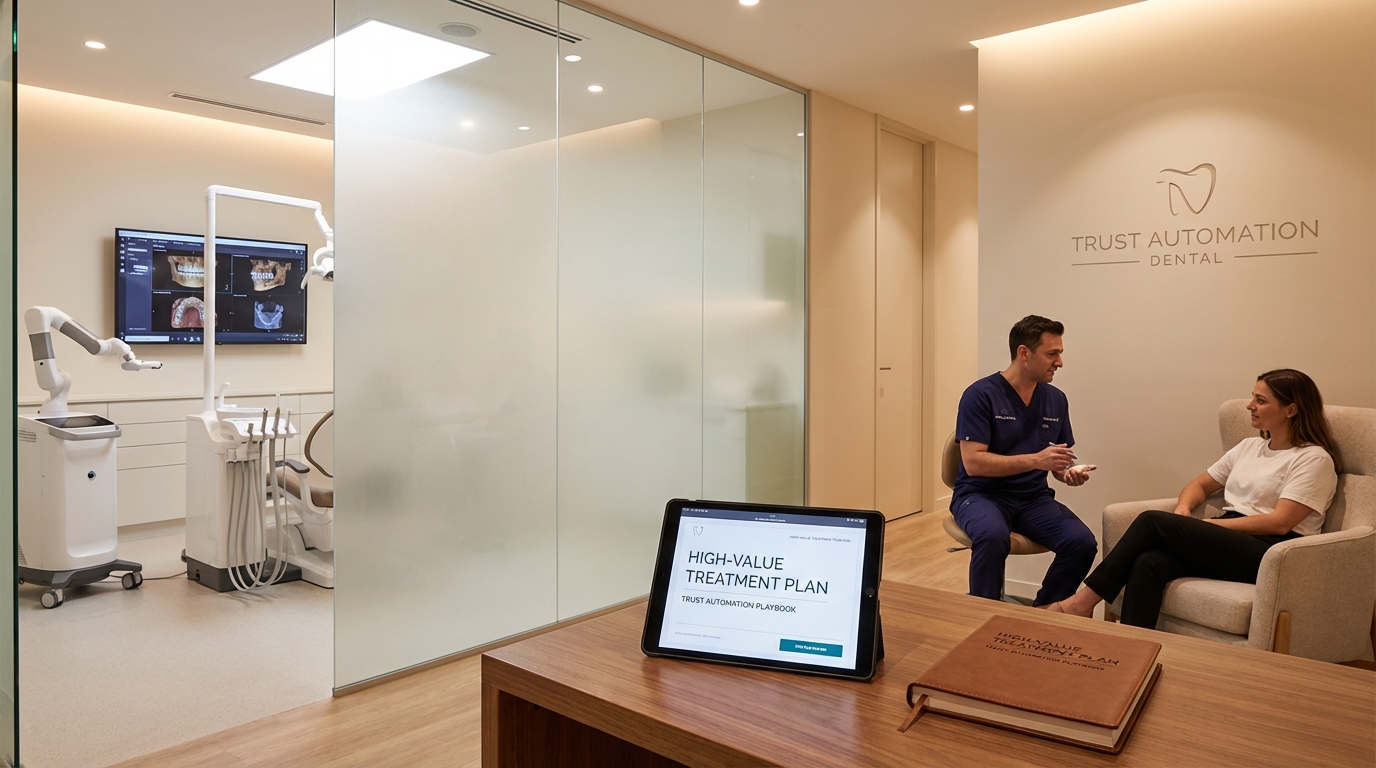
High-Value Treatment Plan Trust Automation Playbook
By KamGeneral1,379 words7 min read
Map Trust Signals Across the High-Value Treatment Plan Journey
A signed treatment plan requires more than a PDF and a price. It requires trust, clarity, and timing. Start by mapping the journey from the moment a high-intent lead books a consult through every education touchpoint, financing conversation, and scheduling milestone. Feed every consult into the same tracker you use for your Closing More Cases dental marketing agency work so marketing, intake, and clinical teams see the same story.
Label each milestone with the trust signal it carries: a financing quote is a credibility trigger, a sedation option conversation is a comfort signal, a smile gallery is an aspiration anchor. Once the signal map is complete, assign automation actions—an education email when the patient opens the treatment plan, a text reminder the night before the financing consult, an alert when imaging is complete. This system prevents the “waiting for someone to remember” gap and makes clear who owns the next step.
Because trust is built with information, mirror every automation with relevant expertise. If your SEO team is already driving traffic through a dental SEO services pillar, repurpose that content into the follow-up sequences so prospective patients see consistent language and social proof. The automation should feel like a continuation of the same promises that converted them to the consult in the first place.

Educate and Reassure Across Channels Without Adding Staff
Patients at this stage are balancing the fear of a big commitment with the desire for transformation. They need reassurance, not more manual chasing. Build automated education sequences that push the right pieces of content across text, email, and patient portal without requiring new hires. Use data to decide the timing: send a concise explainer video link 24 hours after the consult, a financing checklist on day three, and a testimonial spotlight on day five.
Sequence the channels so each strengthens the other instead of repeating the same message. For example, follow an email that outlines the surgical steps with a text that simply says, “We have a short video that walks you through what to expect. Want me to send it?” The ADA patient communication resources confirm that consistent, patient-centered language reduces decision anxiety—a principle that your automation should mirror.
Give each automation block a measurable goal: open rate, link click, or response to a question. If one channel underperforms, experiment with a different format (a short audio note, a quick FAQ reply, a surgeon’s note). The goal is not to bombard—they’re busy people—but to reinforce trust through gentle, consistent nudges. Keep the sequences modular so you can swap in new content as you gather testimonials, financing updates, or sedation success stories.

Turn Engagement Signals Into Coordinated Staff Alerts
Automations should always feed humans, not replace them. When a patient reopens the treatment plan, clicks the financing calculator three times, or books a second consult, those are trust signals worth escalating. Capture those events inside your automation platform and translate them into alerts for the implant coordinator, financial counselor, or surgeon scheduler.
Pair the alerts with context so the recipient immediately knows whether to call, text, or prep a financing approval. For example, if a patient views the treatment plan after hours, send the coordinator a daily digest with the patient’s name, the treatment type, and the best channel to reach them. If the patient sends a quick reply after a text, let automation cue a thank-you note and schedule a handoff call the next morning.
The Harvard Business Review reports that tying micro-actions to accountability keeps digital experiments from stalling. Train the team to honor automation escalations within a fixed window—say 30 minutes for financing cues, 60 minutes for scheduling nudges. If the assigned owner misses the window, escalate the alert to a supervisor or add a backup action. This turns automation into a staff multiplier, not a liability.
Measure Automation ROI and Report to Leadership
Automation ownership earns budget when it shows revenue. Connect your trust-automation command center to the same KPIs you review in your weekly leadership huddle: consult volume, consult-to-sign ratio, average treatment value, and the length of the consult-to-sign cycle. Report the automation coverage (percent of high-value plans receiving the full trust sequence) alongside the outcomes so every stakeholder sees the financial impact.
Use those dashboards to highlight experiments. Did adding a testimonial video to the day-two sequence lift conversions by 4%? Did a financing checklist text reduce bookings waiting for approval? McKinsey underscores that digital investments win when teams commit to both leading and lagging indicators. Share the wins, the tweaks, and the next hypothesis so automation keeps improving instead of plateauing.
Translate the data into story-backed wins. For example: “Automation increased the number of signed full-arch cases by two per month while reducing the financing follow-up cycle by nine days.” Connect those wins to real revenue, then loop in the team during your mission-control meeting so everyone sees that automation is not a gadget—it is a repeatable revenue lever.
Summary & Next Steps
Trust-building automation keeps high-value treatment plans within reach. Start by mapping every trust signal, automate multi-channel education, translate engagement into coordinated alerts, and measure the revenue lift so every consult becomes a predictable result. Book a free strategy call or Book a free website audit to map this playbook to your practice today.
Book a free strategy call: https://www.closingmorecases.com/contact-us
Q: Can I run this playbook without hiring more staff? A: Yes. The automation leverages existing coordinators, the front desk, and your marketing content—automation simply cues the right person at the right time so the team keeps the promise without needing more heads.
Q: How do I make automation feel personal instead of robotic? A: Use patient names, reference their specific treatment plan, and include a human handoff. For example, send an automated text that ends with “Dr. Lee asked me to follow up—reply here if you have questions and I’ll call back within the hour.” That keeps the tone warm while still being automated.
Q: What metrics prove the automation is working? A: Track consult-to-sign cycle time, automation coverage (how many high-value plans hit every step), and acceptance lift. If revenue climbs while the cycle shortens, you have proof. Also monitor engagement metrics like link clicks or portal opens to understand which trust signals are resonating.
Q: What if the automation alert goes unanswered? A: Build redundancy: escalate the alert to a supervisor if it sits for too long, or trigger a backup text that reminds the same patient. Document these SOPs inside your dashboard so every team member knows their role when an alert fires.
Q: Which channels should I automate first? A: Start with the channels your audience already uses—if they booked through text, automate texts plus one other channel (email or portal) in the first 48 hours. Expand to calls or financing chats only after the patient responds to the initial outreach.
Q: How do I keep the automation fresh? A: Regularly swap in new testimonials, financing updates, and surgeon quotes. Review the automation metrics weekly and replace the weakest-performing blocks. This keeps the content relevant and demonstrates continuous improvement without reinventing the entire flow.
Frequently Asked Questions
Ready to Close More Cases?
Book a free strategy call and see how we help dental practices add 40+ new patients in 90 days.
Book Your Free Strategy CallRelated Articles

General6 min read
Asheville Dental Marketing Agency Playbook for High-Value Case Growth
Asheville Dental Marketing Agency Playbook for High-Value Case Growth
General7 min read
Atlanta Dental Marketing Agency Pricing: What It Takes to Buy Consistent Implant Cases
Atlanta Dental Marketing Agency Pricing: What It Takes to Buy Consistent Implant Cases
General6 min read
Back-to-School Revenue Reset for Dental Practices
Reset your practice for the back-to-school rush with scheduling, messaging, and financing systems that turn seasonal slumps into predictable consults.