High-value treatment plans, especially implants and full-mouth rehabilitations, fail for one reason: the team treats them like every other consult. Without a dedicated control room that spots leaks, the marketing investment, financing education, and operations coaching run in parallel but never meet. The result is a $45,000 case that never leaves "pending" on the dashboard. Building a treatment plan control room takes discipline—it needs the right KPIs, reliable automation, and the courage to habitually act when the numbers shift. This post walks through what a control room looks like, how to automate it without hiring more staff, and how to embed data into the rhythm of your huddles.
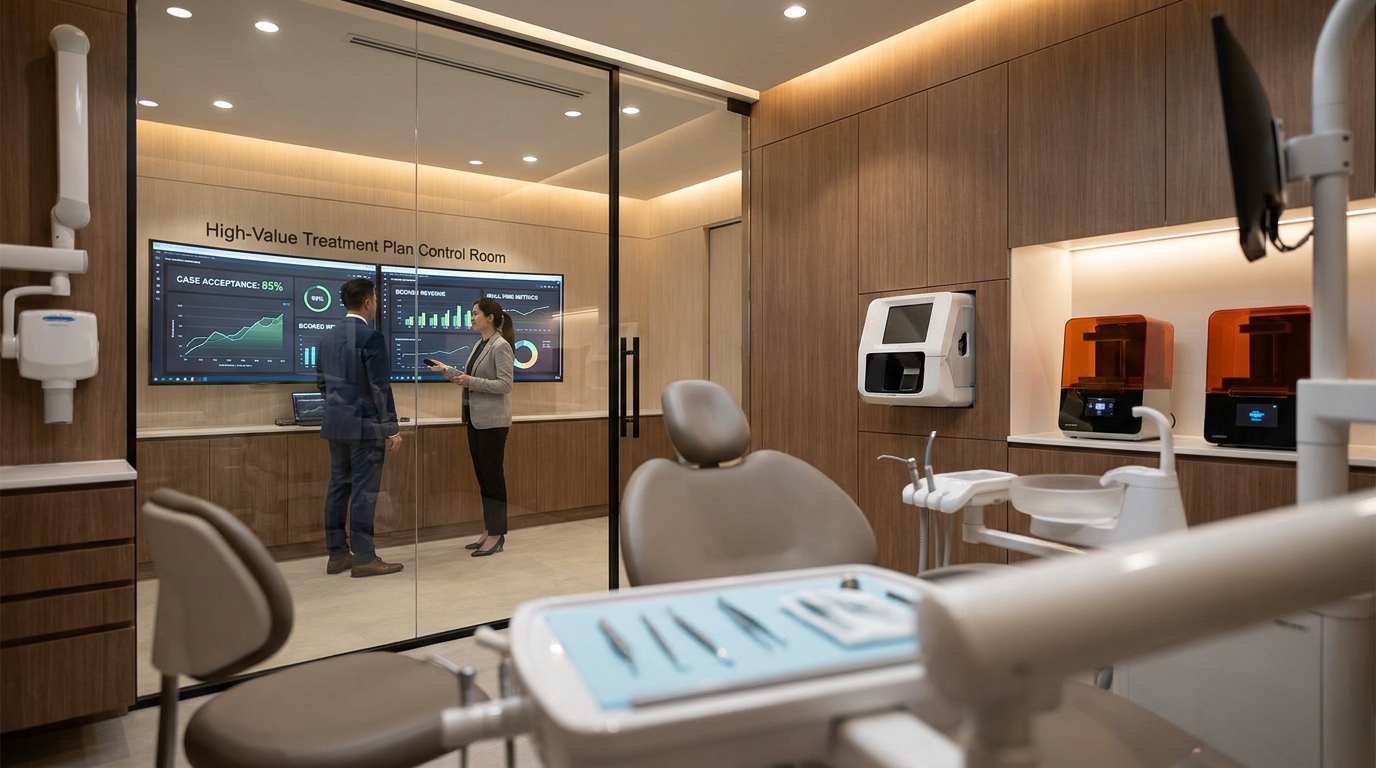
High-Value Treatment Plan Control Room: Real-Time Metrics That Turn Consults Into Booked Cases
By KamGeneral1,819 words9 min read
Why a treatment plan control room wins over ad-hoc hope
High-value cases can’t be treated like impulse dentistry. If your metrics live in separate spreadsheets—marketing campaign ROI here, CRM win-rate there—you lose sight of the net production impact of every consult, financing approval, and referral. A treatment plan control room ties those silos together in one place, giving leadership a single-source view that mirrors what Closing More Cases uses in our high-value treatment plan automation playbook.
Think of the control room as your revenue cockpit. Each thumbnail on the screen is a live signal: how many leads hit your inbox, how many were routed to coordinators within 90 seconds, how many consults showed, how many treatment plans were presented, and how many patients said yes to financing. When one signal dips, the control room flags it, your team drills down, and the next decision is either a remediation step (call the patient, offer a financing refresh) or a systems tweak (adjust Google Ads messaging, add a proof video to the landing page). The faster you can spot that dip, the quicker you prevent a finished case from falling into the backlog.
High-value control rooms are also accountability machines. They pair the daily grind of patient work with a weekly review of engineered KPIs. If your leadership team can’t tell within 72 hours why a case is still pending, you no longer have a sales problem—you have a visibility problem. This same visibility is what practices buying Closing More Cases’ dental marketing agency rely on to prove the agency’s ROI before calling it a retainer.
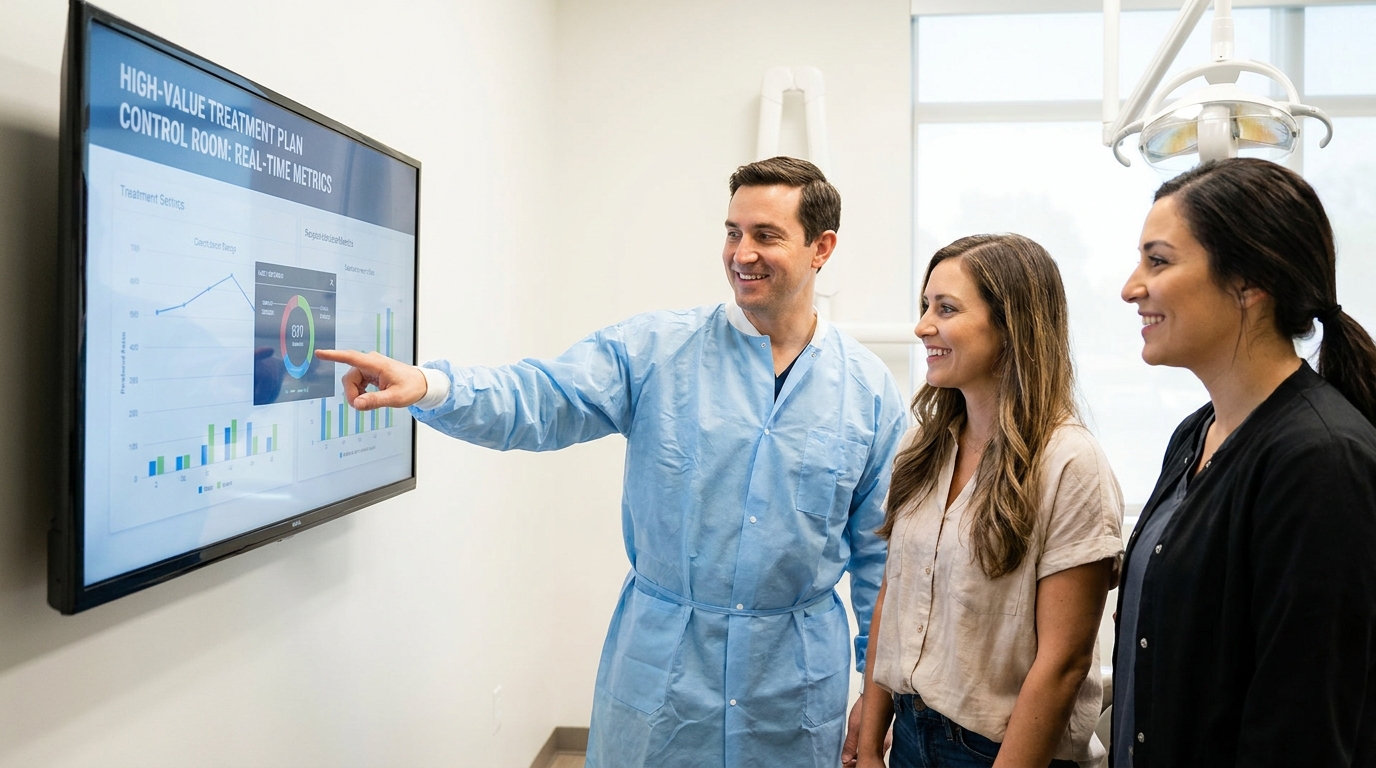
The KPI stack every treatment plan control room must monitor
A control room feels overwhelming until you agree on the right stack. Here’s the five-signal stack we track for every high-value treatment plan:
-
Speed-to-lead response time (≤90 seconds) – leads that see an immediate answer stay in the funnel. According to HubSpot research, leads contacted within 5 minutes are 21× more likely to become booked appointments, and the control room keeps watch on that 90-second line with call tracking and chat automation.
-
Consult show rate (≥82%) – your marketing can be perfect, but if patients skip consults, the pipeline collapses. Log every no-show, assign the reason, and feed retention data back to marketing so creatives can be tweaked (more financing proof, more team confidence, etc.).
-
Treatment plan acceptance (≥62% for implants/cosmetic) – this is where financing education, social proof, and dedicated concierge conversations converge. Track how often plan proposals stay in "pending" longer than 7 days and why. A patient hesitant on price might actually be missing the financing narrative—it’s your job to present the monthly investment vs. the cost of waiting.
-
Financing approval velocity (≤3 days) – finance approvals slow everything. Build an automation that hands off the application to your in-house coordinator plus a third-party concierge and log the timestamp. The control room jokes that "finance is always late," but the data never lies: if approvals slip past day three, flag the sequence for extra reminders.
-
Referral partner follow-up – not every high-value consult comes from paid ads. Track the number of referrals triggered by case studies, physician partners, or YouTube testimonials. When that signal dips, your content team can refresh the referral share kit.
Together, those five KPIs become the north star. Line graphs reveal whether marketing is delivering qualified leads, operations are booking consults, and finance is closing treatment plans. Pass/fail thresholds keep the team honest, and each metric deserves a owner. If speed-to-lead slips, the AI appointment center (or call center) owns it. If acceptance wobbles, the treatment coordinator owns the coaching.
Automating the control room without adding headcount
You don’t need a new hire to stand up this dashboard. Instead, stitch together the tech that already sits inside your stack: your CRM, call tracking, financing portals, review platform, and calendar.
Use automation to keep the control room honest. Every new lead triggers a CRM workflow that: (a) assigns a coordinator, (b) fires a 90-second response action (AI chat, text, or call), and (c) logs the lead source plus speed-to-lead. When the lead books a consult, your CRM ties the appointment to the campaign, so the control room can say "this Google Ads keyword delivered 6 consults last week." If the consult results in a treatment plan, a status update flows to the control room via API—no manual spreadsheet needed.
Financing automation deserves special mention. Rather than carbon-copying Google Forms, integrate your third-party lender or in-house calculator with the patient portal. A new application triggers a workflow: send financing docs, link to a testimonial video, and notify the coordinator if the paperwork stalls. The ADA’s Health Policy Institute shows elective treatments remain a top driver of dental revenue, which means your financing pipeline has to be faster than the typical 3–5 day turnaround. The control room watches the "financing approval" timeline live, and you can board the aggressiveness level (two reminders, a concierge call, or a live financing walkthrough) based on each patient’s risk signal.
To keep adoption high, visualize the stack for the team. Use targeted dashboards inside your CRM or a lightweight BI layer to surface the KPIs that matter. When a new implant consult hits the pipeline, the dashboard should highlight its status, the salesperson responsible, the financing timeline, and whether referrals contributed. That way, every person knows what metric they own. If the same patient is also a referral from a surgeon partner, the referral signal gets credit instead of being lost in a generic "other" bucket.
Coaching loops that keep the numbers moving
No dashboard survives without the humans who read it. Schedule a weekly rhythm around the control room. We recommend a 25-minute "weekly reboot" where the leadership team reviews the five KPIs, pinpoints the biggest leak, and runs a single experiment to fix it.
One week, speed-to-lead might be the problem. The experiment: assign an AI appointment center plus live transfer from 8 a.m.–6 p.m. and measure show rate improvement. The following week, focus on treatment plan acceptance, using a new financing video or patient story to soften objections. Run experiments in two-week cycles so the team isn’t chasing every jitter. Each outcome feeds back into the control room; the dashboard becomes a scoreboard for what actually moved the needle.
Make coaching actionable. When the financing approval timeline drifts, call a 15-minute "approval huddle" with the coordinator, controller, and marketing lead. Pull up the patient’s timeline, brainstorm exactly where the process worsened, and commit to the next outreach (e.g., send a proof-of-life testimonial, schedule a short call). Capture the fix in the control room notes so it becomes repeatable for the next case.
Stop letting silence be the signal. If a treatment plan stays pending for 11 days, the control room should send an automated nudge to the coordinator and marketer, and the weekly huddle should ask "why is this still here?" When leadership sees the same names associated with delays, it’s easier to coach the responsible teammates instead of blaming the market.
Summary + Next steps
High-value treatment plans deserve a control room that links every consult to the marketing touchpoint, the financing conversation, and the operations follow-up. Start by locking in the five KPIs above, then automate the feeds so your CRM streaming the data becomes the engine of accountability. Finally, wrap a coaching cadence around the control room so your team moves from reaction to intention.
If you want a model to copy, pair this control room with Closing More Cases’ automation playbook and marketing services so you can forecast exactly how the next $25K case flows from ad spend to finishing plan acceptance. Book a free strategy call (https://www.closingmorecases.com/contact-us) to map your current scoreboard and decide what to tune next.
Frequently Asked Questions
What is the single most important metric in a treatment plan control room?
Speed-to-lead matters most because delays compound across every downstream metric. A slow response not only kills show rates but also resets the patient’s value perception before financing is even discussed.
How do I automate financing approvals without losing the personal touch?
Link the financing application to your CRM and auto-notify the coordinator plus finance partner when the patient completes the form. Send a humanized text or short video along with the confirmation to reinforce that a real team member is watching the case.
How often should I review the control room dashboard?
Teams should glance at it daily to catch critical drops and dig deeper once a week during a 25-minute reboot meeting. That keeps the attention on trends without letting the data overwhelm daily operations.
What if my marketing campaigns are driving leads but the control room still shows low acceptance?
Look for the "treatment plan acceptance" signal falling faster than the show rate. That usually means financing education, closing scripts, or social proof need reinforcement. Use the control room notes to test a new video, a financing recalculation, or a coordinator walk-through.
Do you need special tools to build a control room?
No. Most CRMs (Salesforce, HubSpot, Dubsado) already have dashboards. Use automation to feed them: call tracking, financing portals, referral forms, and any supporting review platforms. The investment is in discipline, not software.
How does the control room tie into our marketing retainer?
When you can show how each marketing dollar flows through the control room into a booked $45K case, you stop guessing whether the agency is worth it. That’s why we align our own retainers with these same KPIs—everything is accountable before we sign the next month.
Frequently Asked Questions
Ready to Close More Cases?
Book a free strategy call and see how we help dental practices add 40+ new patients in 90 days.
Book Your Free Strategy CallRelated Articles
General6 min read
Asheville Dental Marketing Agency Playbook for High-Value Case Growth
Asheville Dental Marketing Agency Playbook for High-Value Case Growth
General7 min read
Atlanta Dental Marketing Agency Pricing: What It Takes to Buy Consistent Implant Cases
Atlanta Dental Marketing Agency Pricing: What It Takes to Buy Consistent Implant Cases
General6 min read
Back-to-School Revenue Reset for Dental Practices
Reset your practice for the back-to-school rush with scheduling, messaging, and financing systems that turn seasonal slumps into predictable consults.