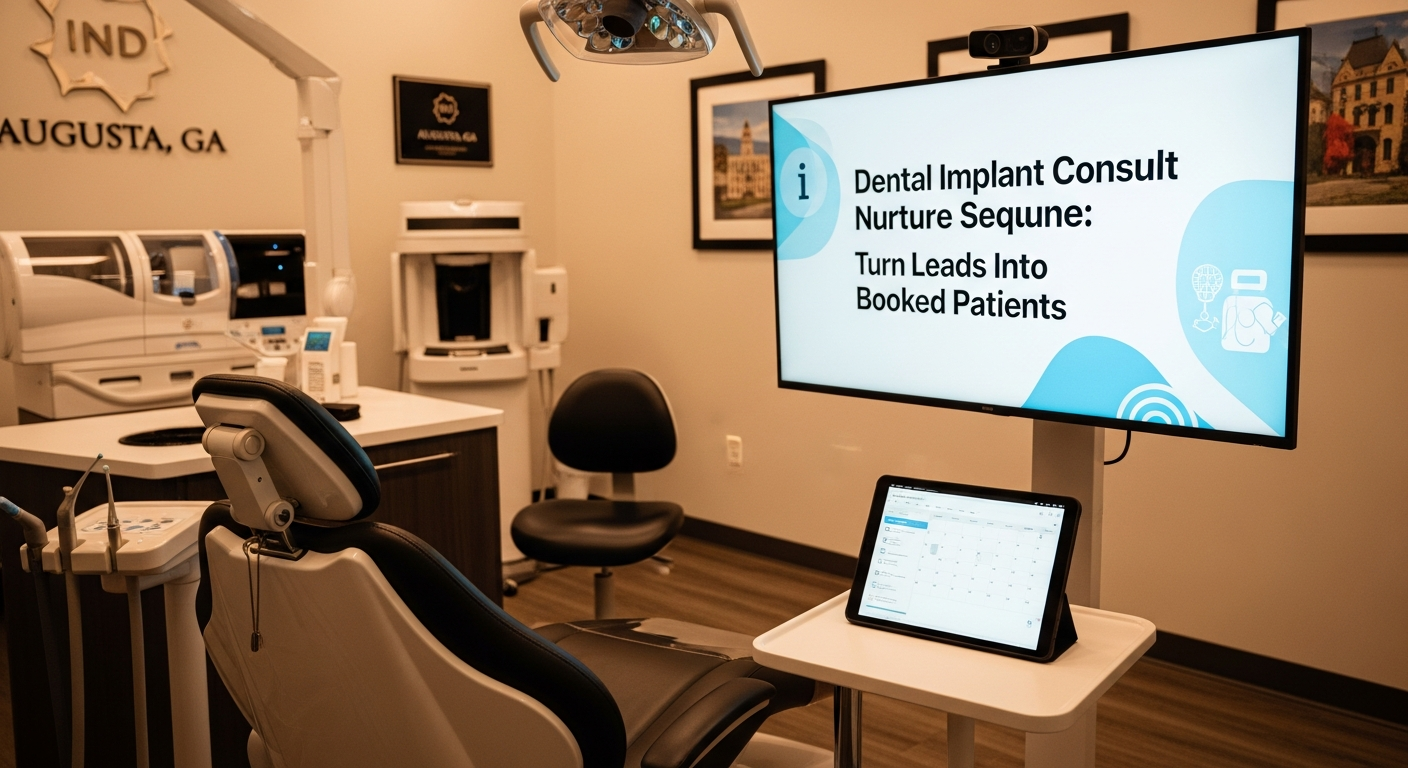
Dental Implant Marketing Starts With Patient Intent
Most implant patients are not casually browsing. They are trying to solve a real problem: missing teeth, failing dentures, painful chewing, embarrassment, or fear that their mouth is getting worse. The marketing has to meet that intent directly.
A good implant campaign separates patients into three groups. The first group is problem-aware: they know they need help but are not sure whether implants are right for them. The second group is solution-aware: they are comparing implants, dentures, bridges, and All-on-4. The third group is provider-aware: they are choosing which practice to trust.
Bottom-of-funnel content should be written for the second and third groups. These patients are asking questions about price, candidacy, risk, alternatives, longevity, and provider experience. They do not need another generic explanation of what an implant is. They need to know what happens next, what it costs, whether they qualify, and why your practice is a smart place to start.
That is why the best implant marketing assets usually include:
- A dedicated implant consult page with clear next steps.
- Financing and payment-plan language that does not feel evasive.
- Before-and-after proof where appropriate and compliant.
- Specific answers to candidacy, anxiety, timeline, and risk questions.
- Fast follow-up that moves the patient into a consult before they drift.
Google also evaluates healthcare content through a trust lens, so your implant pages should demonstrate real expertise, accurate claims, and useful information. Google's own guidance on creating helpful, reliable, people-first content is a useful standard: answer the real question better than the page above you.
Are Dental Implants Becoming Less Popular?
No. The demand for implants is still strong because the underlying patient problems are not going away. Patients want stable chewing, better confidence, fewer denture issues, and long-term tooth replacement. What has changed is the competition around implant marketing.
More practices, DSOs, specialists, and national brands are competing for the same high-value patient. That makes the patient journey noisier. A patient may see a corporate implant ad, a local periodontist, a general dentist, a financing offer, a YouTube video, and five map listings before they decide who to call.
For an independent practice, this means the message has to be sharper. "Dental implants near me" is not enough. Your page needs to answer why your consult is worth booking now. Your ads need to filter for real candidates. Your follow-up has to be fast enough to catch people while the problem is still urgent.
The shift is not from implants to no implants. It is from vague implant marketing to proof-based implant marketing. Practices that explain the pathway clearly are still able to win. Practices that rely on old referral patterns, a thin website page, or sporadic ad campaigns are the ones that feel demand getting softer.
How Much Does Dental Marketing Cost?
The cost of dental marketing depends on the market, offer, service mix, and growth target. Implant marketing is usually more expensive than hygiene or emergency dentistry because the value of the case is higher and the patient decision is more complex.
A practice should think about implant marketing cost in three buckets. First is traffic: Google Ads, SEO, local search, retargeting, and possibly social proof campaigns. Second is conversion infrastructure: landing pages, call tracking, forms, nurture automation, and CRM visibility. Third is sales execution: speed-to-lead, consult scripting, financing follow-up, and unscheduled treatment recovery.
If a practice spends $5,000 on ads but sends traffic to a weak page, waits hours to call back, and has no financing follow-up, the cost per case will feel high. If that same budget is paired with a strong consult funnel, the economics can change quickly because one accepted implant or full-arch case can justify the entire campaign.
The smarter question is not "How cheap can we make our dental marketing?" The smarter question is "What does it cost to generate one qualified implant opportunity, and what percentage of those opportunities become accepted treatment?" That is where dental patient acquisition cost becomes a more useful metric than raw lead volume.
How Much Profit Do Dentists Make on Implants?
Implants can be profitable, but profit depends on case type, clinical workflow, lab costs, chair time, advertising cost, financing, and case acceptance. A single implant crown is different from an overdenture case, and both are different from full-arch treatment.
Marketing should protect margin instead of training patients to shop only on price. If every ad screams the lowest possible fee, the practice attracts the most price-sensitive leads and forces the consult team into a defensive conversation. Better implant marketing creates value before price appears. It explains the outcome, the diagnostic process, the clinical judgment, the restorative plan, and the consequences of waiting.
The economics improve when the funnel does three things:
- It pre-educates patients before the consult.
- It identifies higher-intent candidates earlier.
- It keeps unscheduled treatment from disappearing after the first conversation.
That last point is where many practices leak revenue. A patient may be interested, medically qualified, and financially capable with the right structure, but they leave to "think about it." Without follow-up, that case becomes invisible. A case acceptance system should track every implant consult, the treatment value presented, the reason for delay, and the next action. That is the difference between marketing that creates leads and marketing that grows revenue.
What Is the Downfall of Implants?
Patients search for implant downsides because they are trying to reduce risk. They want to know about surgery, healing time, failure, cost, maintenance, and whether they are too old or medically complicated. Avoiding those questions makes the practice feel less trustworthy.
Good implant marketing names the concerns without amplifying fear. For example, instead of promising a perfect outcome, explain that implant success depends on bone health, gum health, medical history, home care, planning, and follow-up. The American Dental Association's patient guidance on dental implants is a useful authority source because it frames implants as a serious treatment that requires evaluation, not a commodity.
This also helps your consult team. When the page already explains that not every patient is an immediate candidate, the consult can focus on diagnosis and options. When the page explains that costs vary because treatment plans vary, the fee conversation becomes less awkward. When the page explains that waiting can make treatment more complex, urgency becomes clinically grounded instead of sales-driven.
Patients do not need hype. They need confidence. A direct answer to "What could go wrong?" often creates more trust than a page that only talks about smiles and confidence.
At What Age Should You Stop Getting Dental Implants?
Age alone is usually not the deciding factor. Health, bone support, medication history, healing capacity, oral hygiene, and treatment goals matter more. That is an important marketing message because older patients often disqualify themselves before they ever call.
Your implant content should make this clear: the consult exists to determine candidacy. Patients should not assume they are too old, too anxious, too complex, or too far gone. A practice that can explain evaluation steps in plain language will capture more serious consults from patients who have been delaying treatment for years.
This section is also a natural place to speak to adult children researching care for parents. They may be comparing dentures, implants, sedation, financing, and quality-of-life outcomes. A strong implant page should serve both the patient and the family member helping them decide.
The business lesson is simple. Every unspoken objection becomes a lost call. If patients wonder whether they are too old, afraid, unhealthy, or expensive to treat, your page should answer that before they bounce.
Who Is the Best Dental Marketing Company?
The best dental marketing company is the one that can tie marketing activity to booked consults, case acceptance, and revenue. For implant growth, that matters more than creative volume or vanity traffic.
Many agencies can run ads. Fewer can diagnose why leads are not becoming scheduled consults. Fewer still can connect the ad, the page, the CRM, the call process, the financing conversation, and the follow-up sequence into one operating system.
When evaluating an implant marketing partner, ask:
- Do they specialize in high-value dental treatment, or do they run generic local service campaigns?
- Can they show how leads become consults and consults become treatment?
- Do they improve follow-up and sales process, or only send more traffic?
- Do they understand financing friction and case acceptance?
- Do they build assets your team can actually use in daily operations?
That is the reason Closing More Cases focuses on the full patient acquisition and conversion path. The work is not just getting seen. It is helping the right patient choose your practice and continue through the decision.
Summary: Build the Implant Funnel Around the Case, Not the Click
Dental implant marketing gets expensive when it is measured only by leads. It gets more profitable when the practice measures the full path: search intent, booked consults, show rates, treatment presented, financing progress, and accepted cases.
The strongest practices answer hard patient questions early, position the consult clearly, and follow up with discipline. They do not wait for a perfect patient to call. They build a system that makes the right patient more likely to call, show, trust, and accept treatment.
Book a free strategy call: If you want more implant consults and better case acceptance, schedule a free strategy call with Closing More Cases at https://www.closingmorecases.com/contact-us.
Are dental implants becoming less popular?
No. Patient demand remains strong, but competition has increased. Practices need clearer proof, better follow-up, and stronger conversion systems to win high-value implant cases.
How much does dental marketing cost?
Costs vary by market and growth goal. Implant marketing usually requires paid search, SEO, conversion pages, call tracking, automation, and disciplined follow-up.
How much profit do dentists make on implants?
Profit depends on case type, clinical costs, chair time, marketing cost, and case acceptance. The biggest lever is turning more qualified consults into accepted treatment.
What is the downfall of implants?
Patients worry about cost, surgery, healing, failure, and candidacy. Good marketing addresses those concerns clearly and invites the patient into a diagnostic consult.
At what age should you stop getting dental implants?
Age alone is not the deciding factor. Health, bone, medications, hygiene, and treatment goals matter more, which is why a consult is the right next step.
Who is the best dental marketing company?
The best partner connects marketing to booked consults, treatment acceptance, and revenue instead of stopping at traffic or lead counts.