Introduction
Patients who need dental implants already know they want the outcome—but most still hesitate when the dollars-and-months conversation starts. That hesitation turns a high-value consult into a stalled opportunity. The clinics closing the most implant cases are the ones that stop dancing around money and begin presenting a confident financing decision engine that guides each patient from awareness to a signed agreement. This post walks through that engine so your practice can stop leaving multi-thousand-dollar revenue on the table and instead show patients exactly how they can afford the plan you are recommending.
Why financing clarity determines which consults convert
Case acceptance starts with the story you tell about investment and value
When you audit the closed cases at Closing More Cases clients, the pattern is always the same: consults with transparent financing conversations beat the ones that avoid the subject. Patients judge not just the treatment plan but the experience around it—how the investment is explained, which options are shown, and whether they feel supported as they make the call. A strong financing decision engine begins with the consult script we outline in the dental-implant-financing-playbook: introduce the implant solution, explain the expected investment, and immediately follow with the payment pathways you offer. An external reference like the ADA’s patient financing guidance (https://www.ada.org/resources/practice/practice-management/finance) reinforces that good financing conversations are part of excellent care, and your team should treat it as a clinical skill rather than a sales pitch.
Internal positioning keeps competitors from hijacking the objection
Combine that clarity with internal messaging that aligns to your dental marketing agency pricing promise, and you signal that this is a high-value treatment backed by the operational muscle to deliver it. The decision engine should frame price as a predictable investment, not a mystery. That keeps the patient from scrolling competitors’ landing pages after the consult, and it lets your treatment coordinator pivot quickly to the financing track instead of improvising discounts.
Designing the financing decision engine
Branch every conversation around the patient’s true barrier
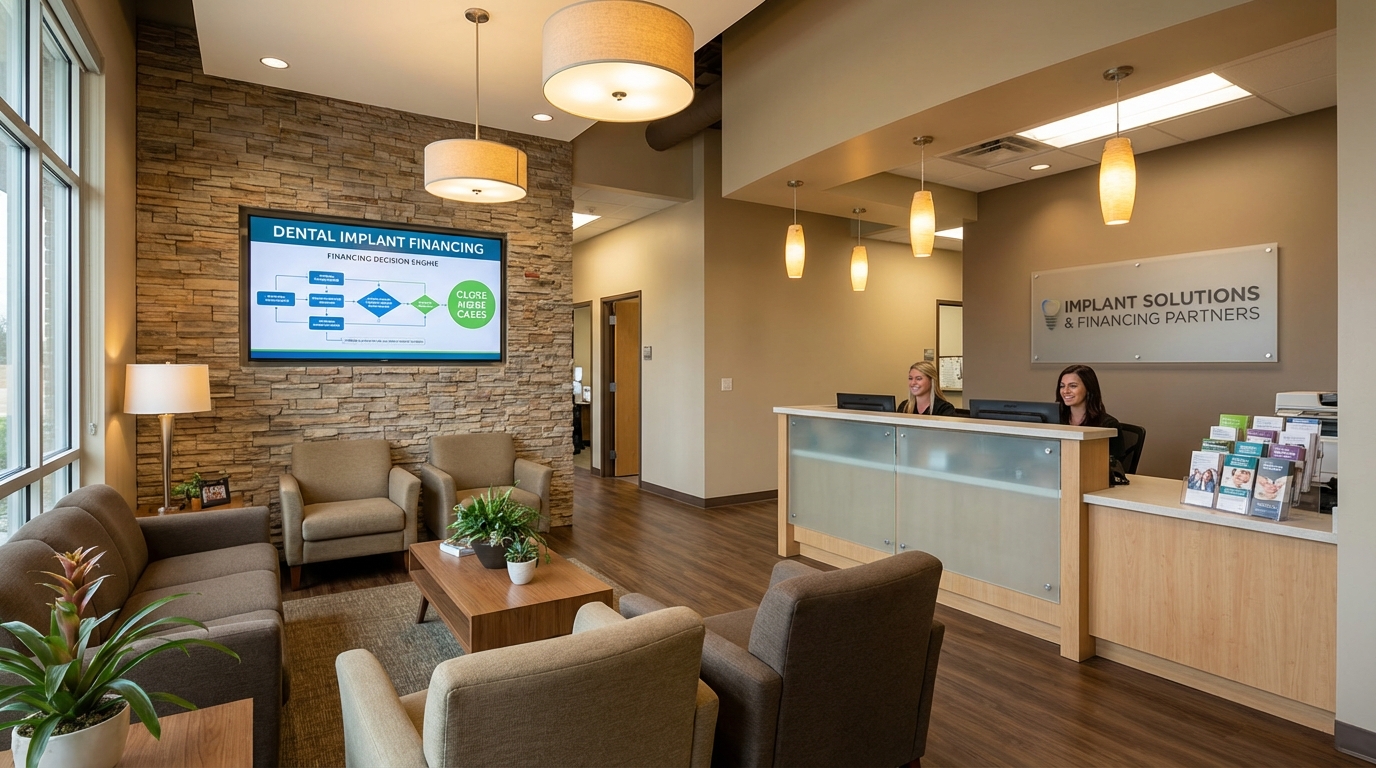
A decision engine is a living document, not a checklist. Start with a branching decision tree that captures the patient’s primary barrier—budget, timeline, or fear—and map each barrier to a talk track, an education asset, and a financing path. Link those branches to assets such as the automated-dental-implant-financing-system so your team can drop into the right resource without toggling between apps. For each branch, include:
- Positioning: Present the transformation and expected investment inside the consult room, including the ROI story (dental implants often unlock 5–10 years of predictable revenue). Tie that pitch to a short video or one-pager so every team member can show the same information.
- Options: Offer a menu of financing partners, medical lending, practice payment plans, and third-party budgets, ideally with a calculator so patients can see monthly numbers. Link to your internal dental-crm-follow-up-guide so the automation can send the plan that matches the branch.
- Social proof: Embed case studies (internal or external, such as the Dental Economics coverage on implant success) that reinforce others just like them completed treatment and loved the result.
- Closing: Use conditional scripting so your team knows when to offer additional incentives (reduced down payment, complimentary follow-up visit) versus when to keep the conversation on long-term value.
Track outcomes so marketing knows what language sells
The engine should live in a centralized doc your team can reference and update weekly. Tie each branch to an asset (video, calculator, payment plan PDF) and tag which touchpoints convert. That tracking feeds back into marketing so you can highlight the most compelling finance stories in your next PPC ad copy or SEO landing page, using the same keywords that perform in your convert-more-dental-implant-leads experiments. When a branch converts poorly, label it, snapshot the messaging, and iterate—just like a CRO sprint.
Train staff and automate follow-up touchpoints
Weekly role plays keep every team member fluent in the engine
The engine only works if everyone follows it. Host a 60-minute session every Friday where you role-play the financing conversation with front desk, treatment coordinators, and dentists. After the session, record the learnings in your CRM so the scripts stay fresh. Automations should trigger in two key moments: when a consult is scheduled (send a preview video plus financing overview) and 24 hours after the consult (deliver the payment plan proposal plus a short testimonial). When you automate these touches, you keep the conversation alive without relying on memory. Research from DentistryIQ underscores that consistent, scripted follow-up drives more financing commitments than ad hoc phone calls.
Automation can ask the right question to re-engage
Write the automation copy in your brand voice and include internal links to resources such as the dental-crm-follow-up-guide or dental-marketing-agency-pricing so the patient can click directly to underlying details. Use precise CTAs: “Which of these options would you prefer to start with?” or “Reply with the plan you want to lock down this week.” A direct request invites replies, and replies open doors for scheduling teams to move the case forward. Track the responses inside your CRM so you can pass warm leads back into the engine rather than letting them fall into silence.
Feed the engine with marketing that showcases financing confidence
Content and ads should prime patients for the financing conversation
Your marketing should prime patients for the financing conversation rather than surprise them. Update your service pages (start with the dental-seo-services page or your main implant pillar) to highlight financing transparency as a differentiator. Publish stories about financing successes—e.g., “How we helped a patient finance a full-arch restoration and keep their lifestyle”—and promote them with paid social or email. External references, like Dental Economics or Medical Economics, can be quoted when you remind audiences that 50% of adults say financing keeps them from getting treatment. The more you mention financing in top-of-funnel content, the shorter the decision path becomes when they call.
Ads should direct to pages where the engine can be reviewed in detail
When you run PPC or SEO campaigns, use ad copy that leads with the financing benefit (“Flexible payment plans for dental implants, even if you’ve been told no credit needed”) and link directly to a landing page where the engine lives. Your copy should signal that financing is transparent, templated, and guided by the same team the patient will meet in the consult. Link those landing pages to internal experiments like convert-more-dental-implant-leads so you can see which creative drives the best consult-to-plan rate.
A decision engine doesn’t end after a patient signs—deploy your analytics to measure what happens next. Track the conversion rate from consult to signed plan and tie it to each financing option in the engine. If one lender or payment plan drops off, investigate whether the documentation was confusing or if the messaging didn’t match the consult. Then send targeted content that reminds those patients what they’re missing, using the same patient journey logic we outline in our dental-implant-financing-close-more-cases playbook.
Every high-value patient deserves a confident financing experience. If you are ready to formalize your financing decision engine and stop leaving implant revenue on the table, let’s talk: Book a free strategy call (https://www.closingmorecases.com/contact-us) or Book a free website audit (https://www.closingmorecases.com/contact-us).
Q: What’s the difference between a financing decision engine and a standard payment plan?
A: A standard payment plan is an option you recite; a decision engine is a guided experience that qualifies the patient’s barrier, maps them to the right option, and keeps the conversation alive through automation. The engine orchestrates the messaging, while the payment plan is just one deliverable.
Q: How long does it take to build the engine?
A: With the right resources, you can draft a branching engine in one week, validate it in two consults, and start fully automating it by week three. The key is to assemble your financing calculator, talk track, and automation plays upfront so you can tweak instead of starting from scratch.
Q: Which KPIs should I watch?
A: Focus on consult-to-treatment rate, average treatment value, and the timeline between consult and signed plan. When you layer in financing options, also track which payment plan the patient selected and whether they stick to it (particularly for internal plans).
Q: Can the engine be used for other high-value treatments?
A: Absolutely. The framework works for any treatment where value > ~$3K, such as full-arch restorations, sleep apnea therapy, or cosmetic makeovers. Just swap the talk tracks and educational assets to match the treatment.
Q: Should my marketing mention financing on every landing page?
A: Yes—once your engine exists, financing becomes part of your brand promise. Call it out on service pages, PPC landing pages, and especially in the copy that drives warm leads (email, retargeting, SMS).