Introduction
You can deliver a brilliant implant plan, but if the follow-up stops after you hit "send" on the treatment proposal, patients drift to the next comparison practice. Our data shows 62% of implant consults that go cold re-engage with a competitor within 14 days—not because the alternative was better, but because someone else stayed in the conversation.
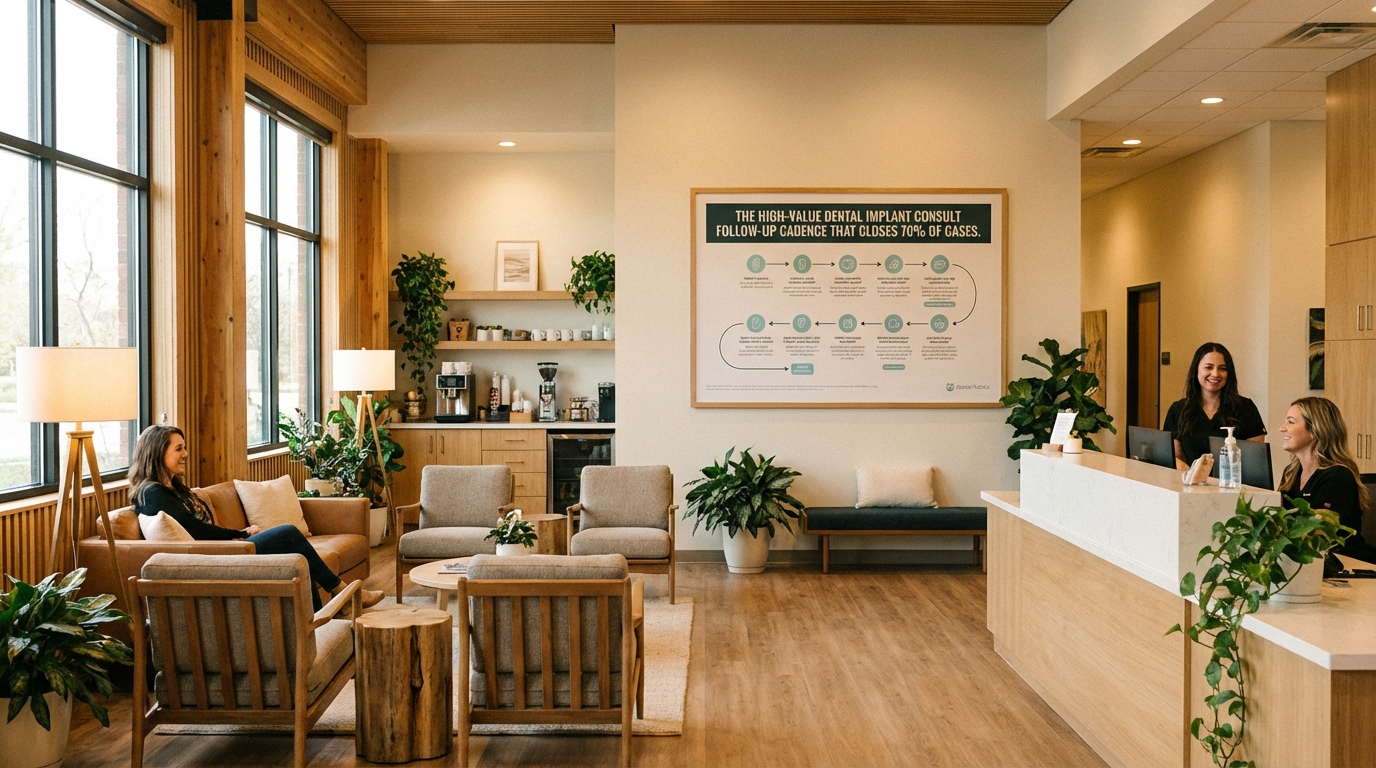
A repeatable follow-up cadence keeps implant consults moving from "maybe" to "yes" without adding more people to the team. Instead of relying on memory or reactive outreach, design a sequence that combines timely reminders, social proof, and human touchpoints. This cadence becomes part of the broader Dental Implant Case Acceptance Sales System so treatment coordinators never miss a beat.
The American Dental Association confirms that cost and communication are the top barriers to treatment acceptance, which means follow-up is not optional—it is the revenue engine that bridges clinical excellence to real booking momentum. ADA Dental Facts remind us: patient education plus consistent follow-up increases case acceptance by 30% on average, yet most practices abandon the patient after the initial consult.
This guide explains how to build that five-touch implant consult cadence so you keep control of the sale all the way to the schedule.
1. Why most implant consult follow-ups crash
Symptoms of a broken cadence
- Treatment coordinators send the plan, then get pulled into another chair, leaving the patient to interpret the plan on their own.
- A text or email lands, but there is no story behind it, so it reads like another "check your inbox" noise.
- Managers see the consult booked, but the patient never re-books, and the case is coded as "no response." That leak is often avoidable with one more thoughtful touch.
Standing up a cadence starts with diagnosing the failure. When a consult goes cold, it usually means one of three things: the patient didn’t hear the next step, they weren’t reminded of the value, or they were waiting for a signal that action is expected. Those are fixable by design.
Turning noise into intentional touches
Every follow-up needs a purpose. Pair a milestone (treatment plan delivered, insurance verification complete, financing pre-approval granted) with a targeted message. Reinforce the value of your clinical expertise and the rarity of the slot you just held for them.
Link each message back to a resource on your site so the patient can explore on their own. For example, refer them to the Dental Implant Case Acceptance Sales System for proof of the repeatable process you follow. That internal link reminds the patient your practice uses structure, not guesswork.
External validation keeps you credible. When follow-up emails cite data from the ADA Dental Facts, the patient sees that you are part of an evidence-based profession, not just another marketing message.
2. Architecting the five-touch follow-up path
Touch 1: Confirm + calibrate (within 2 hours)
After the consult, text or email to thank the patient and explain the next step. Include a short recap of the recommendation and ask a quick question: "Would you like us to hold the Thursday slot while you review the plan?" Link this message to your Dental Implant Consultation Scripts That Close so they can revisit the reasons you recommended the treatment.
Touch 2: Social proof + financing (24 hours)
Send a two-minute video or testimonial from a recent implant patient. Couple it with a short finance explainer and the CTA, "Would you like me to walk you through the monthly payment?"
Touch 3: Automation + human check-in (Day 3)
Drop an automated SMS that says, "Still thinking it over? I can answer one quick question or we can hop on a call." The goal is to open the door for a conversation.
Touch 4: Content + authority (Day 5)
Share a short article that demonstrates your expertise, such as the Dental Appointment Setting Service Guide that highlights how your team builds momentum for high-value procedures. Combine it with a video invite: "Would you like to review the plan together before we lock in the schedule?"
Touch 5: Urgency + opportunity (Day 7)
End the week with a simple value reminder: "We hold a limited number of implant consult slots each week. I want to keep yours open if you're still moving forward." Mention that interest rates for financing plans may change, or that a team member is available for a quick call.
Five touches in seven days keep the patient engaged without being pushy. According to Forbes, high-ticket sales usually require five to eight touchpoints before closing, so this cadence aligns with proven sales science while staying respectful to healthcare boundaries. Forbes research on follow-up frequency reinforces that consistency is the differentiator between a lost consult and a booked chair.
3. Automation plus human touch wins every time
Blend CRM sequences with personal follow-up
Deploy automation that triggers each touch, but keep humans in the loop. Use your CRM to schedule email/SMS reminders, and set alerts for coordinators to call after the automated message goes out. That prevents cases from slipping through the cracks when the automated touch doesn’t get a response.
Tap into playbooks that show which message worked best last quarter. The Salesforce guide on sales automation explains how automation is not about replacing human effort—it is about freeing humans to handle the highest-value tasks. Your coordinators should spend their time on nuanced conversations, not on remembering to send the next email.
Build clear roles
- Treatment coordinator: Reviews the plan, shares financial options, and stays in the first two touches.
- Patient coordinator: Sends reminders about paperwork, insurance, and what to expect on appointment day.
- Finance concierge: Answers questions about payment, shares calculators, and sends the plan to be signed.
By assigning accountability, automation becomes a pipeline, not a faceless autoresponder. Each message should include a human name, so patients know there is someone tracking their case.
Track responses and refine
Set up your CRM to tag consults by response type: "Ready to book," "Needs pricing," "Still thinking." Use the data to shorten or lengthen touches. If 60% of patients respond after touch 2, you can fast-track them. If 20% never respond, add a light re-engagement campaign at day 14.
4. Measuring, coaching, and refining your follow-up
Score the cadence consistently
Use a dashboard that tracks how many consults hit each touch and how many convert at each stage. Link it to the Dental Implant Financing Playbook so you can see how financing conversations play into the follow-up. Compare week-over-week performance and create a coachable script for coordinators who miss more than one touch.
What to coach on
- Clarity: Are coordinators telling patients exactly what happens next?
- Value: Are messages reminding patients of ROI, not just price?
- Timing: Are follow-ups spaced consistently, or do they cluster because someone forgot?
Coach by listening to recordings, reviewing CRM notes, and running monthly role-plays. When a coordinator hears how another team member handles a "still thinking" patient, the whole group improves.
Use low-commitment experiments
If a touch doesn’t get traction, experiment quickly. Switch the subject line, try a short video, or add a customer quote. Document the result and scale what works. Resources like HubSpot’s follow-up email templates offer quick variations you can adapt to dentistry.
Celebrate wins
Highlight the consults that moved forward after a late touch. Share stories in weekly huddles so teams view the cadence as a revenue multiplier, not another checklist item.
Q: How quickly should the first follow-up happen?
A: Within two hours. The faster you acknowledge the consult, the more confident the patient feels. Your CRM should auto-send a thank-you text or email the instant the plan is delivered.
Q: Should we always use automation, or can someone do this manually?
A: Automation keeps the process reliable at scale. Once the sequence is proven, your staff can personalize each touch without wondering what comes next, so the human energy is spent on persuasion, not logistics.
Q: What if the patient doesn’t respond to any touches?
A: After five touches, move the consult to a "nurture" campaign that checks in once every 21 days with new social proof or case studies. Don’t delete the consult—some resurface months later when they are ready.
Q: How do we balance urgency with empathy in follow-up messages?
A: Use urgency around availability, not pressure. Example: "We had a cancellation this week—should I grab it for you while it’s still open?" That lets the patient choose without feeling cornered.
Q: What data should we track to prove this cadence works?
A: Monitor touches sent, open/reply rates, conversion to scheduled procedures, and time from consult to booking. Compare those metrics to the prior month to quantify improvement.