Intro
High-value treatment plans—implants, full-mouth rehabilitations, orthodontics—should not feel like a gamble. The best practices already know the revenue upside, but without systems they lose momentum on consult days, forget to reengage warm prospects, and drown in manual paperwork. This post maps the automation, finance, and people strategies that keep a high-value treatment pipeline consistently filled, so your practice can spend more time delivering results and less time chasing loose ends.
Design a Predictable High-Value Treatment Pipeline
Map every patient touchpoint
Start by documenting each step from consult request to treatment acceptance. Track what happens at consult confirmation, the role of a treatment coordinator, how financing conversations are kicked off, and when clinical teams follow up. Linking this map to a system like the Automated High-Value Treatment Plan Acceptance Playbook turns guesswork into measurable milestones.
Automations should trigger when nothing happens. If a consult finishes without a signed plan, the scheduler, coordinator, and clinical staff automatically receive nudges with talking points, compliance reminders, and availability updates. Built‑in status updates (Consult Scheduled → Estimate Sent → Financing Approved → Treatment Booked) let everyone know where a case sits, preventing email ping‑pong.
Don’t forget to surface this pipeline inside your CRM or practice management software. Most systems allow custom stages and integrations, so pipe in treatment values, acceptance timelines, and next actions. Combine that with an external benchmark—for example, ADA research shows practices that track consult outcomes capture 28% more acceptance per month (https://www.ada.org/resources/practice/practice-management/). Those are the kinds of numbers that justify automation investment.
Automate Financial Conversations Without Losing the Human Touch
Pre-build financing paths that feel personal
Patients rarely say "yes" because an email or spreadsheet told them to. They say "yes" because the practice showed empathy, explained the path forward, and removed price friction. Automation should help, not replace, that conversation. Build templated but customizable messaging for the five most common financing scenarios (pay-in-full, internal plan, third-party lender, in-house payment plan, mixed plan). Store them in a central system so coordinators can copy, review, and personalize in seconds.
Automations can remind patients when payments are due and keep finance paperwork front-loaded. For example, trigger a secure link that collects DTI facts before the consult, then automatically share it with the coordinator and lender. Add note templates so every conversation, call log, and document upload is tagged with the treatment value. Internal documentation like our Automated Dental Implant Financing Follow-Up playbook ensures follow-ups feel conversational yet consistent.
Use external proof to reinforce value—link to a lender’s case study or industry association page such as Dental Economics (https://www.dentaleconomics.com) to show financing success stories. Embedding short videos or testimonials inside automation workflows also keeps the human element alive.
Align Front Office + Clinical Staff with Automation Workflows
Build one revenue-focused scoreboard
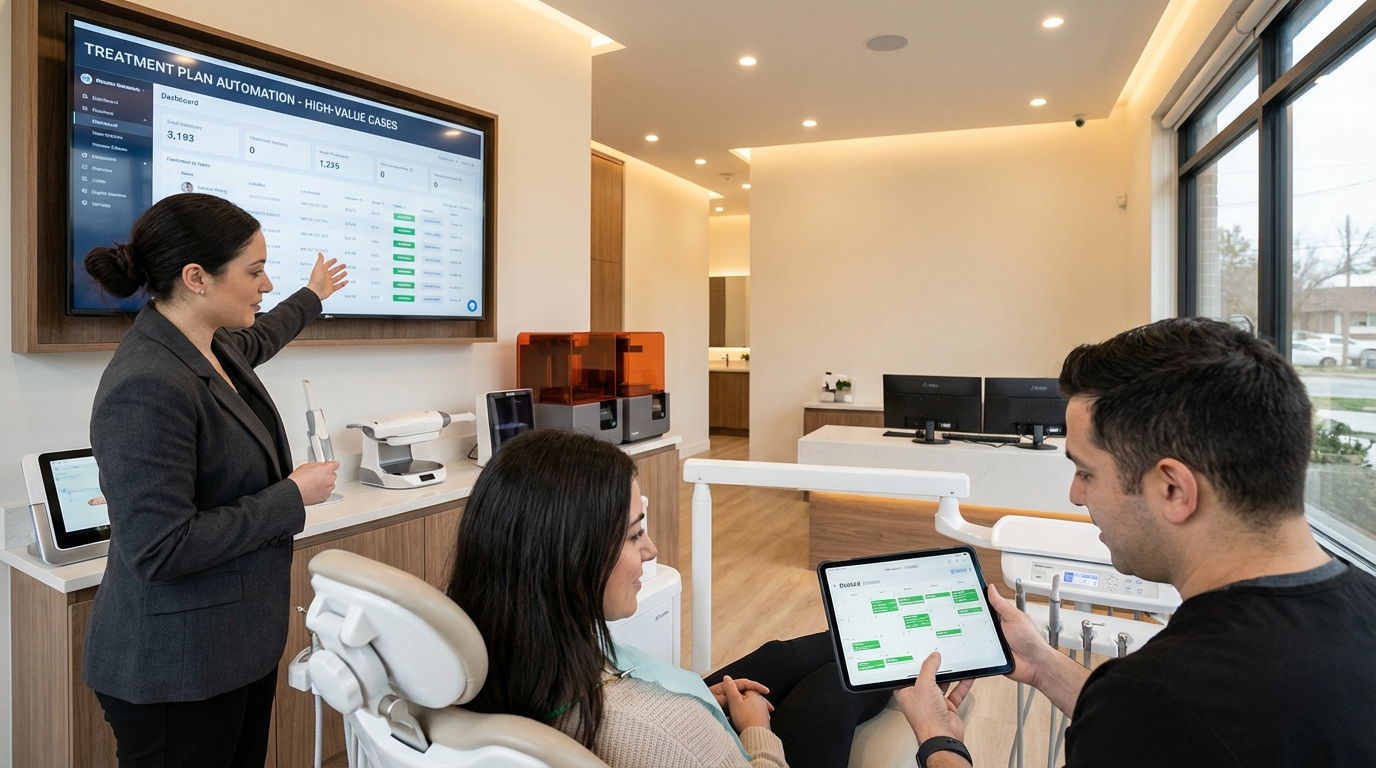
High-value cases require teamwork. When front desk staff keep seeing the same consult no matter what automations are firing, the result is fatigue. Instead, create a shared dashboard that shows consult volume, open proposals, financing status, and revenue potential. A good dashboard also highlights blocked stages (e.g., "Lender docs pending" or "Clinical review delayed") so the right team can step in immediately. Cross-functional teams that share metrics perform better—Harvard Business Review found that teams with shared dashboards make smarter, faster decisions (https://hbr.org/2020/02/why-some-teams-are-smarter-than-others).
Train your schedulers, coordinators, and assistants on how to react to each automated alert. For example, if the system says the patient downloaded a treatment summary but did not sign, the coordinator receives a workflow with script suggestions, social proof, and proposed next available dates. The clinical team gets a quick brief so they can mirror the messaging when the patient arrives for hygiene or pre-op visits.
Internal knowledge like the Implant Lead Education Funnels guide can be referenced in workflows to ensure consistency. Keep one shared reference channel (practice Slack, Asana task, or project board) open for blockers so team members can comment, reassign, or escalate the case without waiting for a status meeting.
Measure Revenue Impact & Scale Without Adding Headcount
Score every touchpoint with revenue in mind
Automation is useless if you cannot link it back to dollars. Tie each workflow trigger to potential revenue: consult → $15K, financing approval → $13K, treatment booking → $12K. Track conversion rates at each stage and detect when a workflow underperforms. For example, if the "Estimate Sent" to "Financing Approved" ratio drops, revisit the sequence of emails or calls in that automation and tweak the copy or timing. Industry reporting like Dental Economics' automation insights (https://www.dentaleconomics.com/technology/article/14215407/automation-for-dentists) shows measurably higher ROI when revenue metrics are part of every workflow review.
Capture qualitative feedback, too. Automations should ask coordinators to note why a patient declined—for price, timing, trust, or preference—which gives you data to benchmark. The High-Value Dental Implant Financing Automation resource shows how to integrate those notes into your dashboards so you can prioritize improvements that move the revenue needle fastest.
Once you have clean data, scale by cloning winning automations across other treatment lines (sleep apnea, orthodontics, full-mouth rehab). Celebrate wins publicly with the team, and reserve a weekly revenue review to discuss automation tweaks. When the whole practice sees the revenue lift tied directly to the automation, you'll have the political support to keep enhancing the system.
Q1: How much time does it take to set up these automations?
A1: Expect 10–15 hours upfront for mapping workflows, writing templated copy, and integrating with your PMS/CRM. After that, maintenance should be 1–2 hours weekly. Use this as a light sprint and then treat it like a living operating system.
Q2: Do patients feel like they’re dealing with robots?
A2: Not if you keep personalization tokens, human review steps, and optional calls in the mix. Automation should move logistics forward while the team adds the warmth. It removes grunt work, not emotional intelligence.
Q3: What software is best for tracking high-value workflows?
A3: Pick a system that supports custom stages, conditional automations, and documentation (e.g., Dentrix, Open Dental, or a sales CRM layered over your PMS). We keep dashboards in Notion + Airtable because it lets us blend finance data with practice notes.
Q4: How can we convince the team to adopt these systems?
A4: Show them how the automation saves them time and can boost revenue (and bonuses). Run a pilot for one treatment line, celebrate the wins, and involve the team in tweaking the scripts.
Q5: What metrics should we monitor weekly?
A5: Track consults scheduled, treatment plans delivered, financing approvals, booking rate, and average case value. Also monitor automation health (failed triggers, stalled stages). Pair numbers with short qualitative notes.
Q6: Can we automate follow-up for declined cases?
A6: Yes—build a "Declined but warm" nurture track with reminders, educational content, and special offers. Re-engagement automations should surface declined cases for manual follow-up after 30–60 days.
Next Steps
- Audit your current treatment workflows and identify where automation can replace manual follow-ups.
- Expand finance conversations with templated messaging and secure document links that reduce friction for both patients and staff.
- Track conversions across each stage and share the revenue impact with the whole team, so automation becomes a strategic advantage.
CTA: Ready to automate your high-value treatment pipeline? Book a free strategy call or Book a free website audit and let Closing More Cases build a bespoke automation roadmap for your practice.