Meta description: Build a decision-driven follow-up system that blends automation, financing concierge touchpoints, and human accountability to close high-value dental implant consults faster. TL;DR: Dental implant consults stall because teams wait for patients to call back. A decision-led automation (mirroring the financing concierge workflow) keeps impatient buyers engaged and nudges them to finalize treatment by combining timely digital nudges with strategic human check-ins.
Automating High-Value Dental Implant Case Acceptance with Decision-Driven Follow-Up
By KamImplants1,296 words6 min read
Intro: Why consult automation matters when every implant case is high-value
Every dental implant consult is worth thousands of dollars in revenue, but the path between consult and case acceptance is littered with friction. Many patients hesitate because financing feels confusing, the timeline seems long, or the office doesn’t follow up fast enough. That’s where automation earns its keep: by translating the consult conversation into a sequence of decision prompts, high-value patients are nudged toward yes before competitors, confusion, or budget anxiety re-enters the equation. Automation stops being a project tracker and becomes a conversion engine when it mirrors the same concierge-level care showcased in the financing concierge workflow and adds human accountability aligned to finance decisions.
This post walks through the four pillars of a decision-driven follow-up engine: designing the automation blueprint, mapping financing decision moments, powering the automation with real-time decision data, and orchestrating human follow-up with digital momentum. Every section links back to internal playbooks you already have and pairs them with practitioner-friendly research or industry guidance so you can cite credibility when you brief staff and track performance. By the end, you’ll have a system blueprint that keeps consults warm, nudges the patient through financing choices, and turns hesitation into lock-in without adding hours to your week.
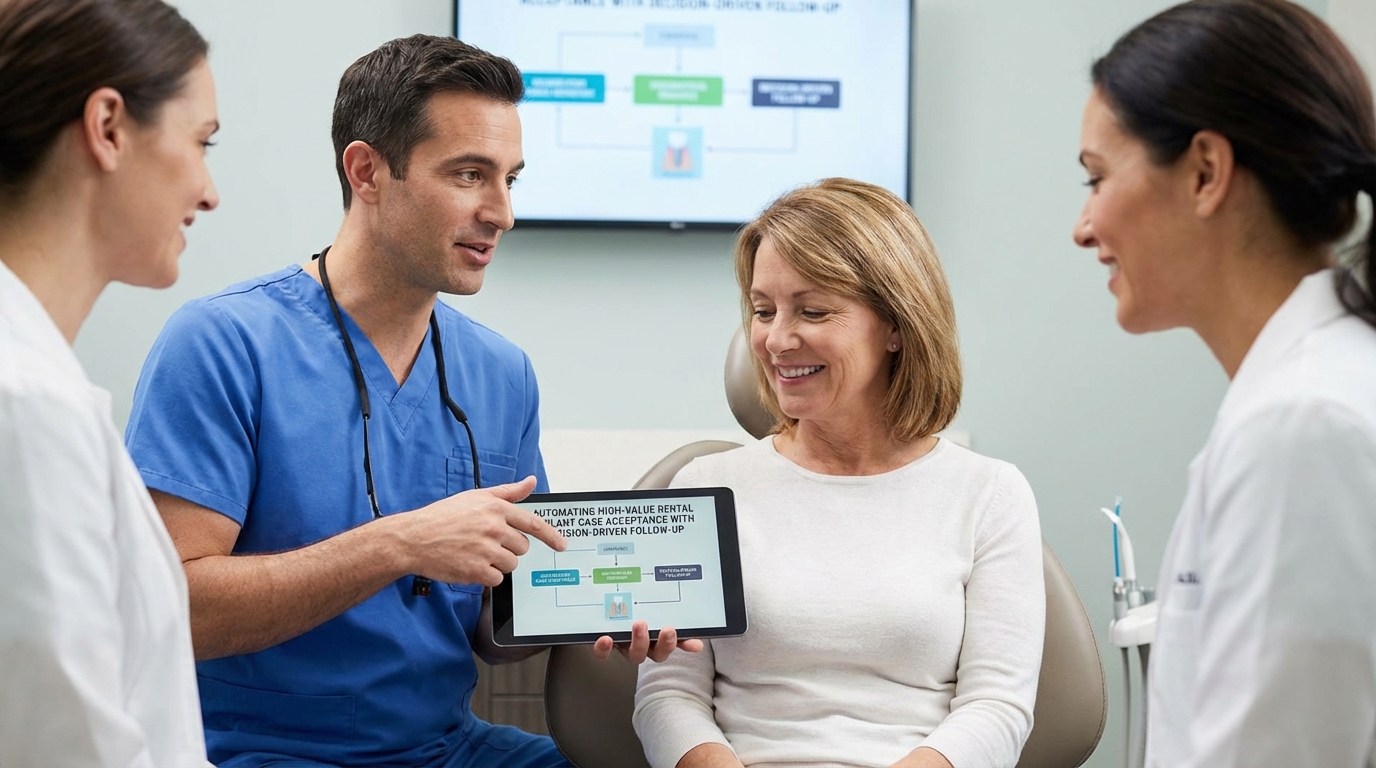
1. Designing the automated high-value consult follow-up
Start by leaning on your existing documentation—anything that spells out patient financial conversations, like the financing concierge workflow. That document already highlights the human sequence; automation simply digitizes the same cadence. Your map should include: the exact consult script used to describe value, the financing options presented, the timing between the consult and your first push, and the decision point that typically triggers sticker shock. These details become the triggers in your automation platform (patient nurture sequences, SMS, email, or CRM tasks).
Pair that map with an external benchmark such as the ADA’s guidance on patient financing clarity (https://www.ada.org/resources/research/science-and-research-institute). Use the ADA’s emphasis on transparency to set internal SLAs: for example, no more than four hours between consult and the first digital finance reminder, or ensure every patient receives a summary of financing options they can forward to their financial decision-maker. The automation should feel personal, not robotic—use templated paragraphs pulled from your consult script, insert the specific ROI they’re chasing, and reference the same financing facts you cover live. When done correctly, automation feels like a deliberate extension of the room, not a checklist tossed into the CRM.
2. Mapping financing decision moments and response windows
The next step is to identify the key decision moments: when a patient says “maybe,” when they ask about monthly payments, or when they vanish after the call. Turn those into automation states by referencing your financing playbook and isolating the language patients used during those decision moments. Those moments become conditional branches: patients who asked for financing details get a follow-up email with FAQs and a financing calculator; patients who asked for time get a gentle SMS with the offer expiration; patients who ghost the practice get a task for a human concierge call within 24 hours.
To keep the follow-up aggressive but respectful, layer in an external data point like the Forbes analysis on dental implant financing behaviors (https://www.forbes.com/advisor/health-insurance/dental-implant-financing-options/). Forbes highlights that financing conversations are often the tipping point for implant acceptance—when finance is in place, consults convert more than 60% of the time. Use that stat to reinforce your automation window: if a patient doesn’t respond to the first three digital touches, trigger a human call. The automation is not just information delivery; it’s about being present at the exact second the patient teeters back toward saying yes.
3. Powering decision-driven automation with financing engine data
Automation needs data to speak intelligently. Feed it the decision context from the financing decision engine you already use or plan to build. That engine tracks what rates a patient qualifies for, which promotions they can combine, and how their monthly payment fits their stated budget. Every automation message should reflect that data: “Here’s your quoted monthly payment, plus the lender we pre-approved you with,” or “This is the same in-house option we discussed during your consult.” When patients see the exact number you promised, they’re more likely to believe the value and proceed.
Integrate implants with an external authority like the ADA’s research on patient financial stress (https://www.ada.org/en/publications/ada-news/2023-archive/august/what-patient-finances-means-for-practice-growth) to justify how personalizing financing communication reduces anxiety and keeps cases from slipping. Use the ADA reference when briefing your teams to reinforce that your automation is evidence-backed, not just convenient. The automation should tag each patient with their financing status (pre-qualification, documentation pending, or ready for signing) so your team knows exactly which decision stage to support when the next human touch happens.
4. Orchestrating human follow-up so automation feels strategic
Even the best automation hits a point where it needs a human nudge, especially for high-ticket implant cases. Build that nudge around your financing follow-up system by creating automation checkpoints that hand the baton back to a person: after a patient views a financing proposal twice, lock a task for your implant concierge to call them back with a revised payment plan; after a financing application is submitted, queue up a SMS confirming receipt plus a human email verifying the next steps.
External business research like Bain’s customer experience work (https://www.bain.com/insights/closing-the-customer-experience-gap/) reminds us people crave clarity when spending thousands. Make your automation do the heavy lifting (push messaging, link to paperwork, call scheduling), and then let humans follow up with context-aware confidence. The automation should generate a summary note before each human follow-up so the practitioner doesn’t waste time asking what happened last. This makes your team feel like a synchronized unit, not two competing systems.
- How soon should automation reach out after the consult? Aim to send the first digital touch within four hours and a follow-up call within 24 hours if there is no response. Link your timing to the consult details captured in your system so every patient feels seen immediately.
- What’s the easiest way to personalize financing messages? Pull key details from your financing decision engine—program the automation to insert the quoted monthly payment, the lender, and the treatment plan value. Use merge tags so each email/SMS mirrors what the patient was told face-to-face.
- Should automation ever replace a human call? No. Automation should always escalate to a human when the case value exceeds your internal threshold (e.g., $5K+ or when financing is involved). Treat automation as the way to keep the consult warm until a human seals the agreement.
- How do I know if the automation is working? Track consult-to-case conversion rate, time-to-acceptance, and response rate to digital nudges. Compare those to the same metrics when you used manual follow-up to prove the automation’s lift.
- Can automation handle patient objections? Yes—build objection-handling scripts into follow-up messages and branch them based on responses. For example, if a patient replies “I need to think about it,” send an FAQ explaining the financing timeline plus a human note scheduling a quick call.
Book a free strategy call to blueprint your decision-driven follow-up or book a free website audit to ensure your digital funnel matches your automation momentum (https://www.closingmorecases.com/contact-us, https://www.closingmorecases.com/contact-us).
Ready to Close More Cases?
Book a free strategy call and see how we help dental practices add 40+ new patients in 90 days.
Book Your Free Strategy CallRelated Articles
Implants4 min read
Atlanta Dental Implant Cost vs. Value Breakdown
Atlanta Dental Implant Cost vs. Value Breakdown
Implants9 min read
Augusta, GA Dental Implant Consult Nurture Sequence: Turn Leads Into Booked Patients
Augusta, GA Dental Implant Consult Nurture Sequence: Turn Leads Into Booked Patients
Implants6 min read
Austin Dental Implant Marketing Agency Playbook: Fill 60 Surgical Seats in 90 Days
Austin Dental Implant Marketing Agency Playbook: Fill 60 Surgical Seats in 90 Days