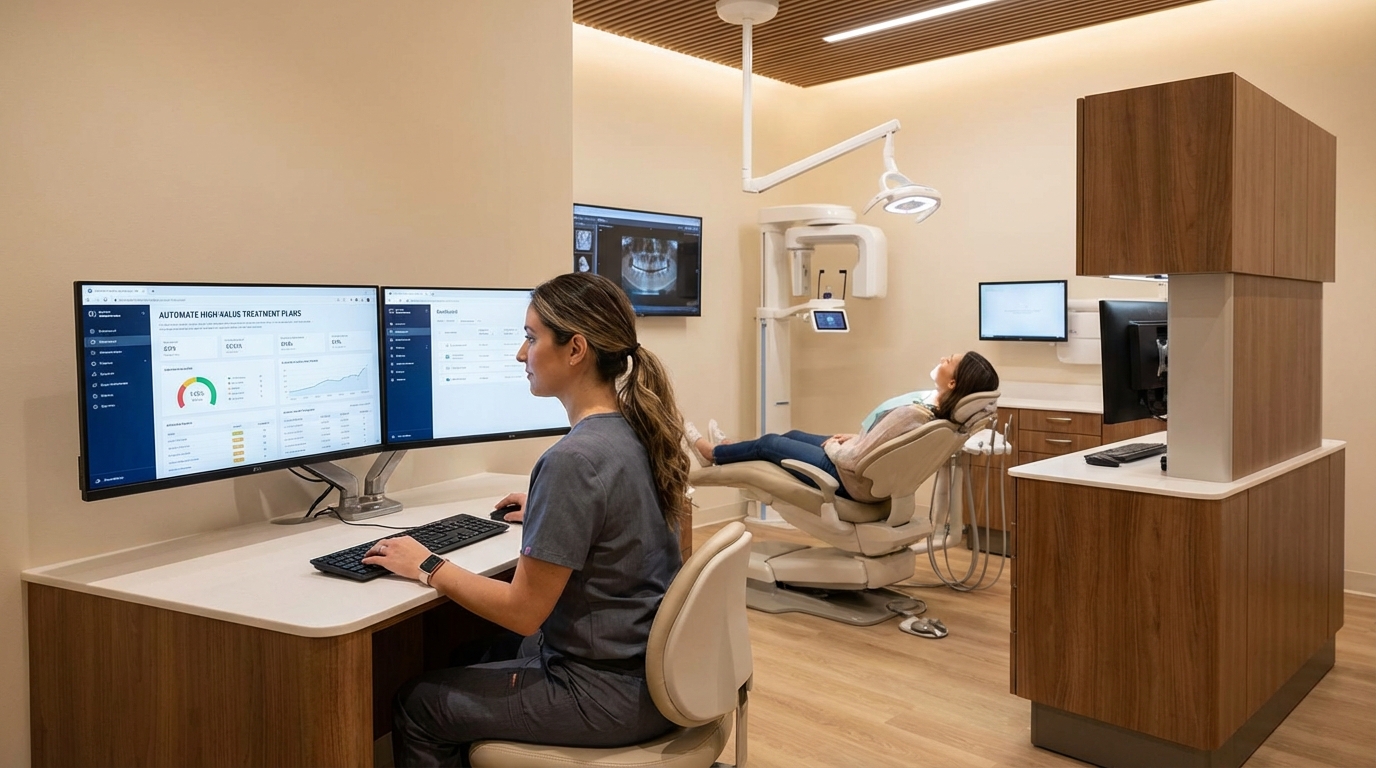
Meta description: Automate your high-value treatment plans so coordinators close more consults without hiring new staff.
Intro
Closing a high-value treatment plan like implants, full-mouth reconstructions, or full-arch cases isn’t about more leads—it’s about removing friction from the consult-to-decide journey. Most practices try to add another coordinator, send one-off emails, or double down on phone calls. The smarter path is to automate the scaffolding around your team so every touchpoint feels intentional, every finance conversation is prompt, and no opportunity falls through the cracks. In this post we map the journey, highlight the automation triggers that matter, and show how to keep real humans accountable while the system does the heavy lifting.
Map every touchpoint into a high-value journey
When you describe the patient journey in a spreadsheet, you quickly see the real hand-offs: ads and referrals feed the CRM, intake calls launch the consult prep sequence, consult reports trigger financing conversations, and treatment planning needs a follow-up loop for undecided patients. Automating without a map just duplicates existing chaos. Instead, define three phases (Pre-Consult, Consult & Finance, Acceptance & Treatment) with explicit owner, signal, and automation for each touchpoint. Use your CRM to tag every lead by treatment intent and financing status so downstream automations react appropriately. For example, a patient who completed the digital consult form with a smile design upload can drop directly into the same workflow that the Automated High-Value Treatment Plan Journey playbook outlines, but now with added transparency for the coordinator.
Create automation rules that match your practice rhythm. If a lead books an implant consult, trigger a concierge email, an SMS reminder, and a finance worksheet download within minutes so the patient never wonders what happens next. Capture key milestones (forms submitted, insurance verified, pre-work photos, consult scheduled) using tags/fields so every system action—email, task, text—comes from real data. This level of traceability keeps the coordinator from feeling like they’re babysitting the tech; they simply monitor the dashboard and step in when a signal turns amber.
Automate financing conversations before the first call
Patients often hesitate not because they can’t afford treatment, but because they don’t understand how financing fits their lives. Delay the financing conversation until after a consult and you invite sticker shock. Instead, automate a finance readiness workflow triggered by consult booking. Once a lead hits your consult schedule, send a short explainer that links to your Dental Implant Financing Concierge System page, invites them to explore pre-approval, and asks them to choose a time to speak with the coordinator. Include a conditional email for self-pay leads that outlines the same options without sounding pushy.
Pair the email with a task that nudges your coordinator to review the patient’s form answers and financing score before the call. That means the first human touch after the automation is personalized: “I saw you selected premium zirconia crowns and preferred a 36-month plan—here’s what that looks like in your monthly budget.” The automation also creates a follow-up SMS if the patient does not open the email within 24 hours, so the financing plan stays top-of-mind without the team having to chase them manually. This is the same principle we teach when combining finance automation with CRM scoring: automation surfaces the information, humans provide the reassurance.
Trigger case-acceptance workflows at the point of decision
Most teams let the patient drift because they think the consult is the only moment that matters. The truth is that acceptance happens in the next 7–14 days—and exactly one system needs to capture that window. Build automation triggers from the consult output: if the plan is created but not accepted, drop a nurture series that highlights three trusted social proof stories, a breakdown of financing options, and a simple FAQ to answer obvious objections. Each email should update a “decision readiness” field in your CRM, and when that field crosses a threshold, automatically pop a task for your coordinator to call or text.
McKinsey reports that organizations which digitize the revenue hand-offs close deals up to 20% faster, so this isn’t theoretical—it’s the same playbook that keeps enterprise sales teams focused on the right follow-ups.
Combine automation with lightweight reporting. Every Tuesday, your team should review a dashboard that counts how many consults are waiting in each stage, how many have automation sequences running, and whether any pending consult has been quiet for 5+ days. Use conditional formatting in your CRM or a simple Airtable view to flag consults that need rapid follow-up. That way the automation works as a guardrail, not a black box. The same data can feed into your profit planning because you can now show how many consults moved from “education” to “decision” versus how many still need nurturing.
Keep humans in charge with real-time signals
Automation should not replace humans—it should empower them. Build a short daily report (email, Slack, or onboarding doc) that highlights 3 signals: (1) how many new consults triggered the automation, (2) which finance conversations still need coordinator attention, and (3) which consults are at risk because the patient went silent. When a patient books a consult but does not show up, automation can text for rescheduling and also tag the consult manager to call. Use automation to feed your team with context, not noise.
Pair this with a simple scoreboard showing conversion percentages from each automation stage. Seeing that 70% of consults who completed the financing readiness automation turn into deposits proves the system is not replacing people—it’s amplifying their time. Leaders can then coach coordinators based on that scoreboard instead of hunting through inboxes for a single thread. And because these automations are anchored to the same CRM that manages your high-value cases, you keep compliance and documentation consistent.
Harvard Business Review even argues that engagement automation works when it feels personal, so the automations you build should look like the friendly nudge a coordinator would send, not a generic broadcast.
Summary & next steps
A coordinated automation blueprint gives your team clarity instead of confusion, especially when the goal is closing more complex cases without adding staff. Map every consult milestone, automate the financing conversation, trigger acceptance workflows based on real signals, and keep humans accountable with transparent dashboards. The practices that adopt this approach report shorter decision timelines and higher per-case revenue because patients arrive prepared and your team works from certainty, not guesswork.
Ready for the next step? Book a free strategy call → https://www.closingmorecases.com/contact-us
How do I start automating without tearing up my current CRM?
Audit your consult journey, identify the small events your CRM already tracks (like a consult booking field or finance checkbox), and build one automation at a time. Don’t rebuild the entire funnel—connect the next best touchpoint, verify it works, then add another. The point is progression, not perfection.
Which automation platforms work best for high-value treatment plans?
Use tools that can read and write to your CRM of record. Many teams pair a scheduling solution (like Calendly) with automation platforms such as Zapier, Make, or native CRM workflows. The key is that the automation can update tags, trigger emails, and assign tasks without requiring duplicative data entry.
Do patients notice the automation?
They notice when something feels automated but thoughtful. Keep messages human, personalize them with their name and the treatment they’re considering, and always have a coordinator ready to reply. Automation should feel like an attentive assistant, not a broadcast.
Can this work for multi-location practices?
Yes. The same automation triggers can be used per location by adding a location field to the workflow. Once an automation is built, you duplicate it for another location, adjust the contact details, and the rest runs with the same logic. That’s how you scale the system without hiring a floating coordinator for every market.
What if my team already has too many automations?
Quality over quantity. Focus on the automations that guard revenue: consult preparation, financing education, and decision nudges. Pause anything that does not contribute to those goals and retire automations that feel like noise. A lean system that your team trusts will outperform a stack of neglected workflows.
How do I measure success?
Track consult-to-deposit conversion rate, average days between consult and commitment, and per-case revenue. Compare those numbers before and after automation, and marry them with qualitative feedback from your coordinators. When automation frees up time, you’ll see the difference in higher quality consults and faster case acceptance.